7Z5K | pdb_00007z5k

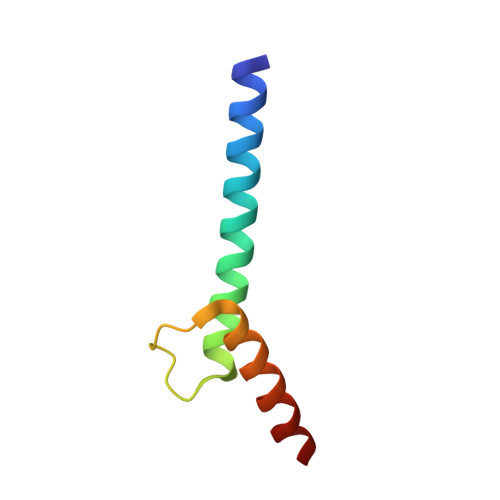
Transcription factor MYF5 bound to non-symmetrical site


Experimental Data Snapshot

  • Method: X-RAY DIFFRACTION
  • Resolution: 2.28 Å
  • R-Value Free: 
    0.266 (Depositor), 0.291 (DCC) 
  • R-Value Work: 
    0.229 (Depositor), 0.257 (DCC) 
  • R-Value Observed: 
    0.231 (Depositor) 

Starting Model: experimental
View more details

wwPDB Validation 3D Report Full Report

Validation slider image for 7Z5K

This is version 1.2 of the entry. See complete history

Literature

Interfacial water confers transcription factors with dinucleotide specificity.

Morgunova, E.Nagy, G.Yin, Y.Zhu, F.Nayak, S.P.Xiao, T.Sokolov, I.Popov, A.Laughton, C.Grubmuller, H.Taipale, J.

(2025) Nat Struct Mol Biol 

  • DOI: https://doi.org/10.1038/s41594-024-01449-6
  • Primary Citation Related Structures: 
    7Z5I, 7Z5K, 8PM5, 8PM7, 8PMC, 8PMF, 8PMN, 8PMV, 8PN4, 8PNA, 8PNC

  • PubMed Abstract: 

    Transcription factors (TFs) recognize specific bases within their DNA-binding motifs, with each base contributing nearly independently to total binding energy. However, the energetic contributions of particular dinucleotides can deviate strongly from the additive approximation, indicating that some TFs can specifically recognize DNA dinucleotides. Here we solved high-resolution (<1 Å) structures of MYF5 and BARHL2 bound to DNAs containing sets of dinucleotides that have different affinities to the proteins. The dinucleotides were recognized either enthalpically, by an extensive water network that connects the adjacent bases to the TF, or entropically, by a hydrophobic patch that maintained interfacial water mobility. This mechanism confers differential temperature sensitivity to the optimal sites, with implications for thermal regulation of gene expression. Our results uncover the enigma of how TFs can recognize more complex local features than mononucleotides and demonstrate that water-mediated recognition is important for predicting affinities of macromolecules from their sequence.


  • Organizational Affiliation
    • Department of Medical Biochemistry and Biophysics, Karolinska Institutet, Stockholm, Sweden.

Macromolecule Content 

  • Total Structure Weight: 24.81 kDa 
  • Atom Count: 1,775 
  • Modeled Residue Count: 148 
  • Deposited Residue Count: 150 
  • Unique protein chains: 1
  • Unique nucleic acid chains: 2

Macromolecules


Find similar proteins by:|  3D Structure
Entity ID: 1
MoleculeChains  Sequence LengthOrganismDetailsImage
Myogenic factor 5
A, B
57Homo sapiensMutation(s): 0 
Gene Names: MYF5BHLHC2
UniProt & NIH Common Fund Data Resources
Find proteins for P13349 (Homo sapiens)
Explore P13349 
Go to UniProtKB:  P13349
PHAROS:  P13349
GTEx:  ENSG00000111049 
Entity Groups
Sequence Clusters30% Identity50% Identity70% Identity90% Identity95% Identity100% Identity
UniProt GroupP13349
Sequence Annotations
Expand
Reference Sequence
Find similar nucleic acids by:  Sequence
Entity ID: 2
MoleculeChains LengthOrganismImage
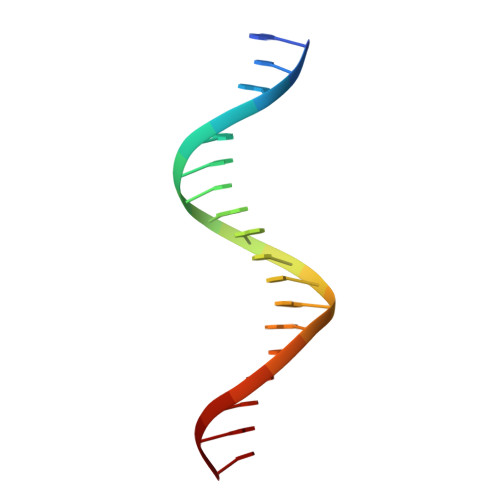
DNA (5'-D(P*GP*CP*GP*CP*AP*AP*CP*AP*GP*CP*TP*GP*AP*CP*GP*CP*GP*T)-3')C [auth E]18Homo sapiens
Sequence Annotations
Expand
Reference Sequence
Find similar nucleic acids by:  Sequence
Entity ID: 3
MoleculeChains LengthOrganismImage
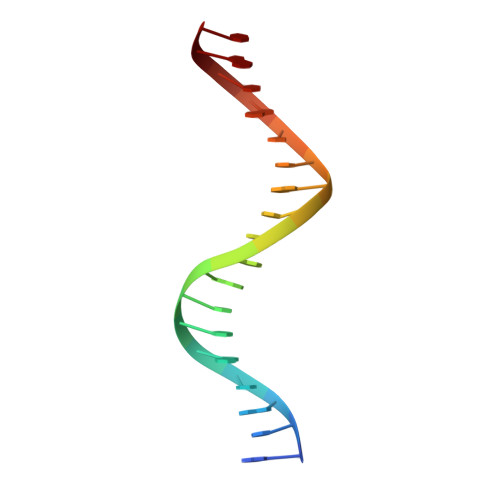
DNA (5'-D(P*AP*CP*GP*CP*GP*TP*CP*AP*GP*CP*TP*GP*TP*TP*GP*CP*GP*C)-3')D [auth F]18Homo sapiens
Sequence Annotations
Expand
Reference Sequence

Experimental Data & Validation

Experimental Data

  • Method: X-RAY DIFFRACTION
  • Resolution: 2.28 Å
  • R-Value Free:  0.266 (Depositor), 0.291 (DCC) 
  • R-Value Work:  0.229 (Depositor), 0.257 (DCC) 
  • R-Value Observed: 0.231 (Depositor) 
Space Group: C 1 2 1
Unit Cell:
Length ( Å )Angle ( ˚ )
a = 170.443α = 90
b = 33.839β = 91.88
c = 53.541γ = 90
Software Package:
Software NamePurpose
PHENIXrefinement
Aimlessdata scaling
PHASERphasing
PDB_EXTRACTdata extraction
XDSdata reduction

Structure Validation

View Full Validation Report


Entry History 

& Funding Information

Deposition Data


Funding OrganizationLocationGrant Number
Not funded--

Revision History  (Full details and data files)

  • Version 1.0: 2023-03-22
    Type: Initial release
  • Version 1.1: 2024-02-07
    Changes: Data collection, Refinement description
  • Version 1.2: 2025-01-15
    Changes: Database references, Structure summary