7VMZ | pdb_00007vmz

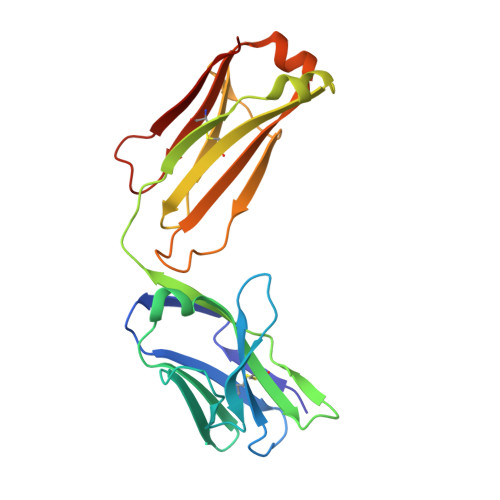
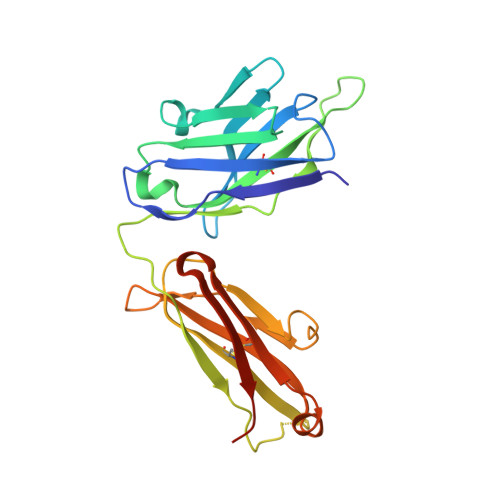
Crystal structure of a human Coronavirus 229E antibody C04 Fab


Experimental Data Snapshot

  • Method: X-RAY DIFFRACTION
  • Resolution: 2.85 Å
  • R-Value Free: 
    0.285 (Depositor), 0.291 (DCC) 
  • R-Value Work: 
    0.248 (Depositor), 0.249 (DCC) 
  • R-Value Observed: 
    0.250 (Depositor) 

Starting Model: experimental
View more details

wwPDB Validation 3D Report Full Report

Validation slider image for 7VMZ

This is version 1.3 of the entry. See complete history

Literature

Antigenic mapping reveals sites of vulnerability on alpha-HCoV spike protein.

Xiang, J.Su, J.Lan, Q.Zhao, W.Zhou, Y.Xu, Y.Niu, J.Xia, S.Qi, Q.Sidhu, S.Lu, L.Miersch, S.Yang, B.

(2022) Commun Biol 5: 1179-1179

  • DOI: https://doi.org/10.1038/s42003-022-04160-8
  • Primary Citation Related Structures: 
    7VMZ, 7VN9, 7VNG

  • PubMed Abstract: 

    Understanding the antigenic signatures of all human coronaviruses (HCoVs) Spike (S) proteins is imperative for pan-HCoV epitopes identification and broadly effective vaccine development. To depict the currently elusive antigenic signatures of α-HCoVs S proteins, we isolated a panel of antibodies against the HCoV-229E S protein and characterized their epitopes and neutralizing potential. We found that the N-terminal domain of HCoV-229E S protein is antigenically dominant wherein an antigenic supersite is present and appears conserved in HCoV-NL63, which holds potential to serve as a pan-α-HCoVs epitope. In the receptor binding domain, a neutralizing epitope is captured in the end distal to the receptor binding site, reminiscent of the locations of the SARS-CoV-2 RBD cryptic epitopes. We also identified a neutralizing antibody that recognizes the connector domain, thus representing the first S2-directed neutralizing antibody against α-HCoVs. The unraveled HCoVs S proteins antigenic similarities and variances among genera highlight the challenges faced by pan-HCoV vaccine design while supporting the feasibility of broadly effective vaccine development against a subset of HCoVs.


  • Organizational Affiliation
    • School of Life Science and Technology and Shanghai Institute for Advanced Immunochemical Studies, ShanghaiTech University, 393 Middle Huaxia Road, 201210, Shanghai, China.

Macromolecule Content 

  • Total Structure Weight: 47.65 kDa 
  • Atom Count: 3,265 
  • Modeled Residue Count: 434 
  • Deposited Residue Count: 446 
  • Unique protein chains: 2

Macromolecules

Find similar proteins by:|  3D Structure
Entity ID: 1
MoleculeChains  Sequence LengthOrganismDetailsImage
C04 Fab Light ChainA [auth L]215Homo sapiensMutation(s): 0 
Find similar proteins by:|  3D Structure
Entity ID: 2
MoleculeChains  Sequence LengthOrganismDetailsImage
C04 Fab Heavy ChainB [auth H]231Homo sapiensMutation(s): 0 

Experimental Data & Validation

Experimental Data

  • Method: X-RAY DIFFRACTION
  • Resolution: 2.85 Å
  • R-Value Free:  0.285 (Depositor), 0.291 (DCC) 
  • R-Value Work:  0.248 (Depositor), 0.249 (DCC) 
  • R-Value Observed: 0.250 (Depositor) 
Space Group: P 62
Unit Cell:
Length ( Å )Angle ( ˚ )
a = 148.215α = 90
b = 148.215β = 90
c = 53.387γ = 120
Software Package:
Software NamePurpose
PHENIXrefinement
HKL-2000data scaling
PDB_EXTRACTdata extraction
HKL-2000data reduction
PHASERphasing

Structure Validation

View Full Validation Report


Entry History 

& Funding Information

Deposition Data


Funding OrganizationLocationGrant Number
National Natural Science Foundation of China (NSFC)China32070170

Revision History  (Full details and data files)

  • Version 1.0: 2022-10-12
    Type: Initial release
  • Version 1.1: 2022-11-23
    Changes: Database references
  • Version 1.2: 2023-11-29
    Changes: Data collection, Refinement description
  • Version 1.3: 2024-11-13
    Changes: Structure summary