7L5B | pdb_00007l5b

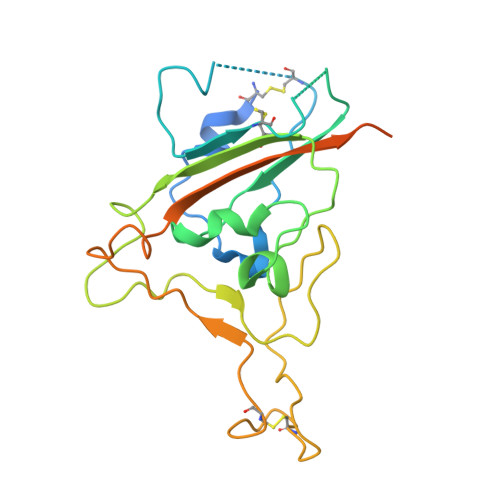
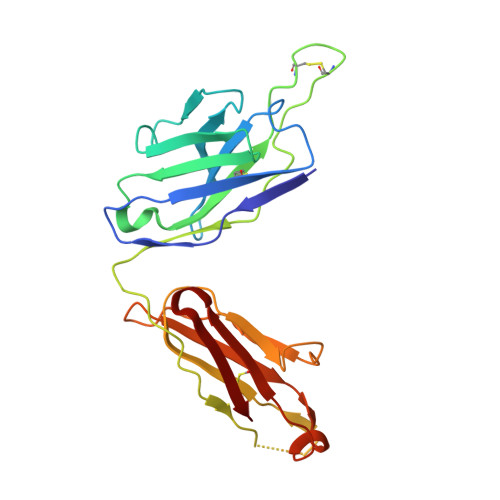
Crystallographic structure of neutralizing antibody 2-15 in complex with SARS-CoV-2 spike receptor-binding Domain (RBD).


Experimental Data Snapshot

  • Method: X-RAY DIFFRACTION
  • Resolution: 3.18 Å
  • R-Value Free: 
    0.239 (Depositor) 
  • R-Value Work: 
    0.187 (Depositor) 
  • R-Value Observed: 
    0.192 (Depositor) 

Starting Model: experimental
View more details

wwPDB Validation 3D Report Full Report

Validation slider image for 7L5B

This is version 1.4 of the entry. See complete history

Literature

Modular basis for potent SARS-CoV-2 neutralization by a prevalent VH1-2-derived antibody class.

Rapp, M.Guo, Y.Reddem, E.R.Yu, J.Liu, L.Wang, P.Cerutti, G.Katsamba, P.Bimela, J.S.Bahna, F.A.Mannepalli, S.M.Zhang, B.Kwong, P.D.Huang, Y.Ho, D.D.Shapiro, L.Sheng, Z.

(2021) Cell Rep 35: 108950-108950

  • DOI: https://doi.org/10.1016/j.celrep.2021.108950
  • Primary Citation Related Structures: 
    7L56, 7L57, 7L58, 7L5B

  • PubMed Abstract: 

    Antibodies with heavy chains that derive from the VH1-2 gene constitute some of the most potent severe acute respiratory syndrome coronavirus 2 (SARS-CoV-2)-neutralizing antibodies yet identified. To provide insight into whether these genetic similarities inform common modes of recognition, we determine the structures of the SARS-CoV-2 spike in complex with three VH1-2-derived antibodies: 2-15, 2-43, and H4. All three use VH1-2-encoded motifs to recognize the receptor-binding domain (RBD), with heavy-chain N53I-enhancing binding and light-chain tyrosines recognizing F486 RBD . Despite these similarities, class members bind both RBD-up and -down conformations of the spike, with a subset of antibodies using elongated CDRH3s to recognize glycan N343 on a neighboring RBD-a quaternary interaction accommodated by an increase in RBD separation of up to 12 Å. The VH1-2 antibody class, thus, uses modular recognition encoded by modular genetic elements to effect potent neutralization, with the VH-gene component specifying recognition of RBD and the CDRH3 component specifying quaternary interactions.


  • Organizational Affiliation
    • Department of Biochemistry and Molecular Biophysics, Columbia University, New York, NY 10032, USA; Zuckerman Mind Brain Behavior Institute, Columbia University, New York, NY 10027, USA.

Macromolecule Content 

  • Total Structure Weight: 73.99 kDa 
  • Atom Count: 4,574 
  • Modeled Residue Count: 599 
  • Deposited Residue Count: 682 
  • Unique protein chains: 3

Macromolecules

Find similar proteins by:|  3D Structure
Entity ID: 1
MoleculeChains  Sequence LengthOrganismDetailsImage
Spike protein S1239Severe acute respiratory syndrome coronavirus 2Mutation(s): 0 
Gene Names: S2
UniProt
Find proteins for P0DTC2 (Severe acute respiratory syndrome coronavirus 2)
Explore P0DTC2 
Go to UniProtKB:  P0DTC2
Entity Groups
Sequence Clusters30% Identity50% Identity70% Identity90% Identity95% Identity100% Identity
UniProt GroupP0DTC2
Sequence Annotations
Expand
Reference Sequence
Find similar proteins by:|  3D Structure
Entity ID: 2
MoleculeChains  Sequence LengthOrganismDetailsImage
2-15 Heavy chainB [auth H]227Homo sapiensMutation(s): 0 
Find similar proteins by:|  3D Structure
Entity ID: 3
MoleculeChains  Sequence LengthOrganismDetailsImage
2-15 Light ChainC [auth L]216Homo sapiensMutation(s): 0 

Experimental Data & Validation

Experimental Data

  • Method: X-RAY DIFFRACTION
  • Resolution: 3.18 Å
  • R-Value Free:  0.239 (Depositor) 
  • R-Value Work:  0.187 (Depositor) 
  • R-Value Observed: 0.192 (Depositor) 
Space Group: I 1 2 1
Unit Cell:
Length ( Å )Angle ( ˚ )
a = 134.013α = 90
b = 70.439β = 96.93
c = 140.039γ = 90
Software Package:
Software NamePurpose
PHENIXrefinement
PHENIXphasing
Aimlessdata scaling
XDSdata reduction

Structure Validation

View Full Validation Report


Entry History 

& Funding Information

Deposition Data


Funding OrganizationLocationGrant Number
Other privateChinaJACK MA Foundation

Revision History  (Full details and data files)

  • Version 1.0: 2021-02-10
    Type: Initial release
  • Version 1.1: 2021-04-14
    Changes: Database references
  • Version 1.2: 2021-04-21
    Changes: Database references
  • Version 1.3: 2023-10-18
    Changes: Data collection, Database references, Refinement description
  • Version 1.4: 2024-10-09
    Changes: Structure summary