7E29 | pdb_00007e29

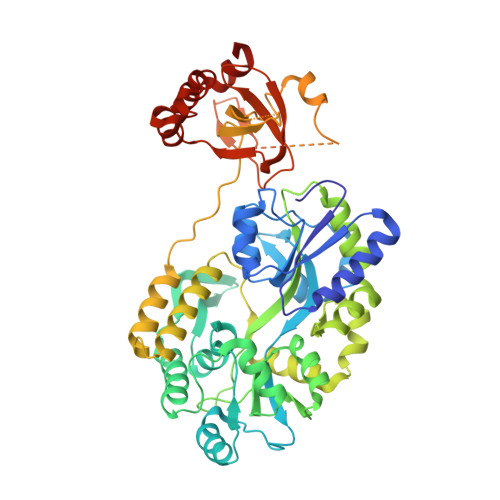
Crystal Structure of Saccharomyces cerevisiae Ioc4 PWWP domain fused with MBP


Experimental Data Snapshot

  • Method: X-RAY DIFFRACTION
  • Resolution: 2.30 Å
  • R-Value Free: 
    0.229 (Depositor), 0.229 (DCC) 
  • R-Value Work: 
    0.173 (Depositor), 0.174 (DCC) 
  • R-Value Observed: 
    0.177 (Depositor) 

Starting Model: experimental
View more details

wwPDB Validation 3D Report Full Report

Validation slider image for 7E29

This is version 1.2 of the entry. See complete history

Literature

H3K36 methylation and DNA-binding both promote Ioc4 recruitment and Isw1b remodeler function.

Li, J.Bergmann, L.Rafael de Almeida, A.Webb, K.M.Gogol, M.M.Voigt, P.Liu, Y.Liang, H.Smolle, M.M.

(2022) Nucleic Acids Res 50: 2549-2565

  • DOI: https://doi.org/10.1093/nar/gkac077
  • Primary Citation Related Structures: 
    7E29

  • PubMed Abstract: 

    The Isw1b chromatin-remodeling complex is specifically recruited to gene bodies to help retain pre-existing histones during transcription by RNA polymerase II. Recruitment is dependent on H3K36 methylation and the Isw1b subunit Ioc4, which contains an N-terminal PWWP domain. Here, we present the crystal structure of the Ioc4-PWWP domain, including a detailed functional characterization of the domain on its own as well as in the context of full-length Ioc4 and the Isw1b remodeler. The Ioc4-PWWP domain preferentially binds H3K36me3-containing nucleosomes. Its ability to bind DNA is required for nucleosome binding. It is also furthered by the unique insertion motif present in Ioc4-PWWP. The ability to bind H3K36me3 and DNA promotes the interaction of full-length Ioc4 with nucleosomes in vitro and they are necessary for its recruitment to gene bodies in vivo. Furthermore, a fully functional Ioc4-PWWP domain promotes efficient remodeling by Isw1b and the maintenance of ordered chromatin in vivo, thereby preventing the production of non-coding RNAs.


  • Organizational Affiliation
    • State Key Laboratory of Biomacromolecules, Institute of Biophysics, Chinese Academy of Sciences, 15 Datun Road, Chaoyang District, Beijing 100101, China.

Macromolecule Content 

  • Total Structure Weight: 61.69 kDa 
  • Atom Count: 4,210 
  • Modeled Residue Count: 496 
  • Deposited Residue Count: 551 
  • Unique protein chains: 1

Macromolecules

Find similar proteins by:|  3D Structure
Entity ID: 1
MoleculeChains  Sequence LengthOrganismDetailsImage
Maltose/maltodextrin-binding periplasmic protein,ISWI one complex protein 4551Escherichia coli K-12Saccharomyces cerevisiae S288C
This entity is chimeric
Mutation(s): 3 
Gene Names: malEb4034JW3994IOC4YMR044WYM9532.09
UniProt
Find proteins for P0AEX9 (Escherichia coli (strain K12))
Explore P0AEX9 
Go to UniProtKB:  P0AEX9
Find proteins for Q04213 (Saccharomyces cerevisiae (strain ATCC 204508 / S288c))
Explore Q04213 
Go to UniProtKB:  Q04213
Entity Groups
Sequence Clusters30% Identity50% Identity70% Identity90% Identity95% Identity100% Identity
UniProt GroupsP0AEX9Q04213
Sequence Annotations
Expand
Reference Sequence

Oligosaccharides

Help  
Entity ID: 2
MoleculeChains Length2D Diagram GlycosylationD Interactions
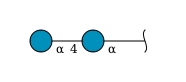
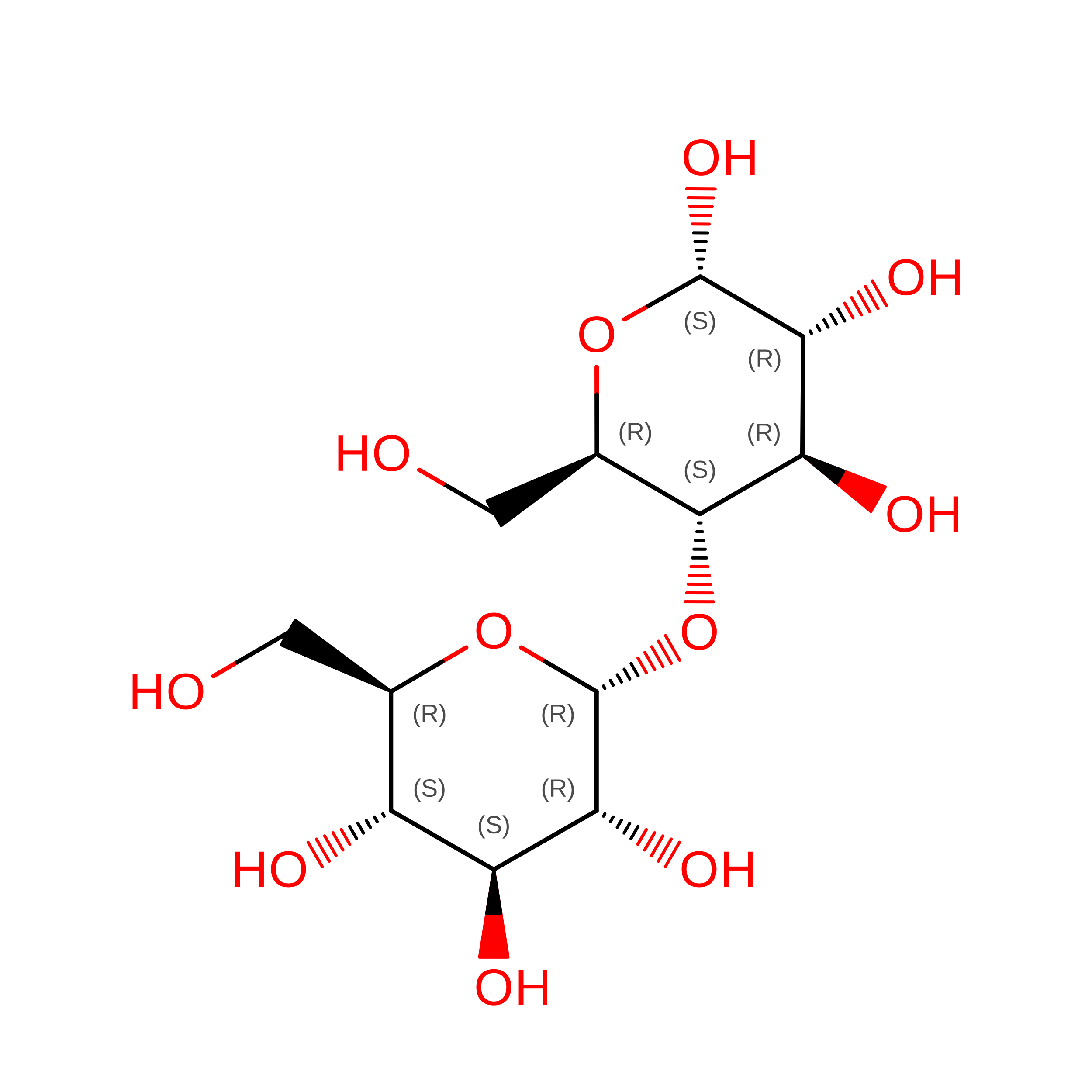
alpha-D-glucopyranose-(1-4)-alpha-D-glucopyranose
B
2N/A
Glycosylation Resources
GlyTouCan: G07411ON
GlyCosmos: G07411ON

Biologically Interesting Molecules (External Reference) 

1 Unique

Experimental Data & Validation

Experimental Data

  • Method: X-RAY DIFFRACTION
  • Resolution: 2.30 Å
  • R-Value Free:  0.229 (Depositor), 0.229 (DCC) 
  • R-Value Work:  0.173 (Depositor), 0.174 (DCC) 
  • R-Value Observed: 0.177 (Depositor) 
Space Group: P 63
Unit Cell:
Length ( Å )Angle ( ˚ )
a = 153.303α = 90
b = 153.303β = 90
c = 42.004γ = 120
Software Package:
Software NamePurpose
PHENIXrefinement
HKL-2000data reduction
HKL-2000data scaling
PHASERphasing

Structure Validation

View Full Validation Report


Entry History 

Deposition Data

Revision History  (Full details and data files)

  • Version 1.0: 2022-02-09
    Type: Initial release
  • Version 1.1: 2022-05-25
    Changes: Database references
  • Version 1.2: 2023-11-29
    Changes: Data collection, Refinement description