7ZDQ | pdb_00007zdq

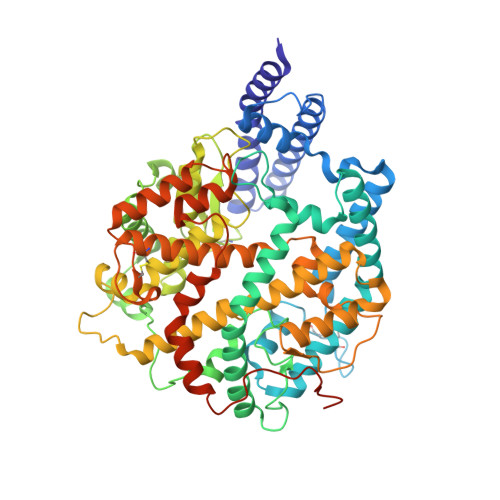
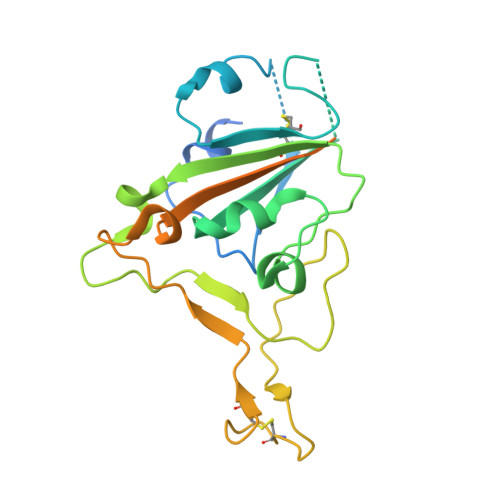
Cryo-EM structure of Human ACE2 bound to a high-affinity SARS CoV-2 mutant


Experimental Data Snapshot

  • Method: ELECTRON MICROSCOPY
  • Resolution: 3.20 Å
  • Aggregation State: PARTICLE 
  • Reconstruction Method: SINGLE PARTICLE 

Starting Model: experimental
View more details

wwPDB Validation 3D Report Full Report

Validation slider image for 7ZDQ

This is version 1.3 of the entry. See complete history

Literature

In vitro evolution predicts emerging SARS-CoV-2 mutations with high affinity for ACE2 and cross-species binding.

Bate, N.Savva, C.G.Moody, P.C.E.Brown, E.A.Evans, S.E.Ball, J.K.Schwabe, J.W.R.Sale, J.E.Brindle, N.P.J.

(2022) PLoS Pathog 18: e1010733-e1010733

  • DOI: https://doi.org/10.1371/journal.ppat.1010733
  • Primary Citation Related Structures: 
    7ZDQ

  • PubMed Abstract: 

    Emerging SARS-CoV-2 variants are creating major challenges in the ongoing COVID-19 pandemic. Being able to predict mutations that could arise in SARS-CoV-2 leading to increased transmissibility or immune evasion would be extremely valuable in development of broad-acting therapeutics and vaccines, and prioritising viral monitoring and containment. Here we use in vitro evolution to seek mutations in SARS-CoV-2 receptor binding domain (RBD) that would substantially increase binding to ACE2. We find a double mutation, S477N and Q498H, that increases affinity of RBD for ACE2 by 6.5-fold. This affinity gain is largely driven by the Q498H mutation. We determine the structure of the mutant-RBD:ACE2 complex by cryo-electron microscopy to reveal the mechanism for increased affinity. Addition of Q498H to SARS-CoV-2 RBD variants is found to boost binding affinity of the variants for human ACE2 and confer a new ability to bind rat ACE2 with high affinity. Surprisingly however, in the presence of the common N501Y mutation, Q498H inhibits binding, due to a clash between H498 and Y501 side chains. To achieve an intermolecular bonding network, affinity gain and cross-species binding similar to Q498H alone, RBD variants with the N501Y mutation must acquire instead the related Q498R mutation. Thus, SARS-CoV-2 RBD can access large affinity gains and cross-species binding via two alternative mutational routes involving Q498, with route selection determined by whether a variant already has the N501Y mutation. These mutations are now appearing in emerging SARS-CoV-2 variants where they have the potential to influence human-to-human and cross-species transmission.


  • Organizational Affiliation
    • Department of Molecular & Cell Biology, University of Leicester, Leicester, Leicester United Kingdom.

Macromolecule Content 

  • Total Structure Weight: 100.05 kDa 
  • Atom Count: 6,264 
  • Modeled Residue Count: 763 
  • Deposited Residue Count: 866 
  • Unique protein chains: 2

Macromolecules

Find similar proteins by:|  3D Structure
Entity ID: 1
MoleculeChains  Sequence LengthOrganismDetailsImage
Processed angiotensin-converting enzyme 2620Homo sapiensMutation(s): 0 
Gene Names: ACE2UNQ868/PRO1885
EC: 3.4.17 (UniProt), 3.4.17.23 (UniProt)
UniProt & NIH Common Fund Data Resources
Find proteins for Q9BYF1 (Homo sapiens)
Explore Q9BYF1 
Go to UniProtKB:  Q9BYF1
PHAROS:  Q9BYF1
GTEx:  ENSG00000130234 
Entity Groups
Sequence Clusters30% Identity50% Identity70% Identity90% Identity95% Identity100% Identity
UniProt GroupQ9BYF1
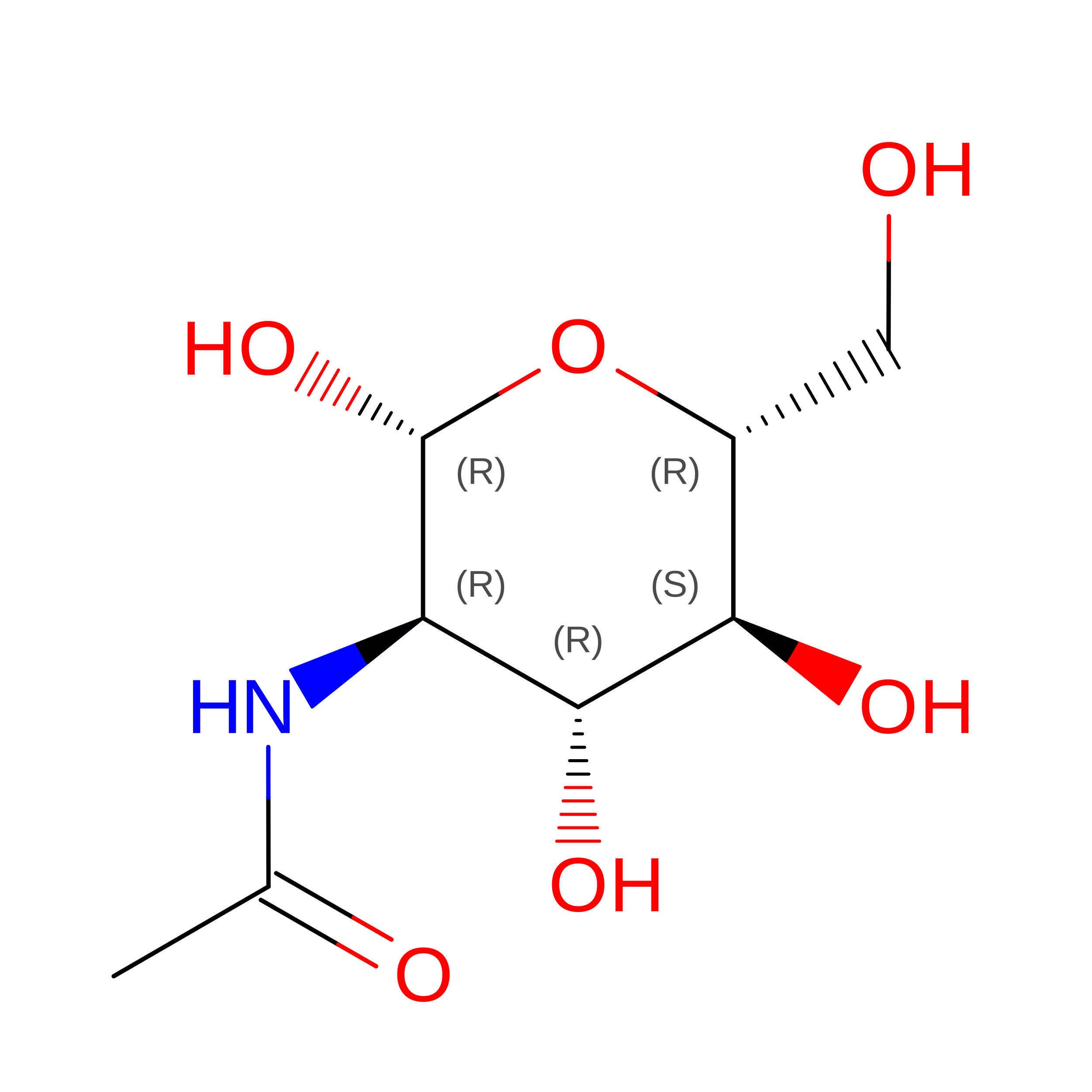
Glycosylation
Glycosylation Sites: 3Go to GlyGen: Q9BYF1-1
Sequence Annotations
Expand
Reference Sequence
Find similar proteins by:|  3D Structure
Entity ID: 2
MoleculeChains  Sequence LengthOrganismDetailsImage
Spike protein S1246Severe acute respiratory syndrome coronavirus 2Mutation(s): 2 
Gene Names: S2
UniProt
Find proteins for P0DTC2 (Severe acute respiratory syndrome coronavirus 2)
Explore P0DTC2 
Go to UniProtKB:  P0DTC2
Entity Groups
Sequence Clusters30% Identity50% Identity70% Identity90% Identity95% Identity100% Identity
UniProt GroupP0DTC2
Sequence Annotations
Expand
Reference Sequence

Experimental Data & Validation

Experimental Data

  • Method: ELECTRON MICROSCOPY
  • Resolution: 3.20 Å
  • Aggregation State: PARTICLE 
  • Reconstruction Method: SINGLE PARTICLE 
EM Software:
TaskSoftware PackageVersion
RECONSTRUCTIONRELION3.1
MODEL REFINEMENTPHENIX1.19.2

Structure Validation

View Full Validation Report


Entry History 

& Funding Information

Deposition Data


Funding OrganizationLocationGrant Number
British Heart FoundationUnited KingdomPG/19/27/34305

Revision History  (Full details and data files)

  • Version 1.0: 2022-05-18
    Type: Initial release
  • Version 1.1: 2022-06-01
    Changes: Structure summary
  • Version 1.2: 2022-08-10
    Changes: Database references
  • Version 1.3: 2024-11-20
    Changes: Data collection, Refinement description, Structure summary