7YPV | pdb_00007ypv

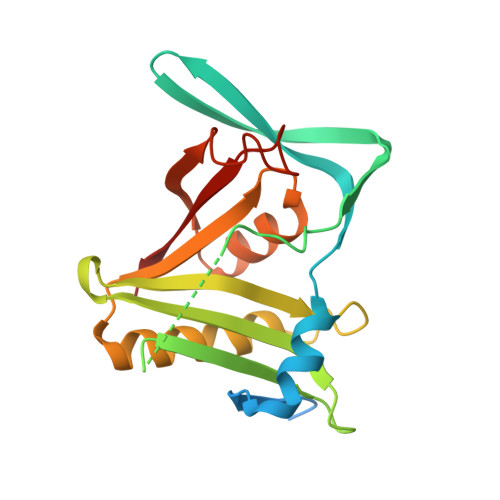
Crystal structure of OrE-ST-F


Experimental Data Snapshot

  • Method: X-RAY DIFFRACTION
  • Resolution: 2.42 Å
  • R-Value Free: 
    0.245 (Depositor), 0.249 (DCC) 
  • R-Value Work: 
    0.211 (Depositor), 0.213 (DCC) 

Starting Model: experimental
View more details

wwPDB Validation 3D Report Full Report

Validation slider image for 7YPV

Ligand Structure Quality Assessment 


This is version 1.1 of the entry. See complete history. 

Literature

N-Formimidoylation/-iminoacetylation modification in aminoglycosides requires FAD-dependent and ligand-protein NOS bridge dual chemistry.

Wang, Y.L., Chang, C.Y., Hsu, N.S., Lo, I.W., Lin, K.H., Chen, C.L., Chang, C.F., Wang, Z.C., Ogasawara, Y., Dairi, T., Maruyama, C., Hamano, Y., Li, T.L.

(2023) Nat Commun 14: 2528-2528

  • DOI: https://doi.org/10.1038/s41467-023-38218-w
  • Primary Citation Related Structures: 
    7XQA, 7XX0, 7XXC, 7XXD, 7XXM, 7XXP, 7XXR, 7XYE, 7XYL, 7Y0X, 7YPU, 7YPV, 8GRI

  • PubMed Abstract: 

    Oxidized cysteine residues are highly reactive and can form functional covalent conjugates, of which the allosteric redox switch formed by the lysine-cysteine NOS bridge is an example. Here, we report a noncanonical FAD-dependent enzyme Orf1 that adds a glycine-derived N-formimidoyl group to glycinothricin to form the antibiotic BD-12. X-ray crystallography was used to investigate this complex enzymatic process, which showed Orf1 has two substrate-binding sites that sit 13.5 Å apart unlike canonical FAD-dependent oxidoreductases. One site could accommodate glycine and the other glycinothricin or glycylthricin. Moreover, an intermediate-enzyme adduct with a NOS-covalent linkage was observed in the later site, where it acts as a two-scissile-bond linkage facilitating nucleophilic addition and cofactor-free decarboxylation. The chain length of nucleophilic acceptors vies with bond cleavage sites at either N-O or O-S accounting for N-formimidoylation or N-iminoacetylation. The resultant product is no longer sensitive to aminoglycoside-modifying enzymes, a strategy that antibiotic-producing species employ to counter drug resistance in competing species.


  • Organizational Affiliation: 
    • Genomics Research Center, Academia Sinica, Taipei, 11529, Taiwan.

Macromolecule Content 

  • Total Structure Weight: 180.59 kDa 
  • Atom Count: 11,119 
  • Modeled Residue Count: 1,370 
  • Deposited Residue Count: 1,648 
  • Unique protein chains: 1

Macromolecules

Find similar proteins by:|  3D Structure
Entity ID: 1
MoleculeChains  Sequence LengthOrganismDetailsImage
Acetyltransferase
A, B, C, D, E
A, B, C, D, E, F, G, H
206Streptomyces lavendulae subsp. lavendulaeMutation(s): 0 
Gene Names: SLAV_37450
UniProt
Find proteins for G9MBU1 (Streptomyces lavendulae subsp. lavendulae)
Explore G9MBU1 
Go to UniProtKB:  G9MBU1
Entity Groups
Sequence Clusters30% Identity50% Identity70% Identity90% Identity95% Identity100% Identity
UniProt GroupG9MBU1
Sequence Annotations
Expand
Reference Sequence

Experimental Data & Validation

Experimental Data

  • Method: X-RAY DIFFRACTION
  • Resolution: 2.42 Å
  • R-Value Free:  0.245 (Depositor), 0.249 (DCC) 
  • R-Value Work:  0.211 (Depositor), 0.213 (DCC) 
Space Group: P 1
Unit Cell:
Length ( Å )Angle ( ˚ )
a = 48.714α = 89.945
b = 77.826β = 90.043
c = 108.99γ = 89.991
Software Package:
Software NamePurpose
REFMACrefinement
HKL-2000data reduction
HKL-2000data scaling
MOLREPphasing

Structure Validation

View Full Validation Report


Ligand Structure Quality Assessment 


Entry History 

& Funding Information

Deposition Data


Funding OrganizationLocationGrant Number
Academia Sinica (Taiwan)Taiwan--

Revision History  (Full details and data files)

  • Version 1.0: 2023-05-31
    Type: Initial release
  • Version 1.1: 2023-11-29
    Changes: Data collection, Refinement description