7YNI | pdb_00007yni

Structure of human SGLT1-MAP17 complex bound with substrate 4D4FDG in the occluded conformation


Experimental Data Snapshot

  • Method: ELECTRON MICROSCOPY
  • Resolution: 3.26 Å
  • Aggregation State: PARTICLE 
  • Reconstruction Method: SINGLE PARTICLE 

wwPDB Validation 3D Report Full Report

Validation slider image for 7YNI

This is version 1.2 of the entry. See complete history

Literature

Structures of human SGLT in the occluded state reveal conformational changes during sugar transport.

Cui, W.Niu, Y.Sun, Z.Liu, R.Chen, L.

(2023) Nat Commun 14: 2920-2920

  • DOI: https://doi.org/10.1038/s41467-023-38720-1
  • Primary Citation Related Structures: 
    7YNI, 7YNJ, 7YNK

  • PubMed Abstract: 

    Sodium-Glucose Cotransporters (SGLT) mediate the uphill uptake of extracellular sugars and play fundamental roles in sugar metabolism. Although their structures in inward-open and outward-open conformations are emerging from structural studies, the trajectory of how SGLTs transit from the outward-facing to the inward-facing conformation remains unknown. Here, we present the cryo-EM structures of human SGLT1 and SGLT2 in the substrate-bound state. Both structures show an occluded conformation, with not only the extracellular gate but also the intracellular gate tightly sealed. The sugar substrate are caged inside a cavity surrounded by TM1, TM2, TM3, TM6, TM7, and TM10. Further structural analysis reveals the conformational changes associated with the binding and release of substrates. These structures fill a gap in our understanding of the structural mechanisms of SGLT transporters.


  • Organizational Affiliation
    • State Key Laboratory of Membrane Biology, College of Future Technology, Institute of Molecular Medicine, Peking University, Beijing Key Laboratory of Cardiometabolic Molecular Medicine, 100871, Beijing, China.

Macromolecule Content 

  • Total Structure Weight: 85.97 kDa 
  • Atom Count: 4,387 
  • Modeled Residue Count: 594 
  • Deposited Residue Count: 778 
  • Unique protein chains: 2

Macromolecules

Find similar proteins by:|  3D Structure
Entity ID: 1
MoleculeChains  Sequence LengthOrganismDetailsImage
Sodium/glucose cotransporter 1664Homo sapiensMutation(s): 0 
Gene Names: SLC5A1NAGTSGLT1
Membrane Entity: Yes 
UniProt & NIH Common Fund Data Resources
Find proteins for P13866 (Homo sapiens)
Explore P13866 
Go to UniProtKB:  P13866
PHAROS:  P13866
GTEx:  ENSG00000100170 
Entity Groups
Sequence Clusters30% Identity50% Identity70% Identity90% Identity95% Identity100% Identity
UniProt GroupP13866
Sequence Annotations
Expand
Reference Sequence
Find similar proteins by:|  3D Structure
Entity ID: 2
MoleculeChains  Sequence LengthOrganismDetailsImage
PDZK1-interacting protein 1114Homo sapiensMutation(s): 0 
Gene Names: PDZK1IP1MAP17
Membrane Entity: Yes 
UniProt & NIH Common Fund Data Resources
Find proteins for Q13113 (Homo sapiens)
Explore Q13113 
Go to UniProtKB:  Q13113
PHAROS:  Q13113
GTEx:  ENSG00000162366 
Entity Groups
Sequence Clusters30% Identity50% Identity70% Identity90% Identity95% Identity100% Identity
UniProt GroupQ13113
Sequence Annotations
Expand
Reference Sequence

Small Molecules

Ligands 1 Unique
IDChains Name / Formula / InChI Key2D Diagram3D Interactions
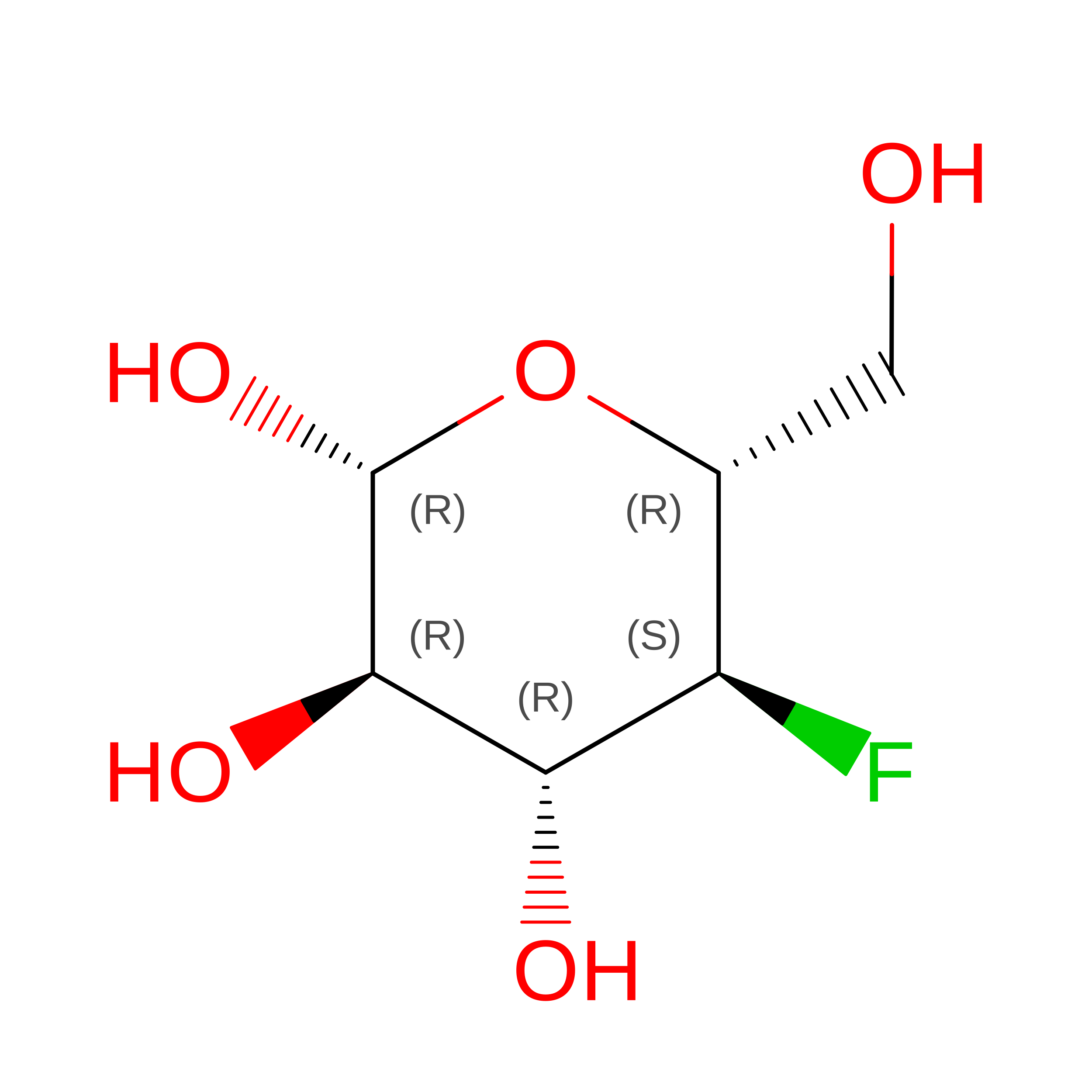
KQC
(Subject of Investigation/LOI)

Query on KQC


Download:Ideal Coordinates CCD File
C [auth A](2R,3R,4R,5S,6R)-5-fluoranyl-6-(hydroxymethyl)oxane-2,3,4-triol
C6 H11 F O5
FIHYONSINSKFAH-VFUOTHLCSA-N

Experimental Data & Validation

Experimental Data

  • Method: ELECTRON MICROSCOPY
  • Resolution: 3.26 Å
  • Aggregation State: PARTICLE 
  • Reconstruction Method: SINGLE PARTICLE 
EM Software:
TaskSoftware PackageVersion
RECONSTRUCTIONcryoSPARCv3.1.0

Structure Validation

View Full Validation Report


Entry History 

& Funding Information

Deposition Data


Funding OrganizationLocationGrant Number
National Natural Science Foundation of China (NSFC)China91957201
National Natural Science Foundation of China (NSFC)China31821091
National Natural Science Foundation of China (NSFC)China31870833

Revision History  (Full details and data files)

  • Version 1.0: 2023-05-31
    Type: Initial release
  • Version 1.1: 2023-12-13
    Changes: Data collection, Database references, Refinement description
  • Version 1.2: 2024-11-13
    Changes: Data collection, Structure summary