7Y8S | pdb_00007y8s

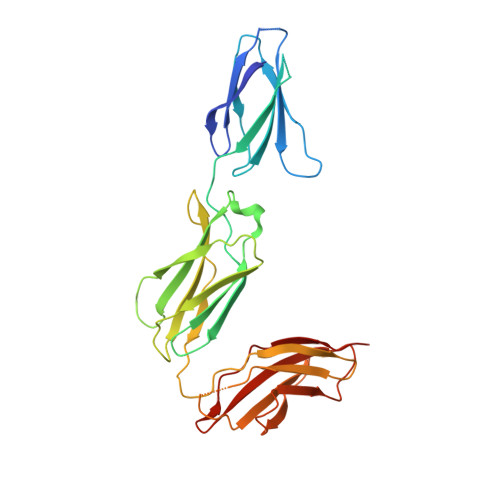
Crystal structure of sDscam FNIII1-3 domains, isoform beta2v6


Experimental Data Snapshot

  • Method: X-RAY DIFFRACTION
  • Resolution: 2.70 Å
  • R-Value Free: 
    0.275 (Depositor), 0.276 (DCC) 
  • R-Value Work: 
    0.222 (Depositor), 0.223 (DCC) 
  • R-Value Observed: 
    0.225 (Depositor) 

Starting Model: experimental
View more details

wwPDB Validation 3D Report Full Report

Validation slider image for 7Y8S

This is version 1.1 of the entry. See complete history

Literature

Structural basis for the self-recognition of sDSCAM in Chelicerata.

Cheng, J.Yu, Y.Wang, X.Zheng, X.Liu, T.Hu, D.Jin, Y.Lai, Y.Fu, T.M.Chen, Q.

(2023) Nat Commun 14: 2522-2522

  • DOI: https://doi.org/10.1038/s41467-023-38205-1
  • Primary Citation Related Structures: 
    7Y4X, 7Y54, 7Y5J, 7Y5R, 7Y6E, 7Y6O, 7Y73, 7Y8H, 7Y8I, 7Y8S, 7Y95, 7Y9A

  • PubMed Abstract: 

    To create a functional neural circuit, neurons develop a molecular identity to discriminate self from non-self. The invertebrate Dscam family and vertebrate Pcdh family are implicated in determining synaptic specificity. Recently identified in Chelicerata, a shortened Dscam (sDscam) has been shown to resemble the isoform-generating characters of both Dscam and Pcdh and represent an evolutionary transition. Here we presented the molecular details of sDscam self-recognition via both trans and cis interactions using X-ray crystallographic data and functional assays. Based on our results, we proposed a molecular zipper model for the assemblies of sDscam to mediate cell-cell recognition. In this model, sDscam utilized FNIII domain to form side-by-side interactions with neighboring molecules in the same cell while established hand-in-hand interactions via Ig1 domain with molecules from another cell around. Together, our study provided a framework for understanding the assembly, recognition, and evolution of sDscam.


  • Organizational Affiliation
    • National Clinical Research Center for Geriatrics, West China Hospital, State Key Laboratory of Biotherapy and Collaborative Innovation Center of Biotherapy, Sichuan University, 610041, Chengdu, China.

Macromolecule Content 

  • Total Structure Weight: 66.11 kDa 
  • Atom Count: 4,508 
  • Modeled Residue Count: 563 
  • Deposited Residue Count: 596 
  • Unique protein chains: 1

Macromolecules

Find similar proteins by:|  3D Structure
Entity ID: 1
MoleculeChains  Sequence LengthOrganismDetailsImage
Dscam
A, B
298ChelicerataMutation(s): 0 
Gene Names: Dscam
UniProt
Find proteins for A0A161FW14 (Olivierus martensii)
Explore A0A161FW14 
Go to UniProtKB:  A0A161FW14
Entity Groups
Sequence Clusters30% Identity50% Identity70% Identity90% Identity95% Identity100% Identity
UniProt GroupA0A161FW14
Sequence Annotations
Expand
Reference Sequence

Experimental Data & Validation

Experimental Data

  • Method: X-RAY DIFFRACTION
  • Resolution: 2.70 Å
  • R-Value Free:  0.275 (Depositor), 0.276 (DCC) 
  • R-Value Work:  0.222 (Depositor), 0.223 (DCC) 
  • R-Value Observed: 0.225 (Depositor) 
Space Group: P 64 2 2
Unit Cell:
Length ( Å )Angle ( ˚ )
a = 171.649α = 90
b = 171.649β = 90
c = 114.933γ = 120
Software Package:
Software NamePurpose
PHENIXrefinement
HKL-3000data scaling
PDB_EXTRACTdata extraction
HKL-3000data reduction
PHASERphasing

Structure Validation

View Full Validation Report


Entry History 

& Funding Information

Deposition Data


Funding OrganizationLocationGrant Number
National Natural Science Foundation of China (NSFC)China--

Revision History  (Full details and data files)

  • Version 1.0: 2023-05-24
    Type: Initial release
  • Version 1.1: 2023-11-29
    Changes: Data collection, Refinement description