7XHR | pdb_00007xhr

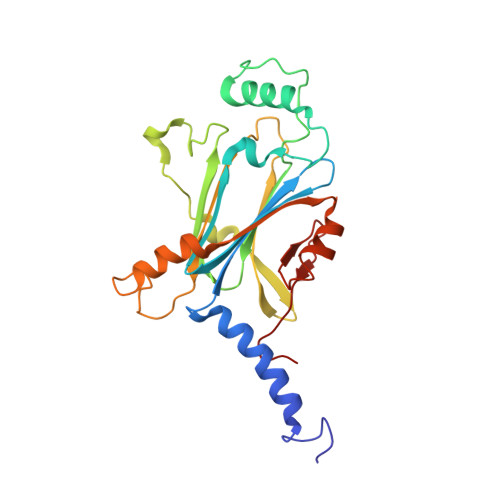
Crystal structure of Wild Type Cypovirus Polyhedra produced by cell-free protein synthesis


Experimental Data Snapshot

  • Method: X-RAY DIFFRACTION
  • Resolution: 1.80 Å
  • R-Value Free: 
    0.184 (Depositor), 0.195 (DCC) 
  • R-Value Work: 
    0.149 (Depositor), 0.161 (DCC) 

Starting Model: experimental
View more details

wwPDB Validation 3D Report Full Report

Validation slider image for 7XHR

This is version 1.1 of the entry. See complete history

Literature

Cell-free protein crystallization for nanocrystal structure determination.

Abe, S.Tanaka, J.Kojima, M.Kanamaru, S.Hirata, K.Yamashita, K.Kobayashi, A.Ueno, T.

(2022) Sci Rep 12: 16031-16031

  • DOI: https://doi.org/10.1038/s41598-022-19681-9
  • Primary Citation Related Structures: 
    7XHR, 7XHS, 7XWS

  • PubMed Abstract: 

    In-cell protein crystallization (ICPC) has been investigated as a technique to support the advancement of structural biology because it does not require protein purification and a complicated crystallization process. However, only a few protein structures have been reported because these crystals formed incidentally in living cells and are insufficient in size and quality for structure analysis. Here, we have developed a cell-free protein crystallization (CFPC) method, which involves direct protein crystallization using cell-free protein synthesis. We have succeeded in crystallization and structure determination of nano-sized polyhedra crystal (PhC) at a high resolution of 1.80 Å. Furthermore, nanocrystals were synthesized at a reaction scale of only 20 μL using the dialysis method, enabling structural analysis at a resolution of 1.95 Å. To further demonstrate the potential of CFPC, we attempted to determine the structure of crystalline inclusion protein A (CipA), whose structure had not yet been determined. We added chemical reagents as a twinning inhibitor to the CFPC solution, which enabled us to determine the structure of CipA at 2.11 Å resolution. This technology greatly expands the high-throughput structure determination method of unstable, low-yield, fusion, and substrate-biding proteins that have been difficult to analyze with conventional methods.


  • Organizational Affiliation
    • School of Life Science and Technology, Tokyo Institute of Technology, Nagatsuta-cho 4259, Midori-ku, Yokohama, 226-8501, Japan. saabe@bio.titech.ac.jp.

Macromolecule Content 

  • Total Structure Weight: 28.44 kDa 
  • Atom Count: 2,152 
  • Modeled Residue Count: 247 
  • Deposited Residue Count: 247 
  • Unique protein chains: 1

Macromolecules

Find similar proteins by:|  3D Structure
Entity ID: 1
MoleculeChains  Sequence LengthOrganismDetailsImage
Polyhedrin247Bombyx mori cypovirus 1Mutation(s): 0 
UniProt
Find proteins for P11041 (Bombyx mori cytoplasmic polyhedrosis virus)
Explore P11041 
Go to UniProtKB:  P11041
Entity Groups
Sequence Clusters30% Identity50% Identity70% Identity90% Identity95% Identity100% Identity
UniProt GroupP11041
Sequence Annotations
Expand
Reference Sequence

Experimental Data & Validation

Experimental Data

  • Method: X-RAY DIFFRACTION
  • Resolution: 1.80 Å
  • R-Value Free:  0.184 (Depositor), 0.195 (DCC) 
  • R-Value Work:  0.149 (Depositor), 0.161 (DCC) 
Space Group: I 2 3
Unit Cell:
Length ( Å )Angle ( ˚ )
a = 103.61α = 90
b = 103.61β = 90
c = 103.61γ = 90
Software Package:
Software NamePurpose
REFMACrefinement
PHENIXrefinement
CrystFELdata scaling
Cootmodel building
XDSdata reduction
PHASERphasing

Structure Validation

View Full Validation Report


Entry History 

& Funding Information

Deposition Data


Funding OrganizationLocationGrant Number
Japan Society for the Promotion of Science (JSPS)JapanJP18H05421
Japan Society for the Promotion of Science (JSPS)JapanJP19H02830
Japan Science and TechnologyJapanJPMJTR20U1

Revision History  (Full details and data files)

  • Version 1.0: 2023-02-01
    Type: Initial release
  • Version 1.1: 2023-11-29
    Changes: Data collection, Refinement description