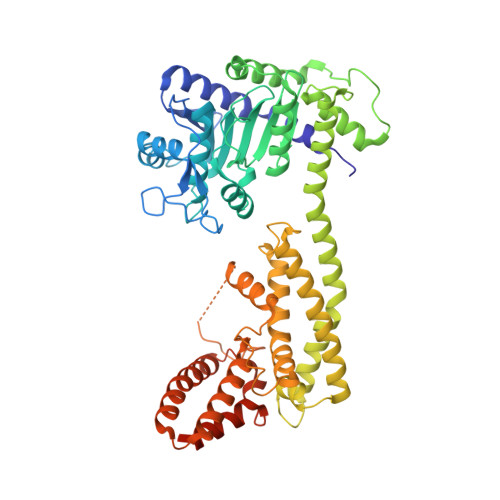
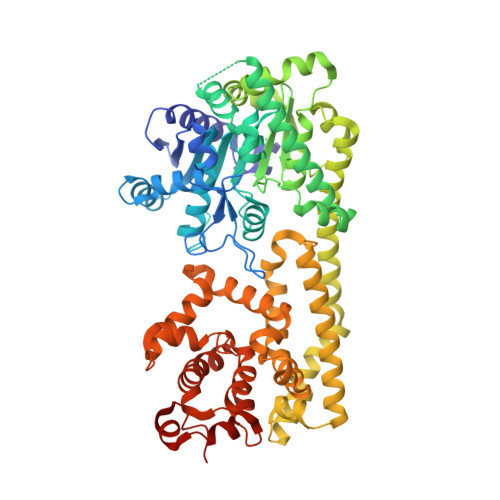
7XDD | pdb_00007xdd

Cryo-EM structure of EDS1 and PAD4


Experimental Data Snapshot

  • Method: ELECTRON MICROSCOPY
  • Resolution: 2.93 Å
  • Aggregation State: PARTICLE 
  • Reconstruction Method: SINGLE PARTICLE 

wwPDB Validation 3D Report Full Report

Validation slider image for 7XDD

This is version 1.4 of the entry. See complete history. 

Literature

Identification and receptor mechanism of TIR-catalyzed small molecules in plant immunity.

Huang, S., Jia, A., Song, W., Hessler, G., Meng, Y., Sun, Y., Xu, L., Laessle, H., Jirschitzka, J., Ma, S., Xiao, Y., Yu, D., Hou, J., Liu, R., Sun, H., Liu, X., Han, Z., Chang, J., Parker, J.E., Chai, J.

(2022) Science 377: eabq3297-eabq3297

  • DOI: https://doi.org/10.1126/science.abq3297
  • Primary Citation Related Structures: 
    7XDD, 7XEY

  • PubMed Abstract: 

    Plant nucleotide-binding leucine-rich repeat-containing (NLR) receptors with an N-terminal Toll/interleukin-1 receptor (TIR) domain sense pathogen effectors to enable TIR-encoded nicotinamide adenine dinucleotide hydrolase (NADase) activity for immune signaling. TIR-NLR signaling requires the helper NLRs N requirement gene 1 (NRG1), Activated Disease Resistance 1 (ADR1), and Enhanced Disease Susceptibility 1 (EDS1), which forms a heterodimer with each of its paralogs Phytoalexin Deficient 4 (PAD4) and Senescence-Associated Gene 101 (SAG101). Here, we show that TIR-containing proteins catalyze the production of 2'-(5''-phosphoribosyl)-5'-adenosine monophosphate (pRib-AMP) and diphosphate (pRib-ADP) in vitro and in planta. Biochemical and structural data demonstrate that EDS1-PAD4 is a receptor complex for pRib-AMP and pRib-ADP, which allosterically promote EDS1-PAD4 interaction with ADR1-L1 but not NRG1A. Our study identifies TIR-catalyzed pRib-AMP and pRib-ADP as a missing link in TIR signaling through EDS1-PAD4 and as likely second messengers for plant immunity.


  • Organizational Affiliation: 
    • Beijing Advanced Innovation Center for Structural Biology, Tsinghua-Peking Joint Center for Life Sciences, Center for Plant Biology, School of Life Sciences, Tsinghua University, 100084 Beijing, China.

Macromolecule Content 

  • Total Structure Weight: 132.48 kDa 
  • Atom Count: 9,021 
  • Modeled Residue Count: 1,123 
  • Deposited Residue Count: 1,161 
  • Unique protein chains: 2

Macromolecules

Find similar proteins by:|  3D Structure
Entity ID: 1
MoleculeChains  Sequence LengthOrganismDetailsImage
Lipase-like PAD4538Arabidopsis thalianaMutation(s): 0 
Gene Names: PAD4, EDS9, At3g52430, F22O6.190
EC: 2.3.1
UniProt
Find proteins for Q9S745 (Arabidopsis thaliana)
Explore Q9S745 
Go to UniProtKB:  Q9S745
Entity Groups
Sequence Clusters30% Identity50% Identity70% Identity90% Identity95% Identity100% Identity
UniProt GroupQ9S745
Sequence Annotations
Expand
Reference Sequence
Find similar proteins by:|  3D Structure
Entity ID: 2
MoleculeChains  Sequence LengthOrganismDetailsImage
Protein EDS1623Arabidopsis thalianaMutation(s): 0 
Gene Names: EDS1, EDS1-90, EDS1A, At3g48090, T17F15.40
UniProt
Find proteins for Q9SU72 (Arabidopsis thaliana)
Explore Q9SU72 
Go to UniProtKB:  Q9SU72
Entity Groups
Sequence Clusters30% Identity50% Identity70% Identity90% Identity95% Identity100% Identity
UniProt GroupQ9SU72
Sequence Annotations
Expand
Reference Sequence

Experimental Data & Validation

Experimental Data

  • Method: ELECTRON MICROSCOPY
  • Resolution: 2.93 Å
  • Aggregation State: PARTICLE 
  • Reconstruction Method: SINGLE PARTICLE 
EM Software:
TaskSoftware PackageVersion
MODEL REFINEMENTPHENIX

Structure Validation

View Full Validation Report


Entry History 

& Funding Information

Deposition Data


Funding OrganizationLocationGrant Number
National Natural Science Foundation of China (NSFC)China--
Alexander von Humboldt FoundationGermany--

Revision History  (Full details and data files)

  • Version 1.0: 2022-07-13
    Type: Initial release
  • Version 1.1: 2022-08-03
    Changes: Database references
  • Version 1.2: 2022-08-10
    Changes: Database references, Source and taxonomy
  • Version 1.3: 2024-06-26
    Changes: Data collection
  • Version 1.4: 2025-06-25
    Changes: Data collection, Structure summary