Download Mendeley
Structure-guided rational design of the Geobacillus thermoglucosidasius feruloyl esterase GthFAE to improve its thermostability.
Yang, W., Sun, L., Dong, P., Chen, Y., Zhang, H., Huang, X., Wu, L., Chen, L., Jing, D., Wu, Y.(2022) Biochem Biophys Res Commun 600: 117-122
- PubMed: 35219099 Search on PubMed
- DOI: https://doi.org/10.1016/j.bbrc.2022.02.074
- Primary Citation Related Structures:
7WWH - PubMed Abstract:
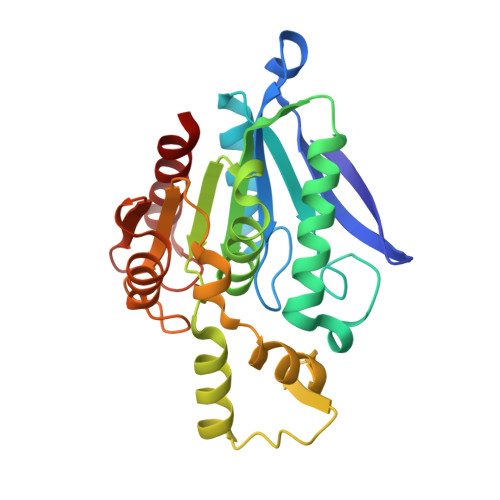
Feruloyl esterases are indispensable biocatalysts catalyzing the cleavage of ester bonds between polysaccharides and their hydroxycinnamoyl cross-links. GthFAE from Geobacillus thermoglucosidasius was identified as a thermophilic alkaline feruloyl esterase with potential applications in paper manufacturing. To improve the enzymatic properties rationally and efficiently, the structure of GthFAE was solved at 1.9 Å, revealing a core domain of classical α/β hydrolase fold and an inserted α/β cap domain. In silico analysis based on it helped us to investigate whether the residues at the active center have positive effects on the stability, and how. Several site-directed mutations were conducted, of which substitutions at residues T41 and T150 apparently improved the thermostability. The combination mutant T41N/T150R exhibited an optimal temperature of 65 °C, a 6.4 °C higher T m compared to wild type by 80 °C, and a 35-fold longer in half-life (201 min) at 70 °C. Molecular dynamics simulations further illustrated that the structure of T41N/T150R was more stable than the wild type and T150R stabilized the cap domain by introducing salt bridges to the region with E154 and D164. This study not only highlighted residues within the active center on their thermostability improving effects, but also contributed to the prospective industrial application of GthFAE.
- Provincial University Key Laboratory of Cellular Stress Response and Metabolic Regulation, College of Life Science, Fujian Normal University, Fuzhou, 350117, China.
Organizational Affiliation: