7VU8 | pdb_00007vu8

L7-Tir domain with bound ligand


Experimental Data Snapshot

  • Method: ELECTRON MICROSCOPY
  • Resolution: 3.00 Å
  • Aggregation State: FILAMENT 
  • Reconstruction Method: SINGLE PARTICLE 

wwPDB Validation 3D Report Full Report

Validation slider image for 7VU8

This is version 1.3 of the entry. See complete history

Literature

TIR domains of plant immune receptors are 2',3'-cAMP/cGMP synthetases mediating cell death.

Yu, D.Song, W.Tan, E.Y.J.Liu, L.Cao, Y.Jirschitzka, J.Li, E.Logemann, E.Xu, C.Huang, S.Jia, A.Chang, X.Han, Z.Wu, B.Schulze-Lefert, P.Chai, J.

(2022) Cell 185: 2370-2386.e18

  • DOI: https://doi.org/10.1016/j.cell.2022.04.032
  • Primary Citation Related Structures: 
    7VU8, 7X5K, 7X5L, 7X5M

  • PubMed Abstract: 

    2',3'-cAMP is a positional isomer of the well-established second messenger 3',5'-cAMP, but little is known about the biology of this noncanonical cyclic nucleotide monophosphate (cNMP). Toll/interleukin-1 receptor (TIR) domains of nucleotide-binding leucine-rich repeat (NLR) immune receptors have the NADase function necessary but insufficient to activate plant immune responses. Here, we show that plant TIR proteins, besides being NADases, act as 2',3'-cAMP/cGMP synthetases by hydrolyzing RNA/DNA. Structural data show that a TIR domain adopts distinct oligomers with mutually exclusive NADase and synthetase activity. Mutations specifically disrupting the synthetase activity abrogate TIR-mediated cell death in Nicotiana benthamiana (Nb), supporting an important role for these cNMPs in TIR signaling. Furthermore, the Arabidopsis negative regulator of TIR-NLR signaling, NUDT7, displays 2',3'-cAMP/cGMP but not 3',5'-cAMP/cGMP phosphodiesterase activity and suppresses cell death activity of TIRs in Nb. Our study identifies a family of 2',3'-cAMP/cGMP synthetases and establishes a critical role for them in plant immune responses.


  • Organizational Affiliation
    • Institute of Biochemistry, University of Cologne, Cologne, Germany; Max Planck Institute for Plant Breeding Research, Cologne, Germany.

Macromolecule Content 

  • Total Structure Weight: 23.86 kDa 
  • Atom Count: 1,433 
  • Modeled Residue Count: 170 
  • Deposited Residue Count: 204 
  • Unique protein chains: 1

Macromolecules

Find similar proteins by:|  3D Structure
Entity ID: 1
MoleculeChains  Sequence LengthOrganismDetailsImage
Flax rust resistance proteinA [auth B]204Linum usitatissimumMutation(s): 1 
UniProt
Find proteins for Q9XEH4 (Linum usitatissimum)
Explore Q9XEH4 
Go to UniProtKB:  Q9XEH4
Entity Groups
Sequence Clusters30% Identity50% Identity70% Identity90% Identity95% Identity100% Identity
UniProt GroupQ9XEH4
Sequence Annotations
Expand
Reference Sequence

Small Molecules

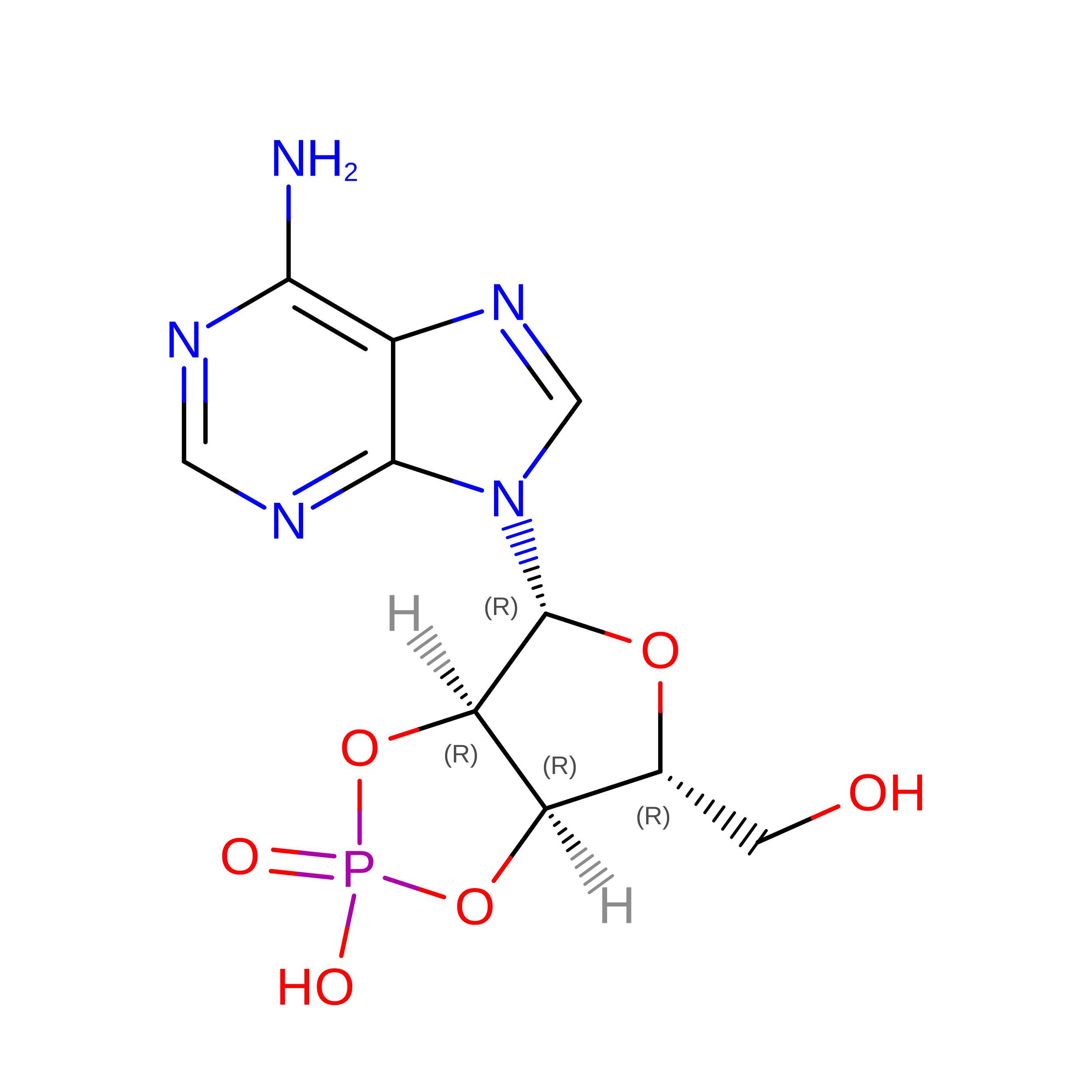
Ligands 1 Unique
IDChains Name / Formula / InChI Key2D Diagram3D Interactions
ACK
(Subject of Investigation/LOI)

Query on ACK


Download:Ideal Coordinates CCD File
B
2',3'- cyclic AMP
C10 H12 N5 O6 P
KMYWVDDIPVNLME-KQYNXXCUSA-N

Experimental Data & Validation

Experimental Data

  • Method: ELECTRON MICROSCOPY
  • Resolution: 3.00 Å
  • Aggregation State: FILAMENT 
  • Reconstruction Method: SINGLE PARTICLE 
EM Software:
TaskSoftware PackageVersion
RECONSTRUCTIONRELION
MODEL REFINEMENTPHENIX1.19.2

Structure Validation

View Full Validation Report


Entry History 

& Funding Information

Deposition Data


Funding OrganizationLocationGrant Number
Not funded--

Revision History  (Full details and data files)

  • Version 1.0: 2022-06-01
    Type: Initial release
  • Version 1.1: 2022-06-08
    Changes: Database references
  • Version 1.2: 2022-07-06
    Changes: Database references
  • Version 1.3: 2024-06-26
    Changes: Data collection