7UNB | pdb_00007unb

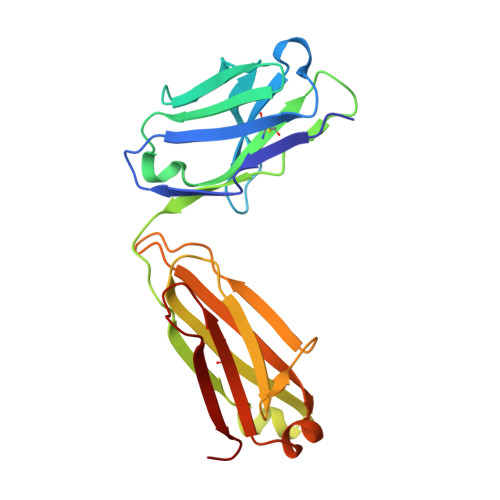
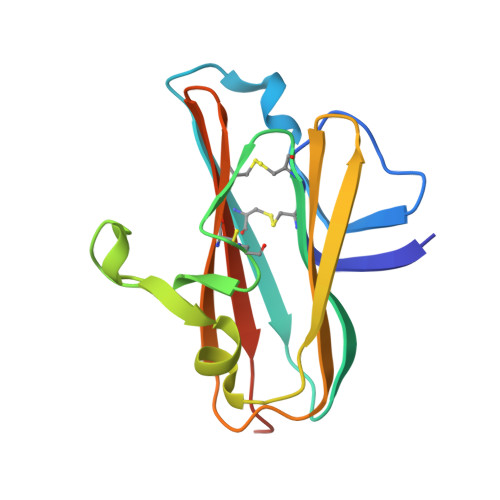
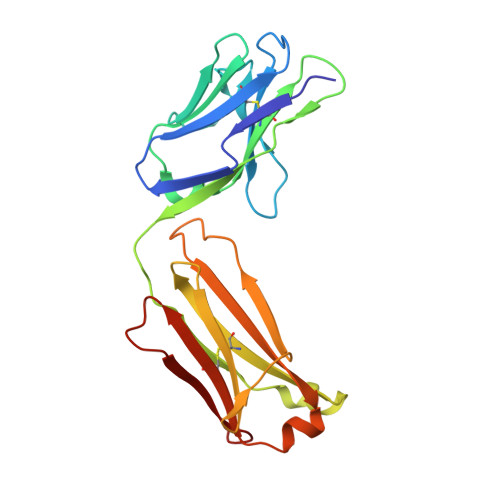
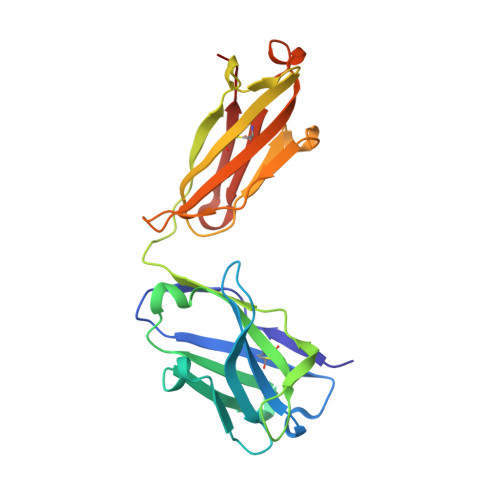
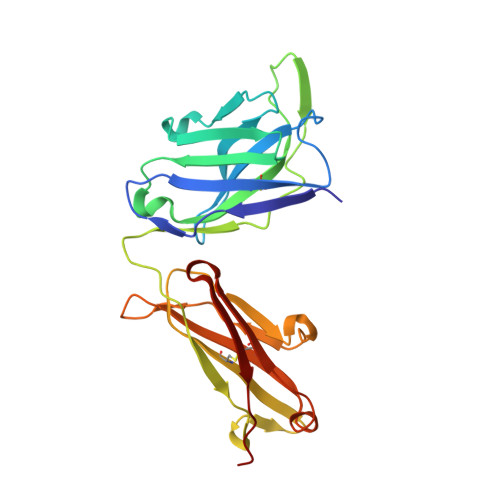
Crystal structure of malaria transmission-blocking antigen Pfs48/45-6C variant in complex with human antibodies RUPA-117 and RUPA-47

  • Classification: IMMUNE SYSTEM
  • Organism(s): Homo sapiens, Plasmodium falciparum
  • Expression System: Homo sapiens
  • Mutation(s): Yes 

  • Deposited: 2022-04-10 Released: 2022-08-10 
  • Deposition Author(s): Hailemariam, S., McLeod, B., Julien, J.-P.
  • Funding Organization(s): National Institutes of Health/National Institute Of Allergy and Infectious Diseases (NIH/NIAID), Bill & Melinda Gates Foundation, Canadian Institutes of Health Research (CIHR), CIFAR Azrieli Global Scholars, Ontario Early Researcher Awards, Canada Research Chairs

Experimental Data Snapshot

  • Method: X-RAY DIFFRACTION
  • Resolution: 2.18 Å
  • R-Value Free: 
    0.228 (Depositor), 0.228 (DCC) 
  • R-Value Work: 
    0.178 (Depositor), 0.179 (DCC) 
  • R-Value Observed: 
    0.180 (Depositor) 

Starting Model: experimental
View more details

wwPDB Validation 3D Report Full Report

Validation slider image for 7UNB

Ligand Structure Quality Assessment 


This is version 1.4 of the entry. See complete history

Literature

Vaccination with a structure-based stabilized version of malarial antigen Pfs48/45 elicits ultra-potent transmission-blocking antibody responses.

McLeod, B.Mabrouk, M.T.Miura, K.Ravichandran, R.Kephart, S.Hailemariam, S.Pham, T.P.Semesi, A.Kucharska, I.Kundu, P.Huang, W.C.Johnson, M.Blackstone, A.Pettie, D.Murphy, M.Kraft, J.C.Leaf, E.M.Jiao, Y.van de Vegte-Bolmer, M.van Gemert, G.J.Ramjith, J.King, C.R.MacGill, R.S.Wu, Y.Lee, K.K.Jore, M.M.King, N.P.Lovell, J.F.Julien, J.P.

(2022) Immunity 55: 1680-1692.e8

  • DOI: https://doi.org/10.1016/j.immuni.2022.07.015
  • Primary Citation Related Structures: 
    7UNB

  • PubMed Abstract: 

    Malaria transmission-blocking vaccines (TBVs) aim to elicit human antibodies that inhibit sporogonic development of Plasmodium falciparum in mosquitoes, thereby preventing onward transmission. Pfs48/45 is a leading clinical TBV candidate antigen and is recognized by the most potent transmission-blocking monoclonal antibody (mAb) yet described; still, clinical development of Pfs48/45 antigens has been hindered, largely by its poor biochemical characteristics. Here, we used structure-based computational approaches to design Pfs48/45 antigens stabilized in the conformation recognized by the most potently inhibitory mAb, achieving >25°C higher thermostability compared with the wild-type protein. Antibodies elicited in mice immunized with these engineered antigens displayed on liposome-based or protein nanoparticle-based vaccine platforms exhibited 1-2 orders of magnitude superior transmission-reducing activity, compared with immunogens bearing the wild-type antigen, driven by improved antibody quality. Our data provide the founding principles for using molecular stabilization solely from antibody structure-function information to drive improved immune responses against a parasitic vaccine target.


  • Organizational Affiliation
    • Program in Molecular Medicine, The Hospital for Sick Children Research Institute, 686 Bay Street, Toronto, ON M5G 0A4, Canada; Department of Biochemistry, University of Toronto, 1 King's College Circle, Toronto, ON M5S 1A8, Canada.

Macromolecule Content 

  • Total Structure Weight: 111.73 kDa 
  • Atom Count: 8,338 
  • Modeled Residue Count: 1,017 
  • Deposited Residue Count: 1,029 
  • Unique protein chains: 5

Macromolecules

Find similar proteins by:|  3D Structure
Entity ID: 1
MoleculeChains  Sequence LengthOrganismDetailsImage
RUPA-47 Fab kappa chainA [auth L]215Homo sapiensMutation(s): 0 
Find similar proteins by:|  3D Structure
Entity ID: 2
MoleculeChains  Sequence LengthOrganismDetailsImage
Gametocyte surface protein P45/48B [auth R]147Plasmodium falciparumMutation(s): 3 
Gene Names: PF45/48PFS45-48PFS45/48PF13_0247PF3D7_1346700
UniProt
Find proteins for Q8I6T1 (Plasmodium falciparum (isolate 3D7))
Explore Q8I6T1 
Go to UniProtKB:  Q8I6T1
Entity Groups
Sequence Clusters30% Identity50% Identity70% Identity90% Identity95% Identity100% Identity
UniProt GroupQ8I6T1
Sequence Annotations
Expand
Reference Sequence
Find similar proteins by:|  3D Structure
Entity ID: 3
MoleculeChains  Sequence LengthOrganismDetailsImage
RUPA-117 Fab kappa chainC [auth E]214Homo sapiensMutation(s): 0 
Find similar proteins by:|  3D Structure
Entity ID: 4
MoleculeChains  Sequence LengthOrganismDetailsImage
RUPA-47 Fab heavy chainD [auth H]223Homo sapiensMutation(s): 0 
Find similar proteins by:|  3D Structure
Entity ID: 5
MoleculeChains  Sequence LengthOrganismDetailsImage
RUPA-117 Fab heavy chainE [auth F]230Homo sapiensMutation(s): 0 

Small Molecules

Ligands 1 Unique
IDChains Name / Formula / InChI Key2D Diagram3D Interactions
NAG
(Subject of Investigation/LOI)

Query on NAG


Download:Ideal Coordinates CCD File
F
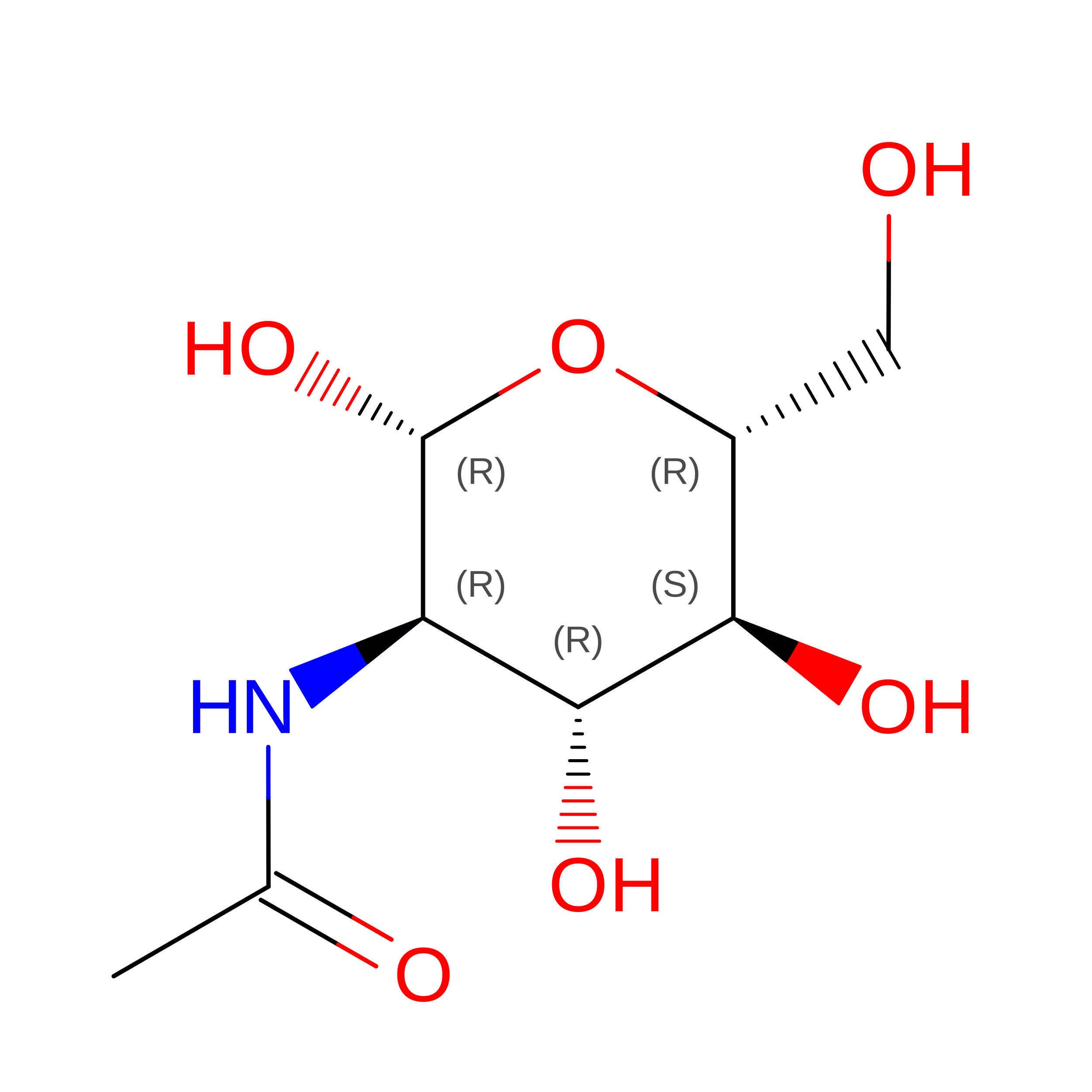
2-acetamido-2-deoxy-beta-D-glucopyranose
C8 H15 N O6
OVRNDRQMDRJTHS-FMDGEEDCSA-N

Experimental Data & Validation

Experimental Data

  • Method: X-RAY DIFFRACTION
  • Resolution: 2.18 Å
  • R-Value Free:  0.228 (Depositor), 0.228 (DCC) 
  • R-Value Work:  0.178 (Depositor), 0.179 (DCC) 
  • R-Value Observed: 0.180 (Depositor) 
Space Group: P 21 21 21
Unit Cell:
Length ( Å )Angle ( ˚ )
a = 73.669α = 90
b = 127.16β = 90
c = 132.706γ = 90
Software Package:
Software NamePurpose
PHENIXrefinement
XDSdata reduction
PHASERphasing
XDSdata scaling

Structure Validation

View Full Validation Report


Ligand Structure Quality Assessment 


Entry History 

& Funding Information

Deposition Data


Funding OrganizationLocationGrant Number
National Institutes of Health/National Institute Of Allergy and Infectious Diseases (NIH/NIAID)United States1R01AI148557-01A1
Bill & Melinda Gates FoundationUnited StatesOPP1156262
Canadian Institutes of Health Research (CIHR)Canada428410
Bill & Melinda Gates FoundationUnited StatesOPP1179906
CIFAR Azrieli Global ScholarsCanada--
Ontario Early Researcher AwardsCanada--
Canada Research ChairsCanada--

Revision History  (Full details and data files)

  • Version 1.0: 2022-08-10
    Type: Initial release
  • Version 1.1: 2022-08-31
    Changes: Database references
  • Version 1.2: 2022-09-28
    Changes: Database references
  • Version 1.3: 2023-10-18
    Changes: Data collection, Refinement description
  • Version 1.4: 2024-11-20
    Changes: Structure summary