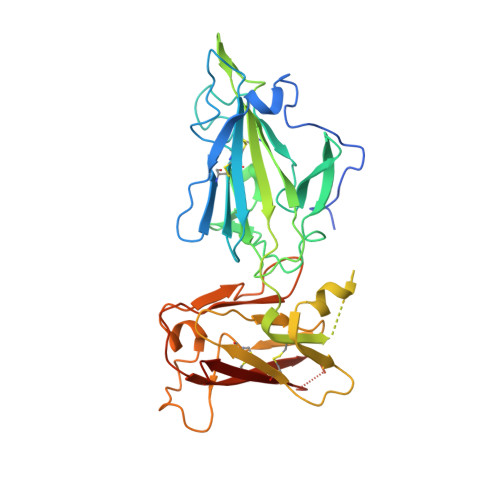
7UI1 | pdb_00007ui1

Pfs230 D1D2 domain in complex with 230AL-37


Experimental Data Snapshot

  • Method: X-RAY DIFFRACTION
  • Resolution: 3.30 Å
  • R-Value Free: 
    0.299 (Depositor), 0.299 (DCC) 
  • R-Value Work: 
    0.264 (Depositor), 0.265 (DCC) 
  • R-Value Observed: 
    0.266 (Depositor) 

Starting Model: experimental
View more details

wwPDB Validation 3D Report Full Report

Validation slider image for 7UI1

This is version 1.3 of the entry. See complete history

Literature

A human antibody epitope map of Pfs230D1 derived from analysis of individuals vaccinated with a malaria transmission-blocking vaccine.

Tang, W.K.Coelho, C.H.Miura, K.Nguemwo Tentokam, B.C.Salinas, N.D.Narum, D.L.Healy, S.A.Sagara, I.Long, C.A.Duffy, P.E.Tolia, N.H.

(2023) Immunity 56: 433-443.e5

  • DOI: https://doi.org/10.1016/j.immuni.2023.01.012
  • Primary Citation Related Structures: 
    7U9E, 7U9W, 7UA2, 7UA8, 7UBS, 7UC8, 7UCQ, 7UFW, 7UI1

  • PubMed Abstract: 

    Pfs230 domain 1 (Pfs230D1) is an advanced malaria transmission-blocking vaccine antigen demonstrating high functional activity in clinical trials. However, the structural and functional correlates of transmission-blocking activity are not defined. Here, we characterized a panel of human monoclonal antibodies (hmAbs) elicited in vaccinees immunized with Pfs230D1. These hmAbs exhibited diverse transmission-reducing activity, yet all bound to Pfs230D1 with nanomolar affinity. We compiled epitope-binning data for seventeen hmAbs and structures of nine hmAbs complexes to construct a high-resolution epitope map and revealed that potent transmission-reducing hmAbs bound to one face of Pfs230D1, while non-potent hmAbs bound to the opposing side. The structure of Pfs230D1D2 revealed that non-potent transmission-reducing epitopes were occluded by the second domain. The hmAb epitope map delineated binary hmAb combinations that synergized for extremely high-potency, transmission-reducing activity. This work provides a high-resolution guide for structure-based design of enhanced immunogens and informs diagnostics that measure the transmission-reducing response.


  • Organizational Affiliation
    • Host-Pathogen Interactions and Structural Vaccinology Section, Laboratory of Malaria Immunology and Vaccinology, National Institute of Allergy and Infectious Diseases, National Institutes of Health, Bethesda, MD, USA.

Macromolecule Content 

  • Total Structure Weight: 273.77 kDa 
  • Atom Count: 17,085 
  • Modeled Residue Count: 2,140 
  • Deposited Residue Count: 2,448 
  • Unique protein chains: 2

Macromolecules

Find similar proteins by:|  3D Structure
Entity ID: 1
MoleculeChains  Sequence LengthOrganismDetailsImage
Gametocyte surface protein P230A,
C [auth B],
E [auth C],
G [auth D]
355Plasmodium falciparumMutation(s): 0 
Gene Names: PFS230PF230S230PF3D7_0209000
UniProt
Find proteins for P68874 (Plasmodium falciparum (isolate 3D7))
Explore P68874 
Go to UniProtKB:  P68874
Entity Groups
Sequence Clusters30% Identity50% Identity70% Identity90% Identity95% Identity100% Identity
UniProt GroupP68874
Sequence Annotations
Expand
Reference Sequence
Find similar proteins by:|  3D Structure
Entity ID: 2
MoleculeChains  Sequence LengthOrganismDetailsImage
230AL-37B [auth H],
D [auth I],
F [auth J],
H [auth K]
257Homo sapiensMutation(s): 0 

Experimental Data & Validation

Experimental Data

  • Method: X-RAY DIFFRACTION
  • Resolution: 3.30 Å
  • R-Value Free:  0.299 (Depositor), 0.299 (DCC) 
  • R-Value Work:  0.264 (Depositor), 0.265 (DCC) 
  • R-Value Observed: 0.266 (Depositor) 
Space Group: P 2 21 21
Unit Cell:
Length ( Å )Angle ( ˚ )
a = 49.58α = 90
b = 155.14β = 90
c = 375.22γ = 90
Software Package:
Software NamePurpose
PHENIXrefinement
XDSdata reduction
XDSdata scaling
PHASERphasing

Structure Validation

View Full Validation Report


Entry History 

& Funding Information

Deposition Data


Funding OrganizationLocationGrant Number
National Institutes of Health/National Institute Of Allergy and Infectious Diseases (NIH/NIAID)United States--

Revision History  (Full details and data files)

  • Version 1.0: 2023-02-15
    Type: Initial release
  • Version 1.1: 2023-03-01
    Changes: Database references
  • Version 1.2: 2023-10-25
    Changes: Data collection, Refinement description
  • Version 1.3: 2024-11-13
    Changes: Structure summary