7UI0 | pdb_00007ui0

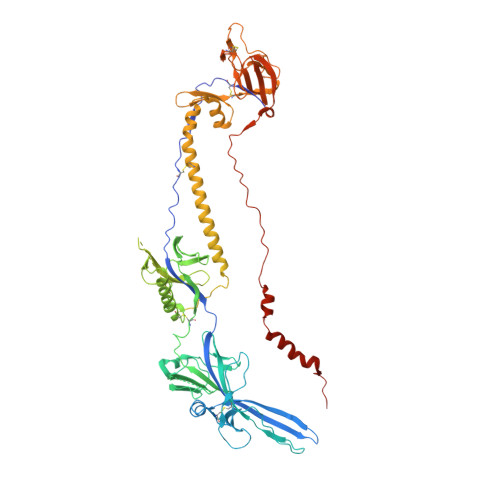
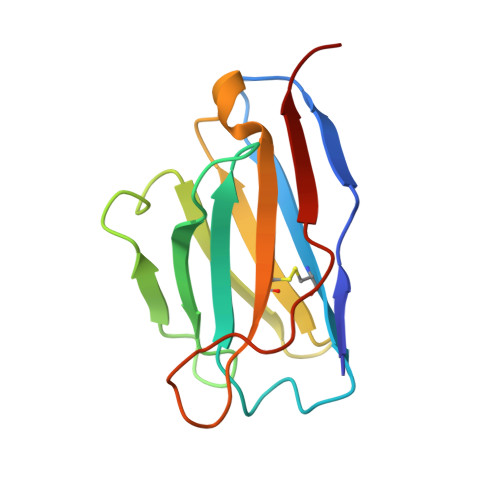
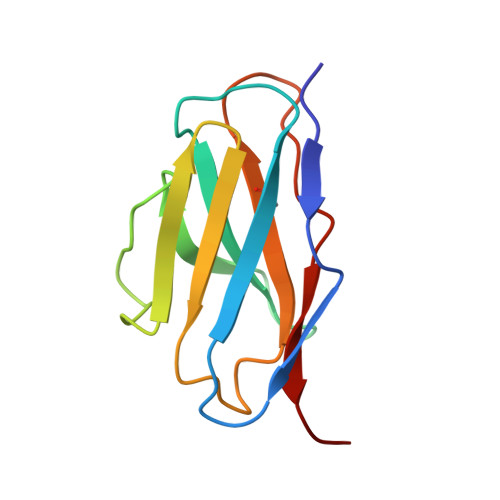
Post-fusion ectodomain of HSV-1 gB in complex with HSV010-13 Fab


Experimental Data Snapshot

  • Method: ELECTRON MICROSCOPY
  • Resolution: 3.40 Å
  • Aggregation State: PARTICLE 
  • Reconstruction Method: SINGLE PARTICLE 

wwPDB Validation 3D Report Full Report

Validation slider image for 7UI0

This is version 1.2 of the entry. See complete history

Literature

A non-neutralizing glycoprotein B monoclonal antibody protects against herpes simplex virus disease in mice.

Kuraoka, M.Aschner, C.B.Windsor, I.W.Mahant, A.M.Garforth, S.J.Kong, S.L.Achkar, J.M.Almo, S.C.Kelsoe, G.Herold, B.C.

(2023) J Clin Invest 133

  • DOI: https://doi.org/10.1172/JCI161968
  • Primary Citation Related Structures: 
    7UHZ, 7UI0

  • PubMed Abstract: 

    There is an unmet need for monoclonal antibodies (mAbs) for prevention or as adjunctive treatment of herpes simplex virus (HSV) disease. Most vaccine and mAb efforts focus on neutralizing antibodies, but for HSV this strategy has proven ineffective. Preclinical studies with a candidate HSV vaccine strain, ΔgD-2, demonstrated that non-neutralizing antibodies that activate Fcγ receptors (FcγRs) to mediate antibody-dependent cellular cytotoxicity (ADCC) provide active and passive protection against HSV-1 and HSV-2. We hypothesized that this vaccine provides a tool to identify and characterize protective mAbs. We isolated HSV-specific mAbs from germinal center and memory B cells and bone marrow plasmacytes of ΔgD-2-vaccinated mice and evaluated these mAbs for binding, neutralizing, and FcγR-activating activity and for protective efficacy in mice. The most potent protective mAb, BMPC-23, was not neutralizing but activated murine FcγRIV, a biomarker of ADCC. The cryo-electron microscopic structure of the Fab-glycoprotein B (gB) assembly identified domain IV of gB as the epitope. A single dose of BMPC-23 administered 24 hours before or after viral challenge provided significant protection when configured as mouse IgG2c and protected mice expressing human FcγRIII when engineered as a human IgG1. These results highlight the importance of FcR-activating antibodies in protecting against HSV.


  • Organizational Affiliation
    • Department of Immunology, Duke University School of Medicine, Durham, North Carolina, USA.

Macromolecule Content 

  • Total Structure Weight: 289.79 kDa 
  • Atom Count: 19,203 
  • Modeled Residue Count: 2,415 
  • Deposited Residue Count: 2,574 
  • Unique protein chains: 3

Macromolecules

Find similar proteins by:|  3D Structure
Entity ID: 1
MoleculeChains  Sequence LengthOrganismDetailsImage
Envelope glycoprotein B
A, B, C
628Human alphaherpesvirus 1 strain KOSMutation(s): 0 
Gene Names: gBUL27
UniProt
Find proteins for P06437 (Human herpesvirus 1 (strain KOS))
Explore P06437 
Go to UniProtKB:  P06437
Entity Groups
Sequence Clusters30% Identity50% Identity70% Identity90% Identity95% Identity100% Identity
UniProt GroupP06437
Sequence Annotations
Expand
Reference Sequence
Find similar proteins by:|  3D Structure
Entity ID: 2
MoleculeChains  Sequence LengthOrganismDetailsImage
HSV10-13 Fab Heavy chainD [auth H],
E [auth I],
F [auth J]
121Mus musculusMutation(s): 0 
Find similar proteins by:|  3D Structure
Entity ID: 3
MoleculeChains  Sequence LengthOrganismDetailsImage
HSV10-13 Light chainG [auth L],
H [auth M],
I [auth N]
109Mus musculusMutation(s): 0 

Experimental Data & Validation

Experimental Data

  • Method: ELECTRON MICROSCOPY
  • Resolution: 3.40 Å
  • Aggregation State: PARTICLE 
  • Reconstruction Method: SINGLE PARTICLE 

Structure Validation

View Full Validation Report


Entry History 

& Funding Information

Deposition Data


Funding OrganizationLocationGrant Number
Howard Hughes Medical Institute (HHMI)United States--

Revision History  (Full details and data files)

  • Version 1.0: 2023-02-08
    Type: Initial release
  • Version 1.1: 2023-02-15
    Changes: Database references
  • Version 1.2: 2024-10-30
    Changes: Data collection, Structure summary