7U23 | pdb_00007u23

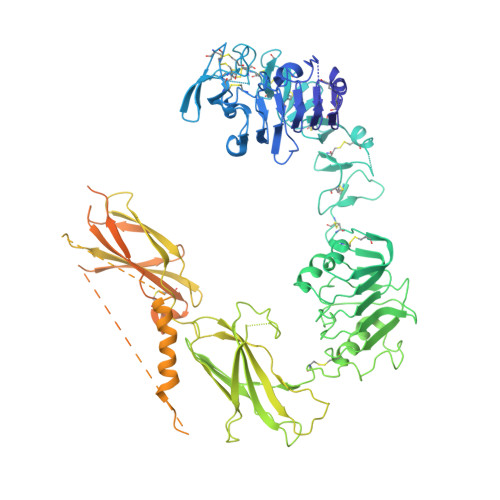
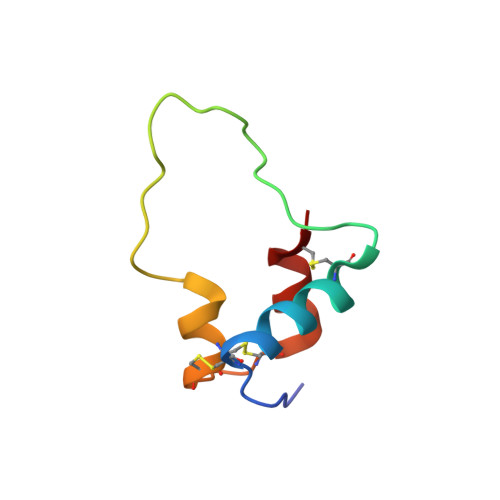
Single-chain LCDV-1 viral insulin-like peptide bound to IGF-1R ectodomain, leucine-zippered form


Experimental Data Snapshot

  • Method: ELECTRON MICROSCOPY
  • Resolution: 4.60 Å
  • Aggregation State: PARTICLE 
  • Reconstruction Method: SINGLE PARTICLE 

wwPDB Validation 3D Report Full Report

Validation slider image for 7U23

This is version 1.2 of the entry. See complete history. 

Literature

Interaction of a viral insulin-like peptide with the IGF-1 receptor produces a natural antagonist.

Moreau, F., Kirk, N.S., Zhang, F., Gelfanov, V., List, E.O., Chrudinova, M., Venugopal, H., Lawrence, M.C., Jimenez, V., Bosch, F., Kopchick, J.J., DiMarchi, R.D., Altindis, E., Ronald Kahn, C.

(2022) Nat Commun 13: 6700-6700

  • DOI: https://doi.org/10.1038/s41467-022-34391-6
  • Primary Citation Related Structures: 
    7U23

  • PubMed Abstract: 

    Lymphocystis disease virus-1 (LCDV-1) and several other Iridoviridae encode viral insulin/IGF-1 like peptides (VILPs) with high homology to human insulin and IGFs. Here we show that while single-chain (sc) and double-chain (dc) LCDV1-VILPs have very low affinity for the insulin receptor, scLCDV1-VILP has high affinity for IGF1R where it can antagonize human IGF-1 signaling, without altering insulin signaling. Consequently, scLCDV1-VILP inhibits IGF-1 induced cell proliferation and growth hormone/IGF-1 induced growth of mice in vivo. Cryo-electron microscopy reveals that scLCDV1-VILP engages IGF1R in a unique manner, inducing changes in IGF1R conformation that led to separation, rather than juxtaposition, of the transmembrane segments and hence inactivation of the receptor. Thus, scLCDV1-VILP is a natural peptide with specific antagonist properties on IGF1R signaling and may provide a new tool to guide development of hormonal analogues to treat cancers or metabolic disorders sensitive to IGF-1 without affecting glucose metabolism.


  • Organizational Affiliation: 
    • Section of Integrative Physiology and Metabolism, Joslin Diabetes Center, Harvard Medical School, Boston, MA, USA.

Macromolecule Content 

  • Total Structure Weight: 231.33 kDa 
  • Atom Count: 11,688 
  • Modeled Residue Count: 1,462 
  • Deposited Residue Count: 2,028 
  • Unique protein chains: 2

Macromolecules

Find similar proteins by:|  3D Structure
Entity ID: 1
MoleculeChains  Sequence LengthOrganismDetailsImage
Insulin-like growth factor 1 receptorA [auth E],
B [auth F]
952Homo sapiensMutation(s): 0 
Gene Names: IGF1R
EC: 2.7.10.1
UniProt & NIH Common Fund Data Resources
Find proteins for P08069 (Homo sapiens)
Explore P08069 
Go to UniProtKB:  P08069
PHAROS:  P08069
GTEx:  ENSG00000140443 
Entity Groups
Sequence Clusters30% Identity50% Identity70% Identity90% Identity95% Identity100% Identity
UniProt GroupP08069
Sequence Annotations
Expand
Reference Sequence
Find similar proteins by:|  3D Structure
Entity ID: 2
MoleculeChains  Sequence LengthOrganismDetailsImage
single-chain LCDV-1 viral insulin-like peptide
C, D
62Lymphocystis disease virus 1Mutation(s): 0 
UniProt
Find proteins for A0A9X9ZA31 (Fish lymphocystis disease virus)
Explore A0A9X9ZA31 
Go to UniProtKB:  A0A9X9ZA31
Entity Groups
Sequence Clusters30% Identity50% Identity70% Identity90% Identity95% Identity100% Identity
UniProt GroupA0A9X9ZA31
Sequence Annotations
Expand
Reference Sequence

Experimental Data & Validation

Experimental Data

  • Method: ELECTRON MICROSCOPY
  • Resolution: 4.60 Å
  • Aggregation State: PARTICLE 
  • Reconstruction Method: SINGLE PARTICLE 
EM Software:
TaskSoftware PackageVersion
RECONSTRUCTIONcryoSPARC
MODEL REFINEMENTPHENIX

Structure Validation

View Full Validation Report


Entry History 

& Funding Information

Deposition Data


Funding OrganizationLocationGrant Number
National Institutes of Health/National Institute of Diabetes and Digestive and Kidney Disease (NIH/NIDDK)United StatesR01DK031036
National Institutes of Health/National Institute of Diabetes and Digestive and Kidney Disease (NIH/NIDDK)United StatesK01DK11796

Revision History  (Full details and data files)

  • Version 1.0: 2022-11-16
    Type: Initial release
  • Version 1.1: 2024-10-23
    Changes: Data collection, Structure summary
  • Version 1.2: 2025-06-04
    Changes: Data collection