7TTX | pdb_00007ttx

Crystal structure of potent neutralizing antibody 10-40 in complex with Sarbecovirus bat RaTG13 receptor-binding domain


Experimental Data Snapshot

  • Method: X-RAY DIFFRACTION
  • Resolution: 2.80 Å
  • R-Value Free: 
    0.321 (Depositor), 0.317 (DCC) 
  • R-Value Work: 
    0.222 (Depositor), 0.224 (DCC) 
  • R-Value Observed: 
    0.227 (Depositor) 

Starting Model: experimental
View more details

wwPDB Validation 3D Report Full Report

Validation slider image for 7TTX

Ligand Structure Quality Assessment 


This is version 1.5 of the entry. See complete history

Literature

An antibody class with a common CDRH3 motif broadly neutralizes sarbecoviruses.

Liu, L.Iketani, S.Guo, Y.Reddem, E.R.Casner, R.G.Nair, M.S.Yu, J.Chan, J.F.Wang, M.Cerutti, G.Li, Z.Morano, N.C.Castagna, C.D.Corredor, L.Chu, H.Yuan, S.Poon, V.K.Chan, C.C.Chen, Z.Luo, Y.Cunningham, M.Chavez, A.Yin, M.T.Perlin, D.S.Tsuji, M.Yuen, K.Y.Kwong, P.D.Sheng, Z.Huang, Y.Shapiro, L.Ho, D.D.

(2022) Sci Transl Med 14: eabn6859-eabn6859

  • DOI: https://doi.org/10.1126/scitranslmed.abn6859
  • Primary Citation Related Structures: 
    7SD5, 7SI2, 7TTM, 7TTX, 7TTY

  • PubMed Abstract: 

    The devastation caused by severe acute respiratory syndrome coronavirus 2 (SARS-CoV-2) has made clear the importance of pandemic preparedness. To address future zoonotic outbreaks due to related viruses in the sarbecovirus subgenus, we identified a human monoclonal antibody, 10-40, that neutralized or bound all sarbecoviruses tested in vitro and protected against SARS-CoV-2 and SARS-CoV in vivo. Comparative studies with other receptor-binding domain (RBD)-directed antibodies showed 10-40 to have the greatest breadth against sarbecoviruses, suggesting that 10-40 is a promising agent for pandemic preparedness. Moreover, structural analyses on 10-40 and similar antibodies not only defined an epitope cluster in the inner face of the RBD that is well conserved among sarbecoviruses but also uncovered a distinct antibody class with a common CDRH3 motif. Our analyses also suggested that elicitation of this class of antibodies may not be overly difficult, an observation that bodes well for the development of a pan-sarbecovirus vaccine.


  • Organizational Affiliation
    • Aaron Diamond AIDS Research Center, Columbia University Vagelos College of Physicians and Surgeons, New York, NY 10032, USA.

Macromolecule Content 

  • Total Structure Weight: 75.03 kDa 
  • Atom Count: 4,910 
  • Modeled Residue Count: 635 
  • Deposited Residue Count: 684 
  • Unique protein chains: 3

Macromolecules

Find similar proteins by:|  3D Structure
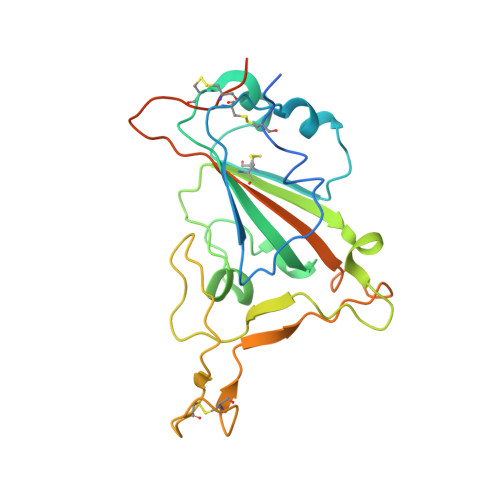
Entity ID: 1
MoleculeChains  Sequence LengthOrganismDetailsImage
Spike glycoprotein231Bat coronavirus RaTG13Mutation(s): 0 
Find similar proteins by:|  3D Structure
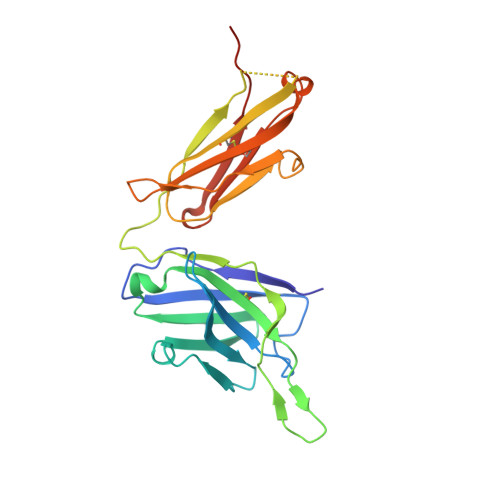
Entity ID: 2
MoleculeChains  Sequence LengthOrganismDetailsImage
1040 heavy chainB [auth H]237Homo sapiensMutation(s): 0 
Find similar proteins by:|  3D Structure
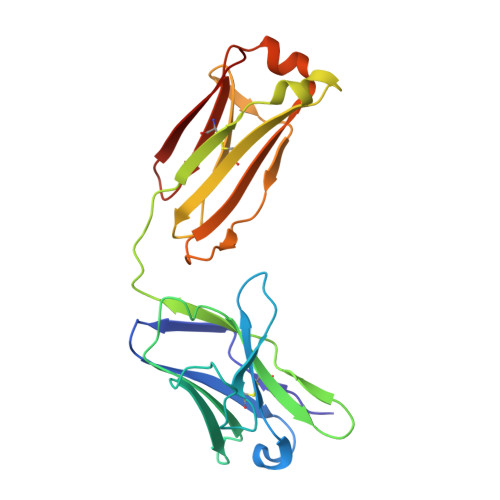
Entity ID: 3
MoleculeChains  Sequence LengthOrganismDetailsImage
1040 light chainC [auth L]216Homo sapiensMutation(s): 0 

Small Molecules

Ligands 1 Unique
IDChains Name / Formula / InChI Key2D Diagram3D Interactions
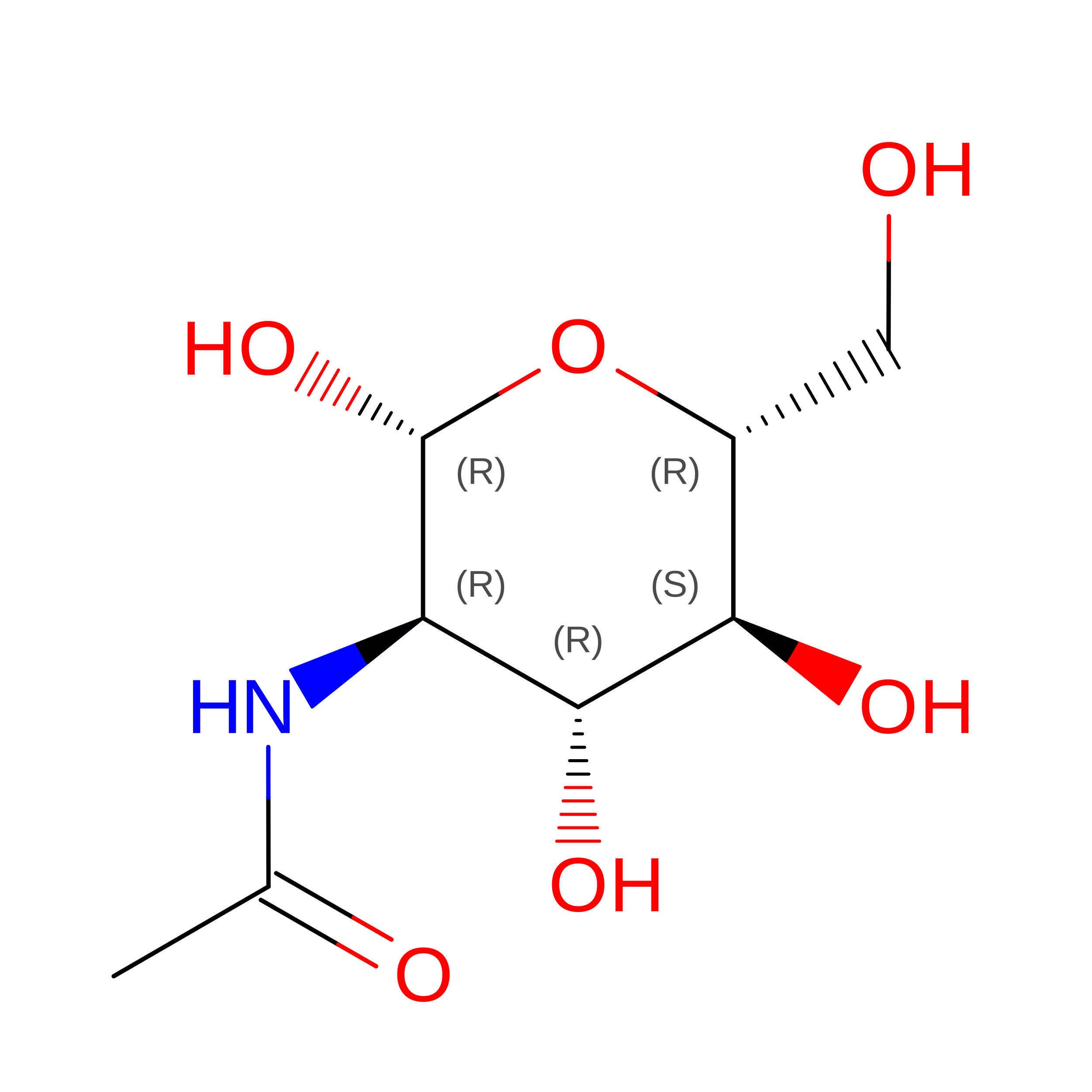
NAG

Query on NAG


Download:Ideal Coordinates CCD File
D [auth A]2-acetamido-2-deoxy-beta-D-glucopyranose
C8 H15 N O6
OVRNDRQMDRJTHS-FMDGEEDCSA-N

Experimental Data & Validation

Experimental Data

  • Method: X-RAY DIFFRACTION
  • Resolution: 2.80 Å
  • R-Value Free:  0.321 (Depositor), 0.317 (DCC) 
  • R-Value Work:  0.222 (Depositor), 0.224 (DCC) 
  • R-Value Observed: 0.227 (Depositor) 
Space Group: P 21 21 21
Unit Cell:
Length ( Å )Angle ( ˚ )
a = 74.174α = 90
b = 76.816β = 90
c = 117.626γ = 90
Software Package:
Software NamePurpose
XDSdata reduction
Aimlessdata scaling
PHENIXrefinement
PDB_EXTRACTdata extraction
PHASERphasing

Structure Validation

View Full Validation Report


Ligand Structure Quality Assessment 


Entry History 

& Funding Information

Deposition Data


Funding OrganizationLocationGrant Number
Jack Ma FoundationChina--

Revision History  (Full details and data files)

  • Version 1.0: 2022-04-27
    Type: Initial release
  • Version 1.1: 2022-05-04
    Changes: Database references
  • Version 1.2: 2022-06-08
    Changes: Database references
  • Version 1.3: 2022-08-10
    Changes: Structure summary
  • Version 1.4: 2023-10-18
    Changes: Data collection, Refinement description
  • Version 1.5: 2024-11-13
    Changes: Structure summary