7TGQ | pdb_00007tgq

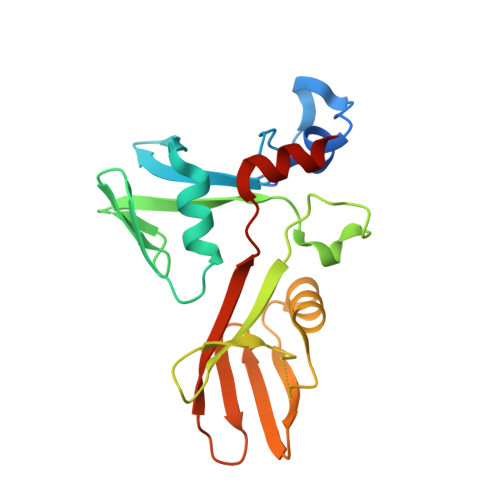
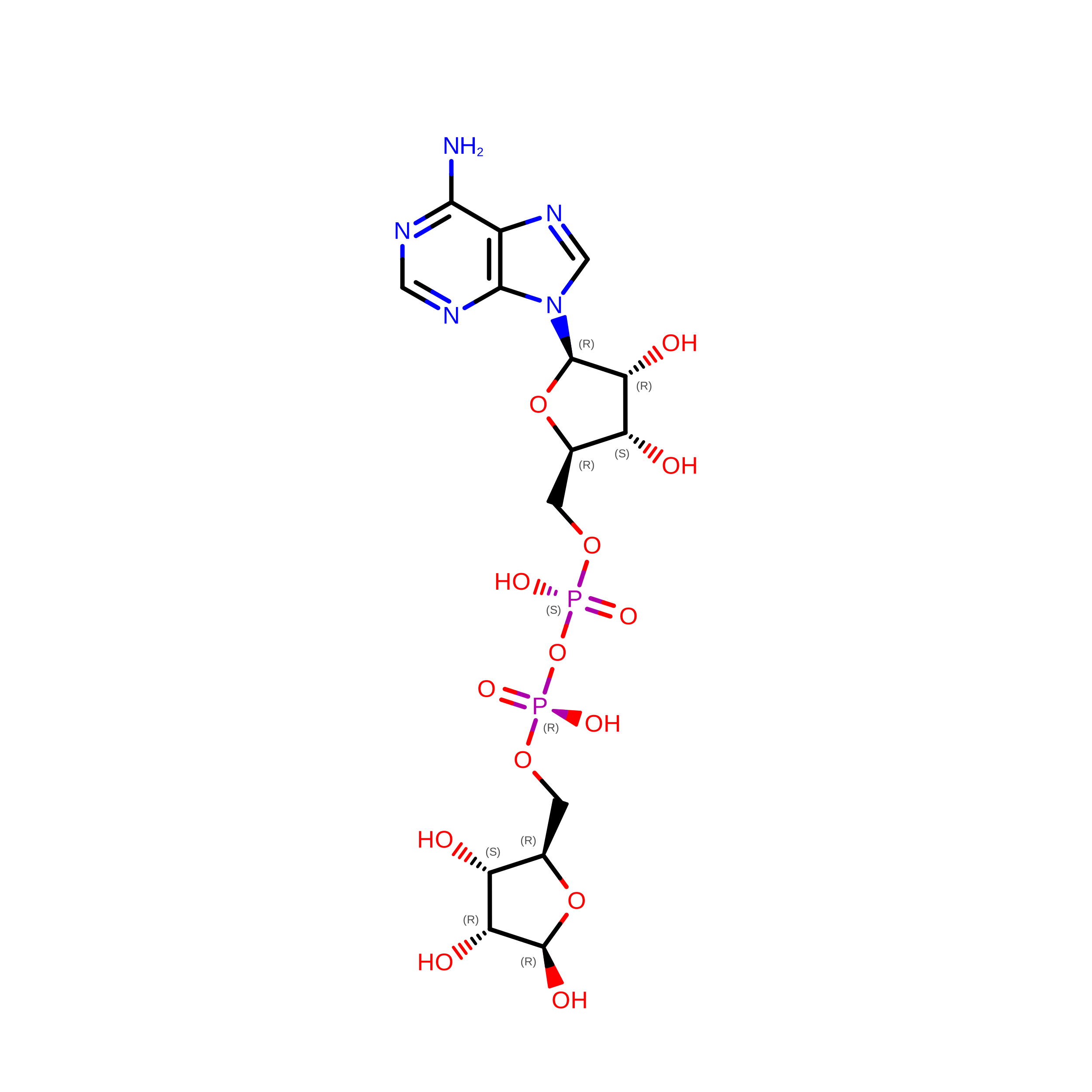
Zinc finger antiviral protein (ZAP) central domain bound to ADP-ribose

  • Classification: ANTIVIRAL PROTEIN
  • Organism(s): Homo sapiens
  • Expression System: Escherichia coli
  • Mutation(s): No 

  • Deposited: 2022-01-09 Released: 2022-02-02 
  • Deposition Author(s): Pornillos, O.P.
  • Funding Organization(s): National Institutes of Health/National Institute Of Allergy and Infectious Diseases (NIH/NIAID)

Experimental Data Snapshot

  • Method: X-RAY DIFFRACTION
  • Resolution: 2.00 Å
  • R-Value Free: 
    0.273 (Depositor), 0.285 (DCC) 
  • R-Value Work: 
    0.238 (Depositor) 
  • R-Value Observed: 
    0.240 (Depositor) 

Starting Model: experimental
View more details

wwPDB Validation 3D Report Full Report

Validation slider image for 7TGQ

Ligand Structure Quality Assessment 


This is version 1.2 of the entry. See complete history

Literature

Poly(ADP-ribose) potentiates ZAP antiviral activity.

Xue, G.Braczyk, K.Goncalves-Carneiro, D.Dawidziak, D.M.Sanchez, K.Ong, H.Wan, Y.Zadrozny, K.K.Ganser-Pornillos, B.K.Bieniasz, P.D.Pornillos, O.

(2022) PLoS Pathog 18: e1009202-e1009202

  • DOI: https://doi.org/10.1371/journal.ppat.1009202
  • Primary Citation Related Structures: 
    7KZH, 7TGQ

  • PubMed Abstract: 

    Zinc-finger antiviral protein (ZAP), also known as poly(ADP-ribose) polymerase 13 (PARP13), is an antiviral factor that selectively targets viral RNA for degradation. ZAP is active against both DNA and RNA viruses, including important human pathogens such as hepatitis B virus and type 1 human immunodeficiency virus (HIV-1). ZAP selectively binds CpG dinucleotides through its N-terminal RNA-binding domain, which consists of four zinc fingers. ZAP also contains a central region that consists of a fifth zinc finger and two WWE domains. Through structural and biochemical studies, we found that the fifth zinc finger and tandem WWEs of ZAP combine into a single integrated domain that binds to poly(ADP-ribose) (PAR), a cellular polynucleotide. PAR binding is mediated by the second WWE module of ZAP and likely involves specific recognition of an adenosine diphosphate-containing unit of PAR. Mutation of the PAR binding site in ZAP abrogates the interaction in vitro and diminishes ZAP activity against a CpG-rich HIV-1 reporter virus and murine leukemia virus. In cells, PAR facilitates formation of non-membranous sub-cellular compartments such as DNA repair foci, spindle poles and cytosolic RNA stress granules. Our results suggest that ZAP-mediated viral mRNA degradation is facilitated by PAR, and provides a biophysical rationale for the reported association of ZAP with RNA stress granules.


  • Organizational Affiliation
    • Department of Molecular Physiology and Biological Physics, University of Virginia, Charlottesville, Virginia, United States of America.

Macromolecule Content 

  • Total Structure Weight: 24.13 kDa 
  • Atom Count: 1,566 
  • Modeled Residue Count: 182 
  • Deposited Residue Count: 202 
  • Unique protein chains: 1

Macromolecules

Find similar proteins by:|  3D Structure
Entity ID: 1
MoleculeChains  Sequence LengthOrganismDetailsImage
Zinc finger CCCH-type antiviral protein 1202Homo sapiensMutation(s): 0 
Gene Names: ZC3HAV1ZC3HDC2PRO1677
UniProt & NIH Common Fund Data Resources
Find proteins for Q7Z2W4 (Homo sapiens)
Explore Q7Z2W4 
Go to UniProtKB:  Q7Z2W4
PHAROS:  Q7Z2W4
GTEx:  ENSG00000105939 
Entity Groups
Sequence Clusters30% Identity50% Identity70% Identity90% Identity95% Identity100% Identity
UniProt GroupQ7Z2W4
Sequence Annotations
Expand
Reference Sequence

Experimental Data & Validation

Experimental Data

  • Method: X-RAY DIFFRACTION
  • Resolution: 2.00 Å
  • R-Value Free:  0.273 (Depositor), 0.285 (DCC) 
  • R-Value Work:  0.238 (Depositor) 
  • R-Value Observed: 0.240 (Depositor) 
Space Group: P 3 2 1
Unit Cell:
Length ( Å )Angle ( ˚ )
a = 89.958α = 90
b = 89.958β = 90
c = 52.807γ = 120
Software Package:
Software NamePurpose
PHENIXrefinement
HKL-2000data reduction
MOLREPphasing
HKL-2000data scaling

Structure Validation

View Full Validation Report


Ligand Structure Quality Assessment 


Entry History 

& Funding Information

Deposition Data


Funding OrganizationLocationGrant Number
National Institutes of Health/National Institute Of Allergy and Infectious Diseases (NIH/NIAID)United StatesR01-AI150479
National Institutes of Health/National Institute Of Allergy and Infectious Diseases (NIH/NIAID)United StatesU54-AI150470

Revision History  (Full details and data files)

  • Version 1.0: 2022-02-02
    Type: Initial release
  • Version 1.1: 2023-01-11
    Changes: Database references
  • Version 1.2: 2023-10-25
    Changes: Data collection, Refinement description