7TEP | pdb_00007tep

Crystal structure of a Cu-bound cytochrome cb562 variant in the presence of reductant

  • Classification: METAL BINDING PROTEIN
  • Organism(s): Escherichia coli
  • Expression System: Escherichia coli
  • Mutation(s): Yes 

  • Deposited: 2022-01-05 Released: 2022-06-29 
  • Deposition Author(s): Kakkis, A., Golub, E.
  • Funding Organization(s): National Institutes of Health/National Institute of General Medical Sciences (NIH/NIGMS), National Science Foundation (NSF, United States), European Molecular Biology Organization (EMBO)

Experimental Data Snapshot

  • Method: X-RAY DIFFRACTION
  • Resolution: 2.70 Å
  • R-Value Free: 
    0.339 (Depositor), 0.337 (DCC) 
  • R-Value Work: 
    0.253 (Depositor), 0.252 (DCC) 
  • R-Value Observed: 
    0.262 (Depositor) 

Starting Model: experimental
View more details

wwPDB Validation 3D Report Full Report

Validation slider image for 7TEP

This is version 1.3 of the entry. See complete history

Literature

Redox- and metal-directed structural diversification in designed metalloprotein assemblies.

Kakkis, A.Golub, E.Choi, T.S.Tezcan, F.A.

(2022) Chem Commun (Camb) 58: 6958-6961

  • DOI: https://doi.org/10.1039/d2cc02440c
  • Primary Citation Related Structures: 
    7RWU, 7RWV, 7RWW, 7RWX, 7RWY, 7SU2, 7TEP

  • PubMed Abstract: 

    Herein we describe a designed protein building block whose self-assembly behaviour is dually gated by the redox state of disulphide bonds and the identity of exogenous metal ions. This protein construct is shown - through extensive structural and biophysical characterization - to access five distinct oligomeric states, exemplifying how the complex interplay between hydrophobic, metal-ligand, and reversible covalent interactions could be harnessed to obtain multiple, responsive protein architectures from a single building block.


  • Organizational Affiliation
    • Department of Chemistry and Biochemistry, University of California, San Diego, 9500 Gilman Drive, La Jolla, CA, 92093, USA. tezcan@ucsd.edu.

Macromolecule Content 

  • Total Structure Weight: 49.36 kDa 
  • Atom Count: 3,591 
  • Modeled Residue Count: 424 
  • Deposited Residue Count: 424 
  • Unique protein chains: 1

Macromolecules

Find similar proteins by:|  3D Structure
Entity ID: 1
MoleculeChains  Sequence LengthOrganismDetailsImage
Soluble cytochrome b562
A, B, C, D
106Escherichia coliMutation(s): 13 
Gene Names: cybC
UniProt
Find proteins for P0ABE7 (Escherichia coli)
Explore P0ABE7 
Go to UniProtKB:  P0ABE7
Entity Groups
Sequence Clusters30% Identity50% Identity70% Identity90% Identity95% Identity100% Identity
UniProt GroupP0ABE7
Sequence Annotations
Expand
Reference Sequence

Small Molecules

Ligands 2 Unique
IDChains Name / Formula / InChI Key2D Diagram3D Interactions
HEC

Query on HEC


Download:Ideal Coordinates CCD File
E [auth A],
H [auth B],
J [auth C],
L [auth D]
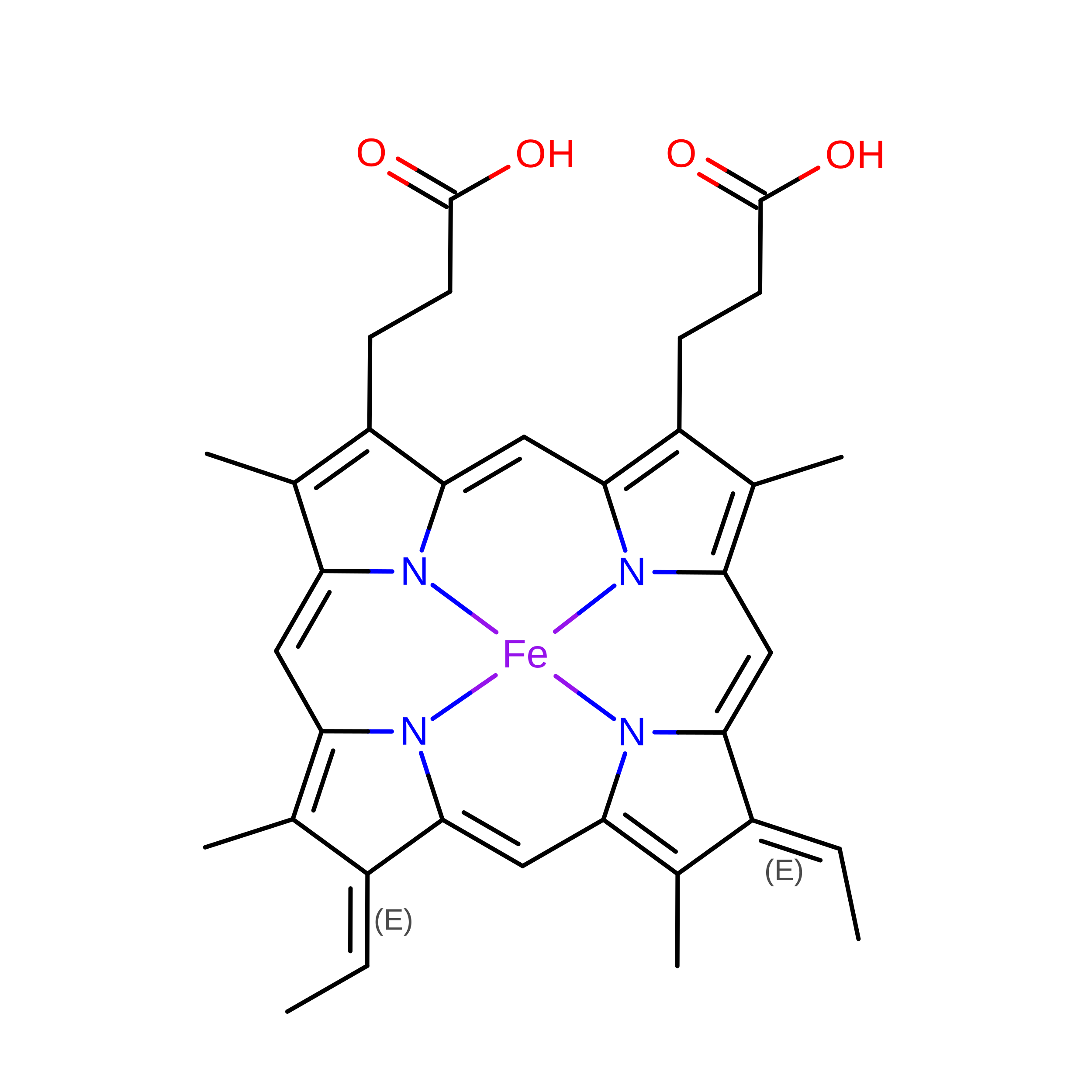
HEME C
C34 H34 Fe N4 O4
HXQIYSLZKNYNMH-LJNAALQVSA-N
CU
(Subject of Investigation/LOI)

Query on CU


Download:Ideal Coordinates CCD File
F [auth A],
G [auth A],
I [auth B],
K [auth C]
COPPER (II) ION
Cu
JPVYNHNXODAKFH-UHFFFAOYSA-N

Experimental Data & Validation

Experimental Data

  • Method: X-RAY DIFFRACTION
  • Resolution: 2.70 Å
  • R-Value Free:  0.339 (Depositor), 0.337 (DCC) 
  • R-Value Work:  0.253 (Depositor), 0.252 (DCC) 
  • R-Value Observed: 0.262 (Depositor) 
Space Group: P 1 21 1
Unit Cell:
Length ( Å )Angle ( ˚ )
a = 47.08α = 90
b = 80.57β = 102.325
c = 49.44γ = 90
Software Package:
Software NamePurpose
PHENIXrefinement
XDSdata reduction
SCALAdata scaling
PHASERphasing

Structure Validation

View Full Validation Report


Entry History 

& Funding Information

Deposition Data


Funding OrganizationLocationGrant Number
National Institutes of Health/National Institute of General Medical Sciences (NIH/NIGMS)European UnionT32GM112584
National Science Foundation (NSF, United States)European UnionCHE1607145
European Molecular Biology Organization (EMBO)European UnionALTF 1336-2015

Revision History  (Full details and data files)

  • Version 1.0: 2022-06-29
    Type: Initial release
  • Version 1.1: 2023-01-11
    Changes: Database references
  • Version 1.2: 2023-10-25
    Changes: Data collection, Refinement description
  • Version 1.3: 2024-12-25
    Changes: Advisory, Derived calculations, Structure summary