7TE8 | pdb_00007te8

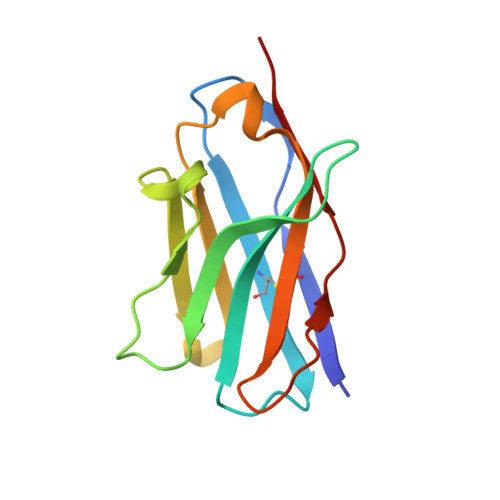
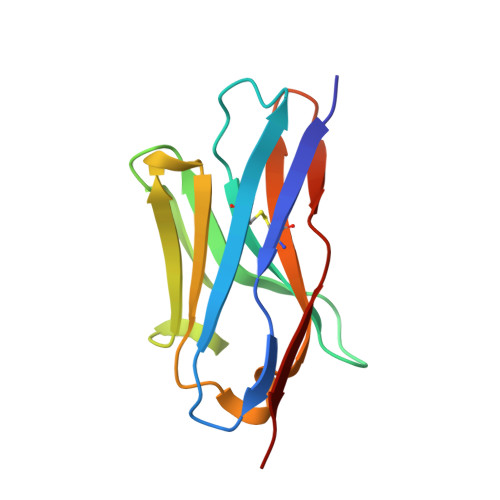
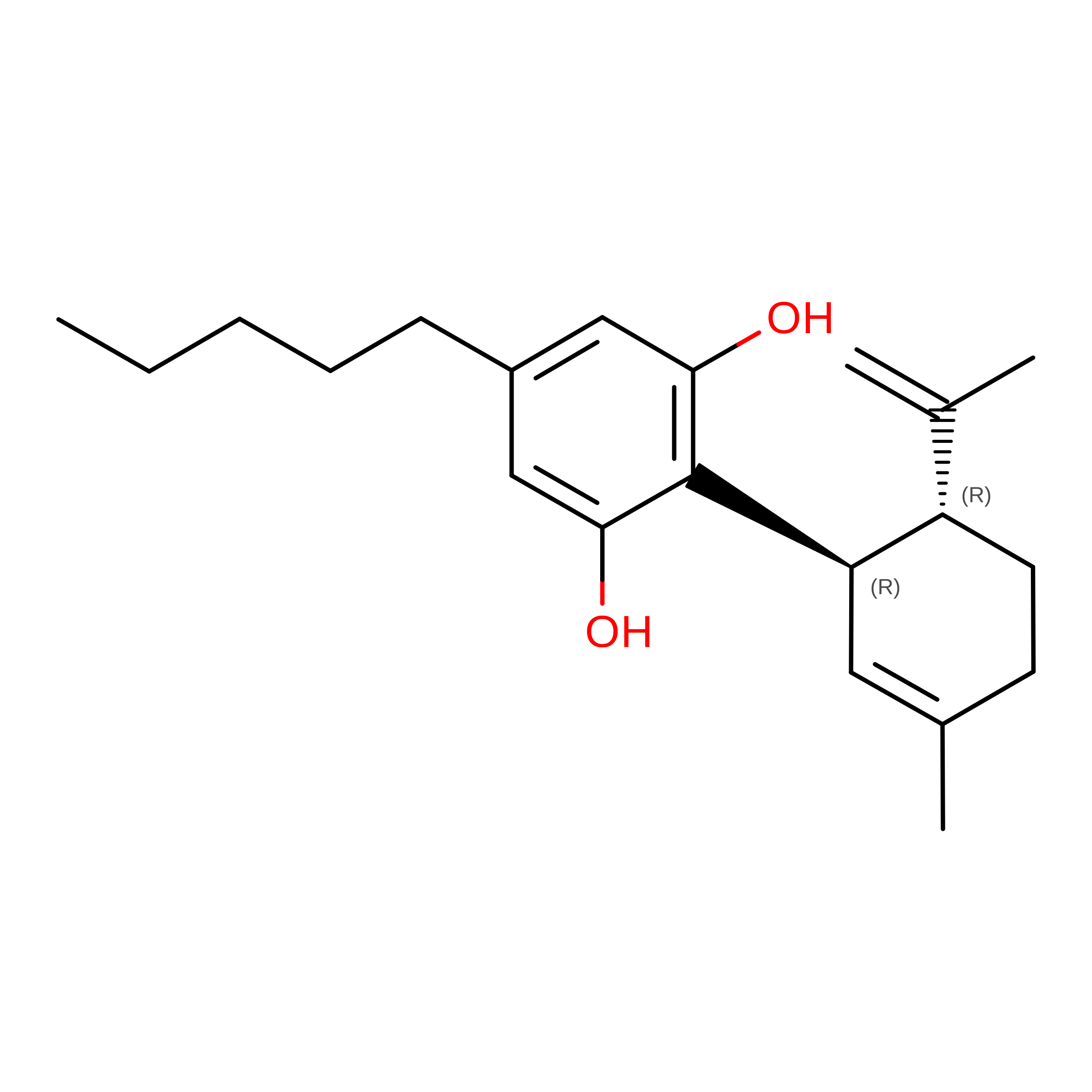
CA14-CBD-DB21 ternary complex

  • Classification: BIOSYNTHETIC PROTEIN
  • Organism(s): synthetic construct
  • Expression System: Escherichia coli
  • Mutation(s): No 

  • Deposited: 2022-01-04 Released: 2022-01-12 
  • Deposition Author(s): Cao, S., Zheng, N.
  • Funding Organization(s): Howard Hughes Medical Institute (HHMI), National Institutes of Health/National Institute of General Medical Sciences (NIH/NIGMS), National Institutes of Health/National Institute on Drug Abuse (NIH/NIDA)

Experimental Data Snapshot

  • Method: X-RAY DIFFRACTION
  • Resolution: 2.00 Å
  • R-Value Free: 
    0.211 (Depositor) 
  • R-Value Work: 
    0.180 (Depositor) 
  • R-Value Observed: 
    0.182 (Depositor) 

Starting Model: in silico
View more details

wwPDB Validation 3D Report Full Report

Validation slider image for 7TE8

Ligand Structure Quality Assessment 


This is version 1.4 of the entry. See complete history

Literature

Defining molecular glues with a dual-nanobody cannabidiol sensor.

Cao, S.Kang, S.Mao, H.Yao, J.Gu, L.Zheng, N.

(2022) Nat Commun 13: 815-815

  • DOI: https://doi.org/10.1038/s41467-022-28507-1
  • Primary Citation Related Structures: 
    7TE8

  • PubMed Abstract: 

    "Molecular glue" (MG) is a term coined to describe the mechanism of action of the plant hormone auxin and subsequently used to characterize synthetic small molecule protein degraders exemplified by immune-modulatory imide drugs (IMiDs). Prospective development of MGs, however, has been hampered by its elusive definition and thermodynamic characteristics. Here, we report the crystal structure of a dual-nanobody cannabidiol-sensing system, in which the ligand promotes protein-protein interaction in a manner analogous to auxin. Through quantitative analyses, we draw close parallels among the dual-nanobody cannabidiol sensor, the auxin perception complex, and the IMiDs-bound CRL4 CRBN E3, which can bind and ubiquitinate "neo-substrates". All three systems, including the recruitment of IKZF1 and CK1α to CRBN, are characterized by the lack of ligand binding activity in at least one protein partner and an under-appreciated preexisting low micromolar affinity between the two proteinaceous subunits that is enhanced by the ligand to reach the nanomolar range. These two unifying features define MGs as a special class of proximity inducers distinct from bifunctional compounds and can be used as criteria to guide target selection for future rational discovery of MGs.


  • Organizational Affiliation
    • Howard Hughes Medical Institute, Department of Pharmacology, University of Washington, Seattle, WA, 98195, USA.

Macromolecule Content 

  • Total Structure Weight: 53.55 kDa 
  • Atom Count: 4,082 
  • Modeled Residue Count: 478 
  • Deposited Residue Count: 480 
  • Unique protein chains: 2

Macromolecules

Find similar proteins by:|  3D Structure
Entity ID: 1
MoleculeChains  Sequence LengthOrganismDetailsImage
CA14A [auth C],
C [auth D]
120synthetic constructMutation(s): 0 
Find similar proteins by:|  3D Structure
Entity ID: 2
MoleculeChains  Sequence LengthOrganismDetailsImage
DB21B [auth A],
D [auth B]
120synthetic constructMutation(s): 0 

Experimental Data & Validation

Experimental Data

  • Method: X-RAY DIFFRACTION
  • Resolution: 2.00 Å
  • R-Value Free:  0.211 (Depositor) 
  • R-Value Work:  0.180 (Depositor) 
  • R-Value Observed: 0.182 (Depositor) 
Space Group: P 2 21 21
Unit Cell:
Length ( Å )Angle ( ˚ )
a = 62.672α = 90
b = 69.153β = 90
c = 109.11γ = 90
Software Package:
Software NamePurpose
PHENIXrefinement
HKL-2000data reduction
HKL-2000data scaling
PHASERphasing

Structure Validation

View Full Validation Report


Ligand Structure Quality Assessment 


Entry History 

& Funding Information

Deposition Data


Funding OrganizationLocationGrant Number
Howard Hughes Medical Institute (HHMI)United States--
National Institutes of Health/National Institute of General Medical Sciences (NIH/NIGMS)United States1R35GM128918
National Institutes of Health/National Institute on Drug Abuse (NIH/NIDA)United StatesR21DA051555
National Institutes of Health/National Institute on Drug Abuse (NIH/NIDA)United StatesR21DA051194

Revision History  (Full details and data files)

  • Version 1.0: 2022-01-12
    Type: Initial release
  • Version 1.1: 2022-02-23
    Changes: Database references
  • Version 1.2: 2022-07-06
    Changes: Source and taxonomy
  • Version 1.3: 2024-04-03
    Changes: Data collection, Refinement description
  • Version 1.4: 2024-11-13
    Changes: Structure summary