Download Mendeley
Computational identification of a systemic antibiotic for gram-negative bacteria.
Miller, R.D., Iinishi, A., Modaresi, S.M., Yoo, B.K., Curtis, T.D., Lariviere, P.J., Liang, L., Son, S., Nicolau, S., Bargabos, R., Morrissette, M., Gates, M.F., Pitt, N., Jakob, R.P., Rath, P., Maier, T., Malyutin, A.G., Kaiser, J.T., Niles, S., Karavas, B., Ghiglieri, M., Bowman, S.E.J., Rees, D.C., Hiller, S., Lewis, K.(2022) Nat Microbiol 7: 1661-1672
- PubMed: 36163500 Search on PubMedSearch on PubMed Central
- DOI: https://doi.org/10.1038/s41564-022-01227-4
- Primary Citation Related Structures:
7R1V, 7R1W, 7T3H - PubMed Abstract:
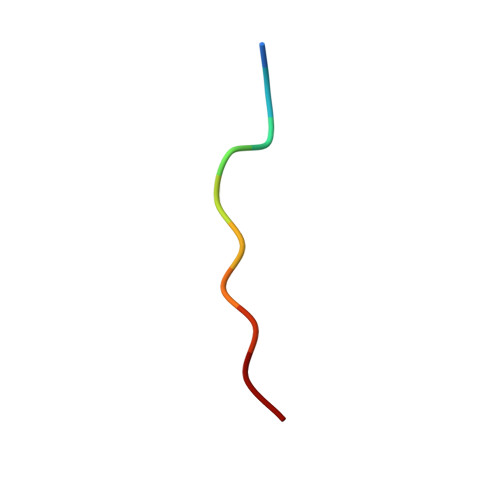
Discovery of antibiotics acting against Gram-negative species is uniquely challenging due to their restrictive penetration barrier. BamA, which inserts proteins into the outer membrane, is an attractive target due to its surface location. Darobactins produced by Photorhabdus, a nematode gut microbiome symbiont, target BamA. We reasoned that a computational search for genes only distantly related to the darobactin operon may lead to novel compounds. Following this clue, we identified dynobactin A, a novel peptide antibiotic from Photorhabdus australis containing two unlinked rings. Dynobactin is structurally unrelated to darobactins, but also targets BamA. Based on a BamA-dynobactin co-crystal structure and a BAM-complex-dynobactin cryo-EM structure, we show that dynobactin binds to the BamA lateral gate, uniquely protruding into its β-barrel lumen. Dynobactin showed efficacy in a mouse systemic Escherichia coli infection. This study demonstrates the utility of computational approaches to antibiotic discovery and suggests that dynobactin is a promising lead for drug development.
- Antimicrobial Discovery Center, Department of Biology, Northeastern University, Boston, MA, USA.
Organizational Affiliation: