7SBH | pdb_00007sbh

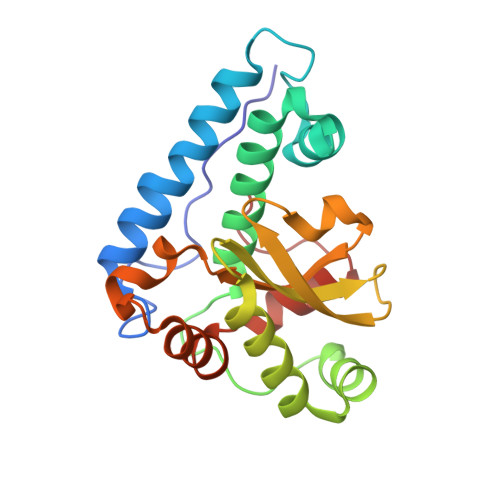
Crystal structure of the iron superoxide dismutase from Acinetobacter sp. Ver3


Experimental Data Snapshot

  • Method: X-RAY DIFFRACTION
  • Resolution: 1.34 Å
  • R-Value Free: 
    0.162 (Depositor), 0.163 (DCC) 
  • R-Value Work: 
    0.144 (Depositor), 0.144 (DCC) 
  • R-Value Observed: 
    0.145 (Depositor) 

Starting Model: experimental
View more details

wwPDB Validation 3D Report Full Report

Validation slider image for 7SBH

Ligand Structure Quality Assessment 


This is version 1.2 of the entry. See complete history

Literature

The distinctive roles played by the superoxide dismutases of the extremophile Acinetobacter sp. Ver3.

Steimbruch, B.A.Sartorio, M.G.Cortez, N.Albanesi, D.Lisa, M.N.Repizo, G.D.

(2022) Sci Rep 12: 4321-4321

  • DOI: https://doi.org/10.1038/s41598-022-08052-z
  • Primary Citation Related Structures: 
    7SBH

  • PubMed Abstract: 

    Acinetobacter sp. Ver3 is a polyextremophilic strain characterized by a high tolerance to radiation and pro-oxidants. The Ver3 genome comprises the sodB and sodC genes encoding an iron ( AV3 SodB) and a copper/zinc superoxide dismutase ( AV3 SodC), respectively; however, the specific role(s) of these genes has remained elusive. We show that the expression of sodB remained unaltered in different oxidative stress conditions whereas sodC was up-regulated in the presence of blue light. Besides, we studied the changes in the in vitro activity of each SOD enzyme in response to diverse agents and solved the crystal structure of AV3 SodB at 1.34 Å, one of the highest resolutions achieved for a SOD. Cell fractionation studies interestingly revealed that AV3 SodB is located in the cytosol whereas AV3 SodC is also found in the periplasm. Consistently, a bioinformatic analysis of the genomes of 53 Acinetobacter species pointed out the presence of at least one SOD type in each compartment, suggesting that these enzymes are separately required to cope with oxidative stress. Surprisingly, AV3 SodC was found in an active state also in outer membrane vesicles, probably exerting a protective role. Overall, our multidisciplinary approach highlights the relevance of SOD enzymes when Acinetobacter spp. are confronted with oxidizing agents.


  • Organizational Affiliation
    • Instituto de Biología Molecular y Celular de Rosario (IBR, CONICET), Departamento de Microbiología, Facultad de Ciencias Bioquímicas y Farmacéuticas, Universidad Nacional de Rosario, Suipacha 531, S2002LRK, Rosario, Argentina.

Macromolecule Content 

  • Total Structure Weight: 23.41 kDa 
  • Atom Count: 2,050 
  • Modeled Residue Count: 208 
  • Deposited Residue Count: 208 
  • Unique protein chains: 1

Macromolecules

Find similar proteins by:|  3D Structure
Entity ID: 1
MoleculeChains  Sequence LengthOrganismDetailsImage
Superoxide dismutase208Acinetobacter sp. Ver3Mutation(s): 0 
Gene Names: CL42_08295
EC: 1.15.1.1
UniProt
Find proteins for A0ACD6B9T3 (Acinetobacter sp. Ver3)
Explore A0ACD6B9T3 
Go to UniProtKB:  A0ACD6B9T3
Entity Groups
Sequence Clusters30% Identity50% Identity70% Identity90% Identity95% Identity100% Identity
UniProt GroupA0ACD6B9T3
Sequence Annotations
Expand
Reference Sequence

Experimental Data & Validation

Experimental Data

  • Method: X-RAY DIFFRACTION
  • Resolution: 1.34 Å
  • R-Value Free:  0.162 (Depositor), 0.163 (DCC) 
  • R-Value Work:  0.144 (Depositor), 0.144 (DCC) 
  • R-Value Observed: 0.145 (Depositor) 
Space Group: C 2 2 21
Unit Cell:
Length ( Å )Angle ( ˚ )
a = 70.933α = 90
b = 87.016β = 90
c = 75.606γ = 90
Software Package:
Software NamePurpose
PHENIXrefinement
Aimlessdata scaling
XDSdata reduction
PHASERphasing

Structure Validation

View Full Validation Report


Ligand Structure Quality Assessment 


Entry History 

& Funding Information

Deposition Data


Funding OrganizationLocationGrant Number
Agencia Nacional de Promocion Cientifica y Tecnologica (FONCYT)ArgentinaPICT 2015-1492

Revision History  (Full details and data files)

  • Version 1.0: 2022-03-16
    Type: Initial release
  • Version 1.1: 2022-03-23
    Changes: Database references
  • Version 1.2: 2023-10-18
    Changes: Data collection, Refinement description