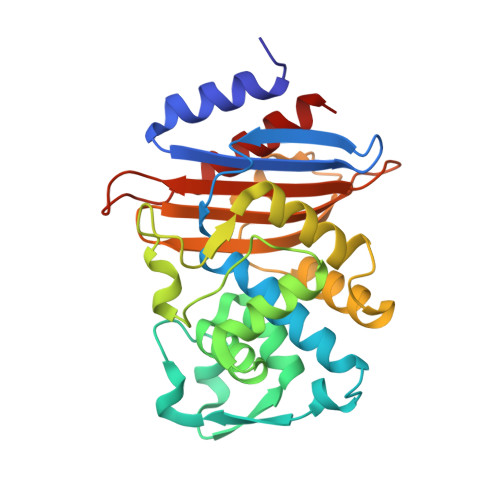
7S0V | pdb_00007s0v

The role of an Asp-Asp pair in the structure, function and inhibition of CTX-M Class A Beta-lactamase


Experimental Data Snapshot

  • Method: X-RAY DIFFRACTION
  • Resolution: 1.95 Å
  • R-Value Free: 
    0.259 (Depositor), 0.260 (DCC) 
  • R-Value Work: 
    0.189 (Depositor), 0.190 (DCC) 
  • R-Value Observed: 
    0.196 (Depositor) 

wwPDB Validation 3D Report Full Report

Validation slider image for 7S0V

Ligand Structure Quality Assessment 


This is version 1.2 of the entry. See complete history

Literature

Mutation of the conserved Asp-Asp pair impairs the structure, function, and inhibition of CTX-M Class A beta-lactamase.

Kemp, M.T.Nichols, D.A.Zhang, X.Defrees, K.Na, I.Renslo, A.R.Chen, Y.

(2021) FEBS Lett 595: 2981-2994

  • DOI: https://doi.org/10.1002/1873-3468.14215
  • Primary Citation Related Structures: 
    7S0V

  • PubMed Abstract: 

    The Asp233-Asp246 pair is highly conserved in Class A β-lactamases, which hydrolyze β-lactam antibiotics. Here, we characterize its function using CTX-M-14 β-lactamase. The D233N mutant displayed decreased activity that is substrate-dependent, with reductions in k cat /K m ranging from 20% for nitrocefin to 6-fold for cefotaxime. In comparison, the mutation reduced the binding of a known reversible inhibitor by 10-fold. The mutant structures showed movement of the 213-219 loop and the loss of the Thr216-Thr235 hydrogen bond, which was restored by inhibitor binding. Mutagenesis of Thr216 further highlighted its contribution to CTX-M activity. These results demonstrate the importance of the aspartate pair to CTX-M hydrolysis of substrates with bulky side chains, while suggesting increased protein flexibility as a means to evolve drug resistance.


  • Organizational Affiliation
    • Department of Molecular Medicine, University of South Florida College of Medicine, Tampa, FL, USA.

Macromolecule Content 

  • Total Structure Weight: 28.4 kDa 
  • Atom Count: 2,206 
  • Modeled Residue Count: 262 
  • Deposited Residue Count: 263 
  • Unique protein chains: 1

Macromolecules

Find similar proteins by:|  3D Structure
Entity ID: 1
MoleculeChains  Sequence LengthOrganismDetailsImage
Beta-lactamase263Escherichia coliMutation(s): 1 
Gene Names: 
EC: 3.5.2.6
UniProt
Find proteins for Q9L5C7 (Escherichia coli)
Explore Q9L5C7 
Go to UniProtKB:  Q9L5C7
Entity Groups
Sequence Clusters30% Identity50% Identity70% Identity90% Identity95% Identity100% Identity
UniProt GroupQ9L5C7
Sequence Annotations
Expand
Reference Sequence

Small Molecules

Ligands 1 Unique
IDChains Name / Formula / InChI Key2D Diagram3D Interactions
J1X
(Subject of Investigation/LOI)

Query on J1X


Download:Ideal Coordinates CCD File
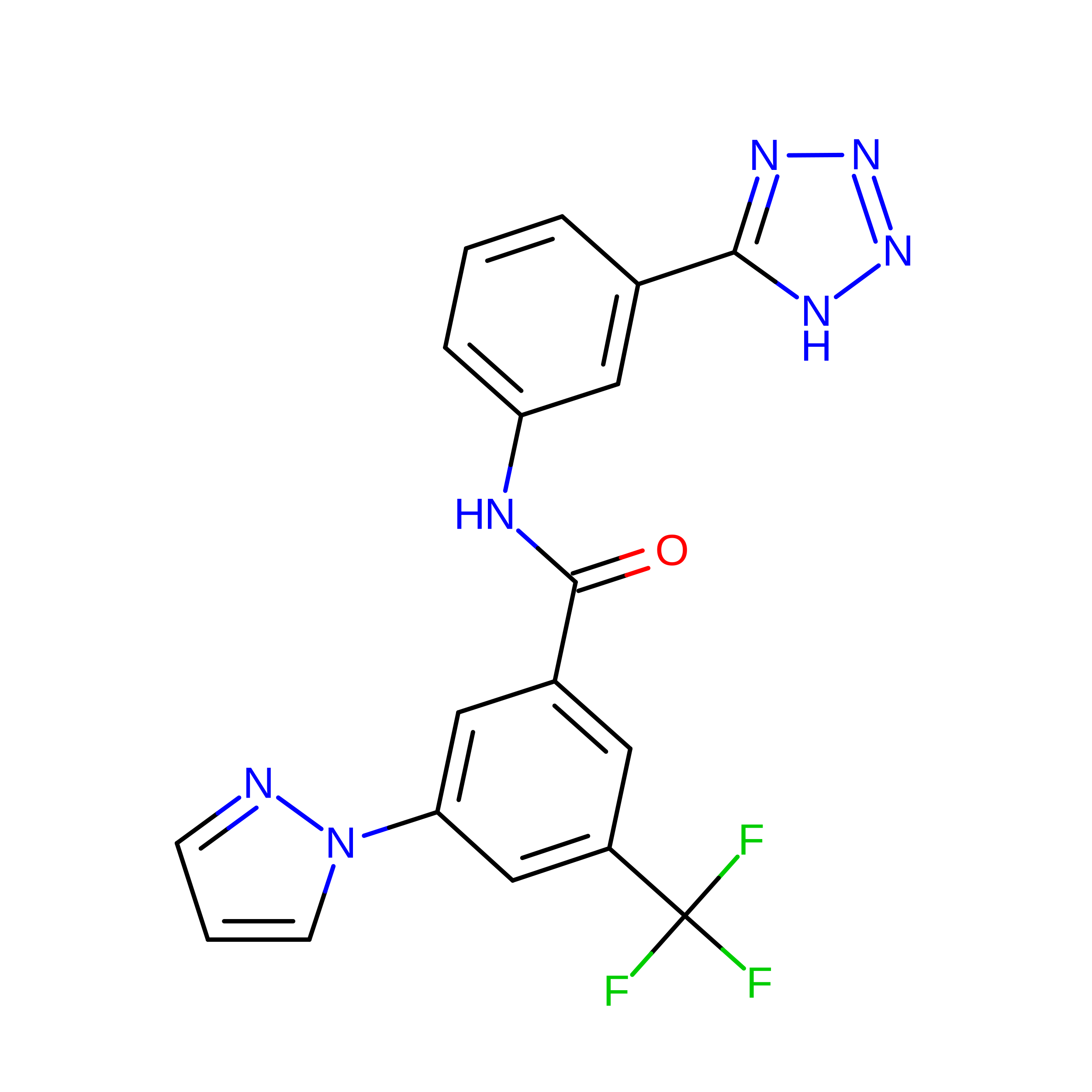
B [auth A]3-(1H-pyrazol-1-yl)-N-[3-(1H-tetrazol-5-yl)phenyl]-5-(trifluoromethyl)benzamide
C18 H12 F3 N7 O
ZMYXPNSTNVZUGF-UHFFFAOYSA-N

Experimental Data & Validation

Experimental Data

  • Method: X-RAY DIFFRACTION
  • Resolution: 1.95 Å
  • R-Value Free:  0.259 (Depositor), 0.260 (DCC) 
  • R-Value Work:  0.189 (Depositor), 0.190 (DCC) 
  • R-Value Observed: 0.196 (Depositor) 
Space Group: P 32 2 1
Unit Cell:
Length ( Å )Angle ( ˚ )
a = 41.62α = 90
b = 41.62β = 90
c = 231.162γ = 120
Software Package:
Software NamePurpose
PHENIXrefinement
SCALAdata scaling
PDB_EXTRACTdata extraction
iMOSFLMdata reduction
PHENIXphasing

Structure Validation

View Full Validation Report


Ligand Structure Quality Assessment 


Entry History 

& Funding Information

Deposition Data


Funding OrganizationLocationGrant Number
National Institutes of Health/National Institute Of Allergy and Infectious Diseases (NIH/NIAID)United StatesAI161762

Revision History  (Full details and data files)

  • Version 1.0: 2021-11-10
    Type: Initial release
  • Version 1.1: 2021-12-29
    Changes: Database references
  • Version 1.2: 2024-05-22
    Changes: Data collection