7RZW | pdb_00007rzw

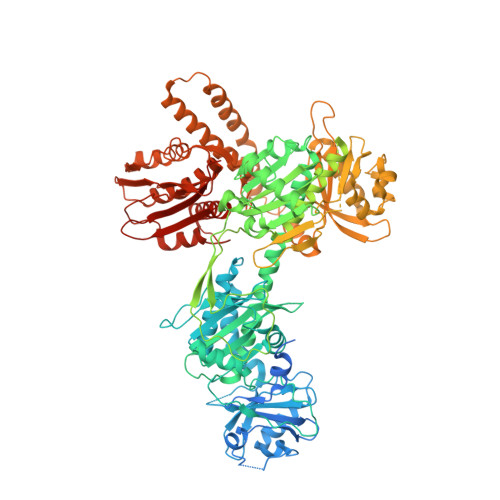
CryoEM structure of Arabidopsis thaliana phytochrome B


Experimental Data Snapshot

  • Method: ELECTRON MICROSCOPY
  • Resolution: 3.30 Å
  • Aggregation State: PARTICLE 
  • Reconstruction Method: SINGLE PARTICLE 

wwPDB Validation 3D Report Full Report

Validation slider image for 7RZW

This is version 1.2 of the entry. See complete history

Literature

Plant phytochrome B is an asymmetric dimer with unique signalling potential.

Li, H.Burgie, E.S.Gannam, Z.T.K.Li, H.Vierstra, R.D.

(2022) Nature 604: 127-133

  • DOI: https://doi.org/10.1038/s41586-022-04529-z
  • Primary Citation Related Structures: 
    7RZW

  • PubMed Abstract: 

    Many aspects of plant photoperception are mediated by the phytochrome (Phy) family of bilin-containing photoreceptors that reversibly interconvert between inactive Pr and active Pfr conformers 1,2 . Despite extensive biochemical studies, full understanding of plant Phy signalling has remained unclear due to the absence of relevant 3D models. Here we report a cryo-electron microscopy structure of Arabidopsis PhyB in the Pr state that reveals a topologically complex dimeric organization that is substantially distinct from its prokaryotic relatives. Instead of an anticipated parallel architecture, the C-terminal histidine-kinase-related domains (HKRDs) associate head-to-head, whereas the N-terminal photosensory regions associate head-to-tail to form a parallelogram-shaped platform with near two-fold symmetry. The platform is internally linked by the second of two internal Per/Arnt/Sim domains that binds to the photosensory module of the opposing protomer and a preceding 'modulator' loop that assembles tightly with the photosensory module of its own protomer. Both connections accelerate the thermal reversion of Pfr back to Pr, consistent with an inverse relationship between dimer assembly and Pfr stability. Lopsided contacts between the HKRDs and the platform create profound asymmetry to PhyB that might imbue distinct signalling potentials to the protomers. We propose that this unique structural dynamism creates an extensive photostate-sensitive surface for conformation-dependent interactions between plant Phy photoreceptors and their signalling partners.


  • Organizational Affiliation
    • Department of Structural Biology, Van Andel Institute, Grand Rapids, MI, USA.

Macromolecule Content 

  • Total Structure Weight: 260.12 kDa 
  • Atom Count: 13,616 
  • Modeled Residue Count: 1,723 
  • Deposited Residue Count: 2,344 
  • Unique protein chains: 1

Macromolecules

Find similar proteins by:|  3D Structure
Entity ID: 1
MoleculeChains  Sequence LengthOrganismDetailsImage
Phytochrome B
A, B
1,172Arabidopsis thalianaMutation(s): 0 
Gene Names: PHYBHY3OOP1At2g18790MSF3.17
UniProt
Find proteins for P14713 (Arabidopsis thaliana)
Explore P14713 
Go to UniProtKB:  P14713
Entity Groups
Sequence Clusters30% Identity50% Identity70% Identity90% Identity95% Identity100% Identity
UniProt GroupP14713
Sequence Annotations
Expand
Reference Sequence

Small Molecules

Ligands 1 Unique
IDChains Name / Formula / InChI Key2D Diagram3D Interactions
O6E
(Subject of Investigation/LOI)

Query on O6E


Download:Ideal Coordinates CCD File
C [auth A],
D [auth B]
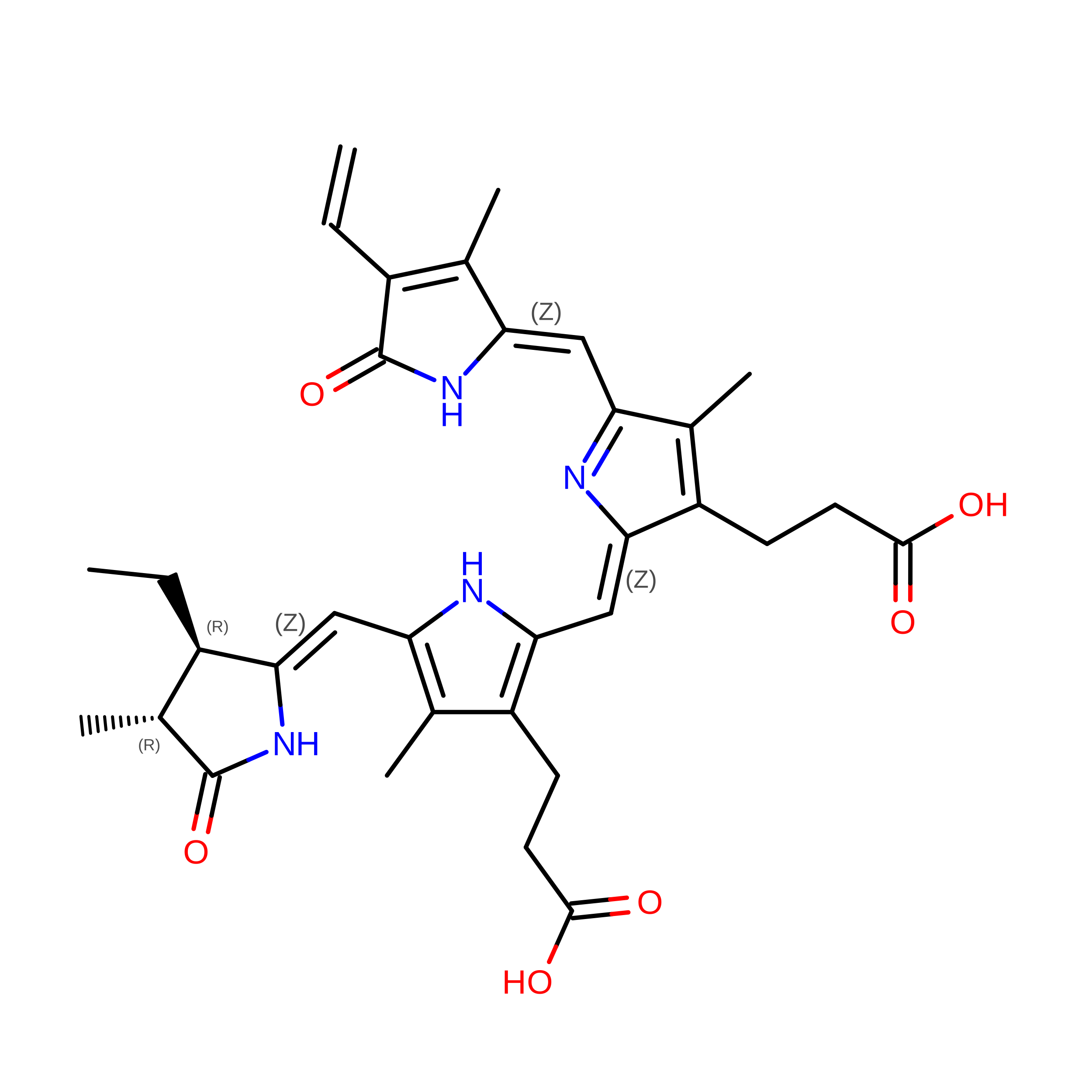
3-[5-[[(3~{R},4~{R})-3-ethyl-4-methyl-5-oxidanylidene-3,4-dihydropyrrol-2-yl]methyl]-2-[[5-[(4-ethyl-3-methyl-5-oxidanylidene-pyrrol-2-yl)methyl]-3-(3-hydroxy-3-oxopropyl)-4-methyl-1~{H}-pyrrol-2-yl]methyl]-4-methyl-1~{H}-pyrrol-3-yl]propanoic acid
C33 H38 N4 O6
SRFSSETUPHUBBC-GMXXPEQVSA-N

Experimental Data & Validation

Experimental Data

  • Method: ELECTRON MICROSCOPY
  • Resolution: 3.30 Å
  • Aggregation State: PARTICLE 
  • Reconstruction Method: SINGLE PARTICLE 
EM Software:
TaskSoftware PackageVersion
RECONSTRUCTIONRELION3
MODEL REFINEMENTPHENIX1.18

Structure Validation

View Full Validation Report


Entry History 

& Funding Information

Deposition Data


Funding OrganizationLocationGrant Number
National Institutes of Health/National Institute of General Medical Sciences (NIH/NIGMS)United StatesGM131754

Revision History  (Full details and data files)

  • Version 1.0: 2022-04-13
    Type: Initial release
  • Version 1.1: 2022-04-20
    Changes: Database references
  • Version 1.2: 2024-11-13
    Changes: Data collection, Structure summary