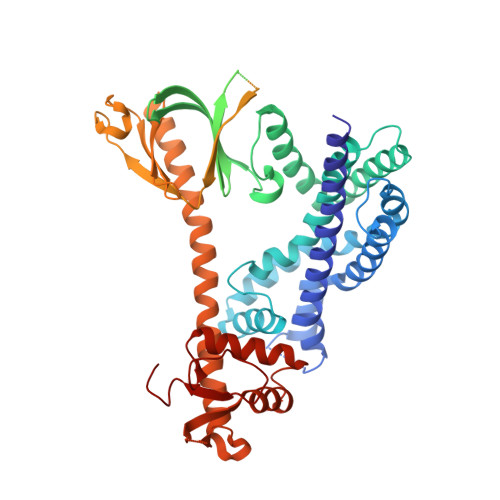
7RX9 | pdb_00007rx9

Structure of autoinhibited P-Rex1


Experimental Data Snapshot

  • Method: X-RAY DIFFRACTION
  • Resolution: 3.22 Å
  • R-Value Free: 
    0.262 (Depositor), 0.263 (DCC) 
  • R-Value Work: 
    0.236 (Depositor), 0.239 (DCC) 
  • R-Value Observed: 
    0.237 (Depositor) 

Starting Model: experimental
View more details

wwPDB Validation 3D Report Full Report

Validation slider image for 7RX9

This is version 1.2 of the entry. See complete history

Literature

Structure of the metastatic factor P-Rex1 reveals a two-layered autoinhibitory mechanism.

Chang, Y.G.Lupton, C.J.Bayly-Jones, C.Keen, A.C.D'Andrea, L.Lucato, C.M.Steele, J.R.Venugopal, H.Schittenhelm, R.B.Whisstock, J.C.Halls, M.L.Ellisdon, A.M.

(2022) Nat Struct Mol Biol 29: 767-773

  • DOI: https://doi.org/10.1038/s41594-022-00804-9
  • Primary Citation Related Structures: 
    7RX9, 7SYF

  • PubMed Abstract: 

    P-Rex (PI(3,4,5)P 3 -dependent Rac exchanger) guanine nucleotide exchange factors potently activate Rho GTPases. P-Rex guanine nucleotide exchange factors are autoinhibited, synergistically activated by Gβγ and PI(3,4,5)P 3 binding and dysregulated in cancer. Here, we use X-ray crystallography, cryogenic electron microscopy and crosslinking mass spectrometry to determine the structural basis of human P-Rex1 autoinhibition. P-Rex1 has a bipartite structure of N- and C-terminal modules connected by a C-terminal four-helix bundle that binds the N-terminal Pleckstrin homology (PH) domain. In the N-terminal module, the Dbl homology (DH) domain catalytic surface is occluded by the compact arrangement of the DH-PH-DEP1 domains. Structural analysis reveals a remarkable conformational transition to release autoinhibition, requiring a 126° opening of the DH domain hinge helix. The off-axis position of Gβγ and PI(3,4,5)P 3 binding sites further suggests a counter-rotation of the P-Rex1 halves by 90° facilitates PH domain uncoupling from the four-helix bundle, releasing the autoinhibited DH domain to drive Rho GTPase signaling.


  • Organizational Affiliation
    • Biomedicine Discovery Institute, Monash University, Clayton, Victoria, Australia. tyler.chang@monash.edu.

Macromolecule Content 

  • Total Structure Weight: 70.6 kDa 
  • Atom Count: 3,555 
  • Modeled Residue Count: 432 
  • Deposited Residue Count: 606 
  • Unique protein chains: 1

Macromolecules

Find similar proteins by:|  3D Structure
Entity ID: 1
MoleculeChains  Sequence LengthOrganismDetailsImage
Phosphatidylinositol 3,4,5-trisphosphate-dependent Rac exchanger 1 protein, Endolysin chimera606Homo sapiensTequatrovirus T4Mutation(s): 0 
Gene Names: PREX1KIAA1415
EC: 3.2.1.17
UniProt & NIH Common Fund Data Resources
Find proteins for P00720 (Enterobacteria phage T4)
Explore P00720 
Go to UniProtKB:  P00720
Find proteins for Q8TCU6 (Homo sapiens)
Explore Q8TCU6 
Go to UniProtKB:  Q8TCU6
PHAROS:  Q8TCU6
GTEx:  ENSG00000124126 
Entity Groups
Sequence Clusters30% Identity50% Identity70% Identity90% Identity95% Identity100% Identity
UniProt GroupsQ8TCU6P00720
Sequence Annotations
Expand
Reference Sequence

Experimental Data & Validation

Experimental Data

  • Method: X-RAY DIFFRACTION
  • Resolution: 3.22 Å
  • R-Value Free:  0.262 (Depositor), 0.263 (DCC) 
  • R-Value Work:  0.236 (Depositor), 0.239 (DCC) 
  • R-Value Observed: 0.237 (Depositor) 
Space Group: P 41 2 2
Unit Cell:
Length ( Å )Angle ( ˚ )
a = 151.256α = 90
b = 151.256β = 90
c = 94.287γ = 90
Software Package:
Software NamePurpose
PHENIXrefinement
XDSdata reduction
Aimlessdata scaling
PHASERphasing

Structure Validation

View Full Validation Report


Entry History 

& Funding Information

Deposition Data


Funding OrganizationLocationGrant Number
National Health and Medical Research Council (NHMRC, Australia)AustraliaAPP1128120
National Health and Medical Research Council (NHMRC, Australia)AustraliaAPP1146578

Revision History  (Full details and data files)

  • Version 1.0: 2022-08-10
    Type: Initial release
  • Version 1.1: 2022-08-24
    Changes: Database references
  • Version 1.2: 2023-10-18
    Changes: Data collection, Refinement description