7RUQ | pdb_00007ruq

Structure of the human GIGYF1-TNRC6C complex


Experimental Data Snapshot

  • Method: X-RAY DIFFRACTION
  • Resolution: 1.79 Å
  • R-Value Free: 
    0.189 (Depositor), 0.190 (DCC) 
  • R-Value Work: 
    0.166 (Depositor), 0.166 (DCC) 
  • R-Value Observed: 
    0.167 (Depositor) 

Starting Model: experimental
View more details

wwPDB Validation 3D Report Full Report

Validation slider image for 7RUQ

This is version 1.3 of the entry. See complete history

Literature

Molecular basis for GIGYF-TNRC6 complex assembly.

Sobti, M.Mead, B.J.Stewart, A.G.Igreja, C.Christie, M.

(2023) RNA 29: 724-734

  • DOI: https://doi.org/10.1261/rna.079596.123
  • Primary Citation Related Structures: 
    7RUP, 7RUQ

  • PubMed Abstract: 

    The GIGYF proteins interact with 4EHP and RNA-associated proteins to elicit transcript-specific translational repression. However, the mechanism by which the GIGYF1/2-4EHP complex is recruited to its target transcripts remain unclear. Here, we report the crystal structures of the GYF domains from GIGYF1 and GIGYF2 in complex with proline-rich sequences from the miRISC-binding proteins TNRC6C and TNRC6A, respectively. The TNRC6 proline-rich motifs bind to a conserved array of aromatic residues on the surface of the GIGYF1/2 GYF domains, thereby bridging 4EHP to Argonaute-miRNA complexes. Our structures also reveal a phenylalanine residue conserved from yeast to human GYF domains that contributes to GIGYF2 thermostability. The molecular details we outline here are likely to be conserved between GIGYF1/2 and other RNA-binding proteins to elicit 4EHP-mediated repression in different biological contexts.


  • Organizational Affiliation
    • Molecular, Structural and Computational Biology Division, The Victor Chang Cardiac Research Institute, Sydney, New South Wales 2010, Australia.

Macromolecule Content 

  • Total Structure Weight: 19.6 kDa 
  • Atom Count: 1,210 
  • Modeled Residue Count: 142 
  • Deposited Residue Count: 178 
  • Unique protein chains: 2

Macromolecules

Find similar proteins by:|  3D Structure
Entity ID: 1
MoleculeChains  Sequence LengthOrganismDetailsImage
GRB10-interacting GYF protein 1A,
B [auth C]
73Homo sapiensMutation(s): 0 
Gene Names: GIGYF1CDS2PERQ1PP3360
UniProt & NIH Common Fund Data Resources
Find proteins for O75420 (Homo sapiens)
Explore O75420 
Go to UniProtKB:  O75420
PHAROS:  O75420
GTEx:  ENSG00000146830 
Entity Groups
Sequence Clusters30% Identity50% Identity70% Identity90% Identity95% Identity100% Identity
UniProt GroupO75420
Sequence Annotations
Expand
Reference Sequence
Find similar proteins by:  Sequence   |   3D Structure  
Entity ID: 2
MoleculeChains  Sequence LengthOrganismDetailsImage
Trinucleotide repeat-containing gene 6C proteinC [auth D],
D [auth B]
16Homo sapiensMutation(s): 0 
Gene Names: TNRC6CKIAA1582
UniProt & NIH Common Fund Data Resources
Find proteins for Q9HCJ0 (Homo sapiens)
Explore Q9HCJ0 
Go to UniProtKB:  Q9HCJ0
PHAROS:  Q9HCJ0
GTEx:  ENSG00000078687 
Entity Groups
Sequence Clusters30% Identity50% Identity70% Identity90% Identity95% Identity100% Identity
UniProt GroupQ9HCJ0
Sequence Annotations
Expand
Reference Sequence

Small Molecules

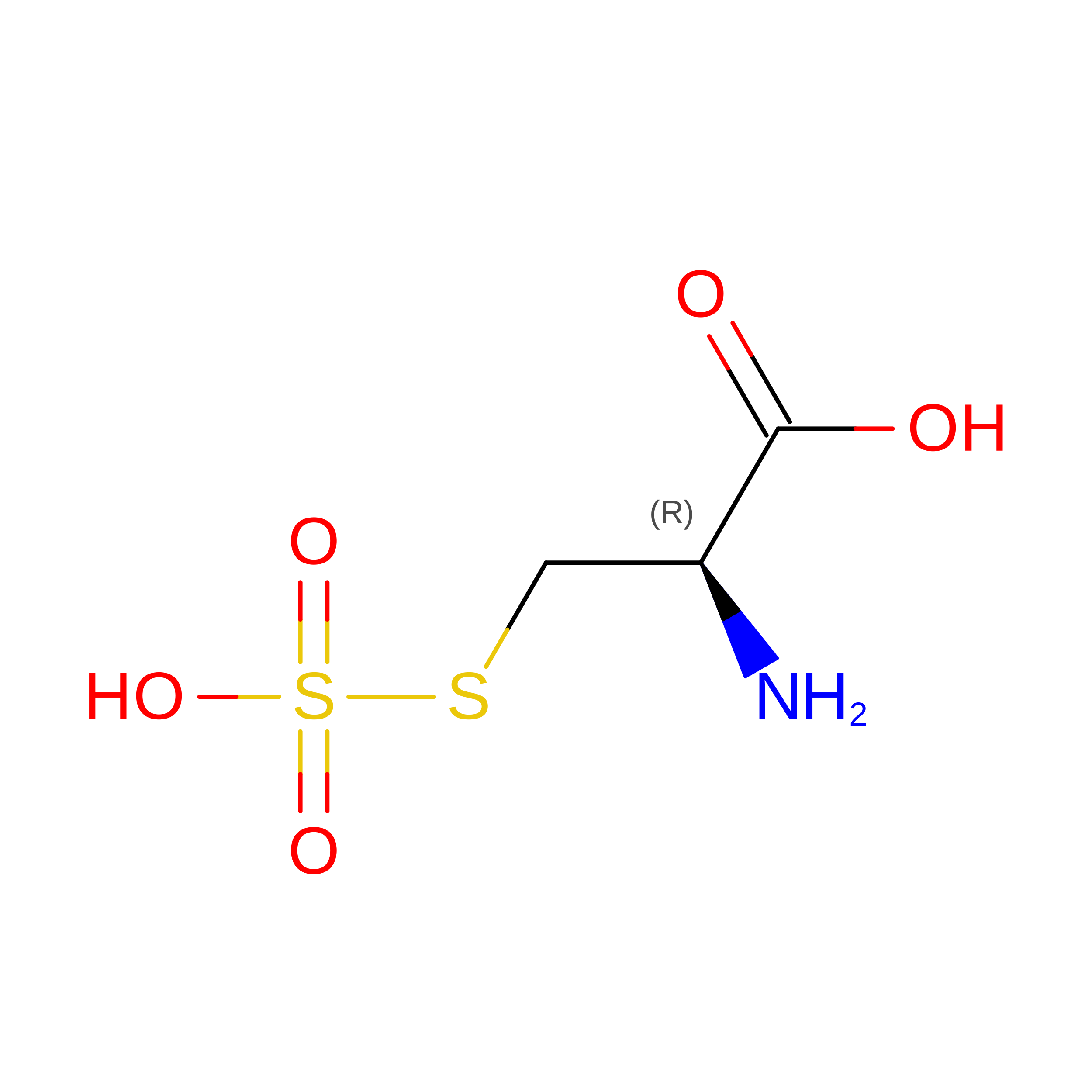
Modified Residues  1 Unique
IDChains TypeFormula2D DiagramParent
CSU
Query on CSU
A,
B [auth C]
L-PEPTIDE LINKINGC3 H7 N O5 S2CYS

Experimental Data & Validation

Experimental Data

  • Method: X-RAY DIFFRACTION
  • Resolution: 1.79 Å
  • R-Value Free:  0.189 (Depositor), 0.190 (DCC) 
  • R-Value Work:  0.166 (Depositor), 0.166 (DCC) 
  • R-Value Observed: 0.167 (Depositor) 
Space Group: C 1 2 1
Unit Cell:
Length ( Å )Angle ( ˚ )
a = 99.918α = 90
b = 32.503β = 133.836
c = 69.578γ = 90
Software Package:
Software NamePurpose
PHENIXrefinement
XDSdata reduction
Aimlessdata scaling
PHASERphasing

Structure Validation

View Full Validation Report


Entry History 

& Funding Information

Deposition Data


Funding OrganizationLocationGrant Number
Australian Research Council (ARC)AustraliaDE160100608

Revision History  (Full details and data files)

  • Version 1.0: 2022-08-24
    Type: Initial release
  • Version 1.1: 2023-03-15
    Changes: Database references
  • Version 1.2: 2023-05-31
    Changes: Database references
  • Version 1.3: 2023-10-25
    Changes: Data collection, Refinement description