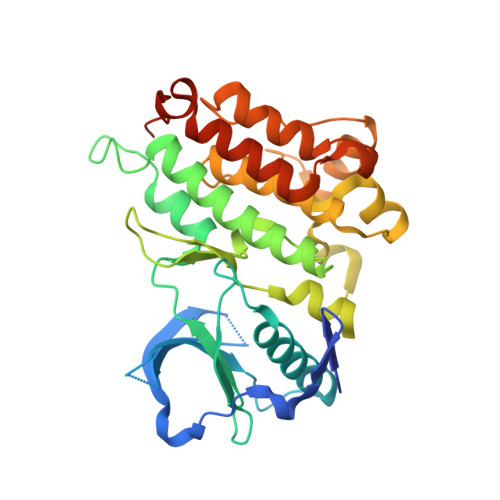
7R7K | pdb_00007r7k

Structure of Human Anaplastic Lymphoma Kinase Domain in complex with (4-[6-amino-5-[(1~{R})-1-[5-fluoro-2-(triazol-2-yl)phenyl]ethoxy]-3-pyridyl]isoindolin-1-one)


Experimental Data Snapshot

  • Method: X-RAY DIFFRACTION
  • Resolution: 1.83 Å
  • R-Value Free: 
    0.221 (Depositor), 0.207 (DCC) 
  • R-Value Work: 
    0.194 (Depositor) 
  • R-Value Observed: 
    0.195 (Depositor) 

Starting Model: experimental
View more details

wwPDB Validation 3D Report Full Report

Validation slider image for 7R7K

Ligand Structure Quality Assessment 


This is version 1.2 of the entry. See complete history

Literature

Analysis of lorlatinib analogs reveals a roadmap for targeting diverse compound resistance mutations in ALK-positive lung cancer.

Shiba-Ishii, A.Johnson, T.W.Dagogo-Jack, I.Mino-Kenudson, M.Johnson, T.R.Wei, P.Weinrich, S.L.McTigue, M.A.Walcott, M.A.Nguyen-Phuong, L.Dionne, K.Acker, A.Kiedrowski, L.A.Do, A.Peterson, J.L.Barth, J.L.Yeap, B.Y.Gainor, J.F.Lin, J.J.Yoda, S.Hata, A.N.

(2022) Nat Cancer 3: 710-722

  • DOI: https://doi.org/10.1038/s43018-022-00399-6
  • Primary Citation Related Structures: 
    7R7K, 7R7R

  • PubMed Abstract: 

    Lorlatinib is currently the most advanced, potent and selective anaplastic lymphoma kinase (ALK) tyrosine kinase inhibitor for the treatment of ALK-positive non-small cell lung cancer in the clinic; however, diverse compound ALK mutations driving therapy resistance emerge. Here, we determine the spectrum of lorlatinib-resistant compound ALK mutations in patients, following treatment with lorlatinib, the majority of which involve ALK G1202R or I1171N/S/T. We further identify structurally diverse lorlatinib analogs that harbor differential selective profiles against G1202R versus I1171N/S/T compound ALK mutations. Structural analysis revealed increased potency against compound mutations through improved inhibition of either G1202R or I1171N/S/T mutant kinases. Overall, we propose a classification of heterogenous ALK compound mutations enabling the development of distinct therapeutic strategies for precision targeting following sequential tyrosine kinase inhibitors.


  • Organizational Affiliation
    • Massachusetts General Hospital Cancer Center, Charlestown, MA, USA.

Macromolecule Content 

  • Total Structure Weight: 37.34 kDa 
  • Atom Count: 2,563 
  • Modeled Residue Count: 290 
  • Deposited Residue Count: 327 
  • Unique protein chains: 1

Macromolecules

Find similar proteins by:|  3D Structure
Entity ID: 1
MoleculeChains  Sequence LengthOrganismDetailsImage
ALK tyrosine kinase receptor327Homo sapiensMutation(s): 0 
Gene Names: ALK
EC: 2.7.10.1
UniProt & NIH Common Fund Data Resources
Find proteins for Q9UM73 (Homo sapiens)
Explore Q9UM73 
Go to UniProtKB:  Q9UM73
PHAROS:  Q9UM73
GTEx:  ENSG00000171094 
Entity Groups
Sequence Clusters30% Identity50% Identity70% Identity90% Identity95% Identity100% Identity
UniProt GroupQ9UM73
Sequence Annotations
Expand
Reference Sequence

Small Molecules

Ligands 1 Unique
IDChains Name / Formula / InChI Key2D Diagram3D Interactions
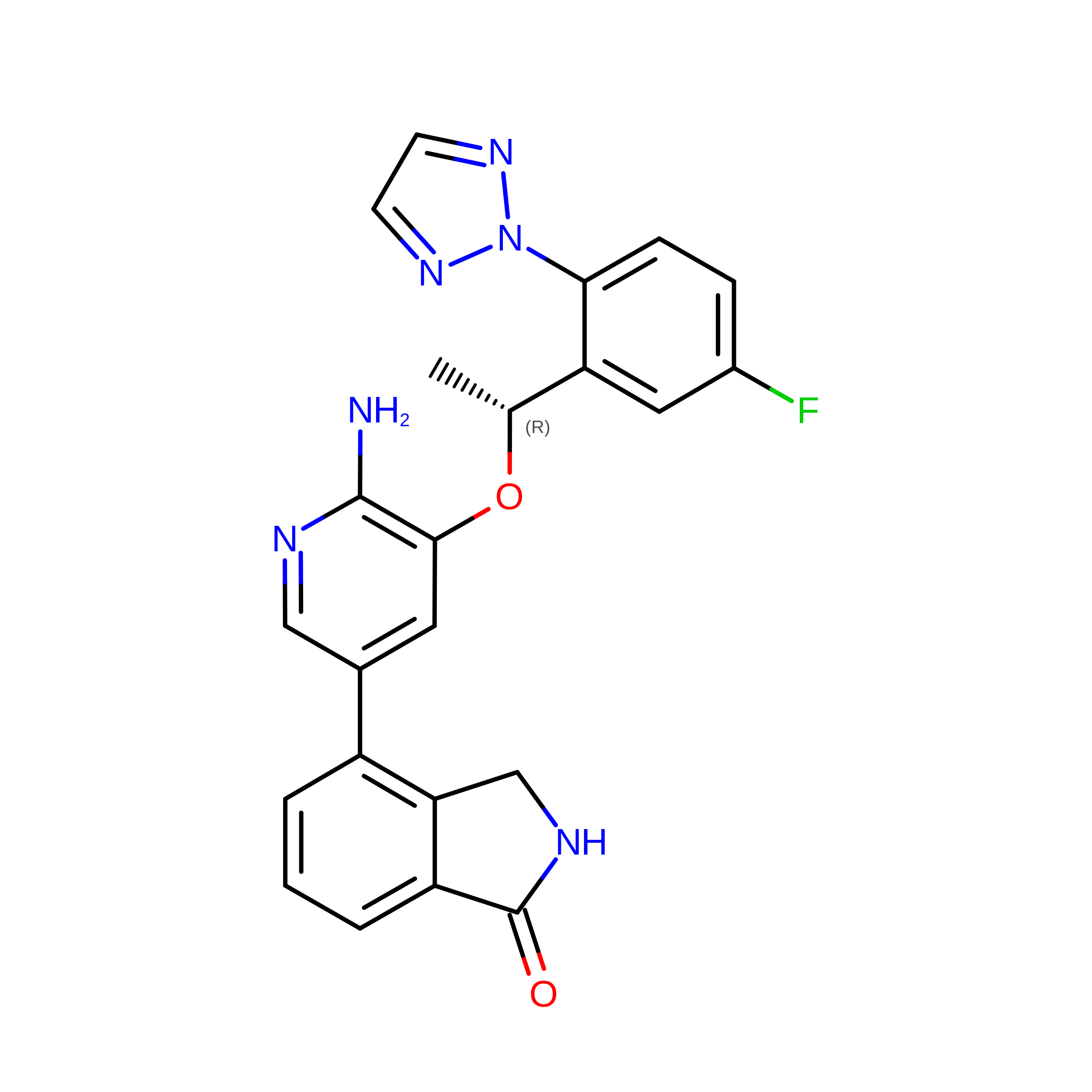
25J
(Subject of Investigation/LOI)

Query on 25J


Download:Ideal Coordinates CCD File
B [auth A]4-(6-amino-5-{(1R)-1-[5-fluoro-2-(2H-1,2,3-triazol-2-yl)phenyl]ethoxy}pyridin-3-yl)-2,3-dihydro-1H-isoindol-1-one
C23 H19 F N6 O2
CKJMFMVVGMXESQ-CYBMUJFWSA-N

Experimental Data & Validation

Experimental Data

  • Method: X-RAY DIFFRACTION
  • Resolution: 1.83 Å
  • R-Value Free:  0.221 (Depositor), 0.207 (DCC) 
  • R-Value Work:  0.194 (Depositor) 
  • R-Value Observed: 0.195 (Depositor) 
Space Group: P 21 21 21
Unit Cell:
Length ( Å )Angle ( ˚ )
a = 51.602α = 90
b = 57.389β = 90
c = 105.432γ = 90
Software Package:
Software NamePurpose
BUSTERrefinement
XDSdata reduction
SCALAdata scaling
CNSphasing

Structure Validation

View Full Validation Report


Ligand Structure Quality Assessment 


Entry History 

Deposition Data

  • Released Date: 2022-06-29 
  • Deposition Author(s): McTigue, M.

Revision History  (Full details and data files)

  • Version 1.0: 2022-06-29
    Type: Initial release
  • Version 1.1: 2022-08-10
    Changes: Database references
  • Version 1.2: 2023-10-18
    Changes: Data collection, Refinement description