7Q6J | pdb_00007q6j

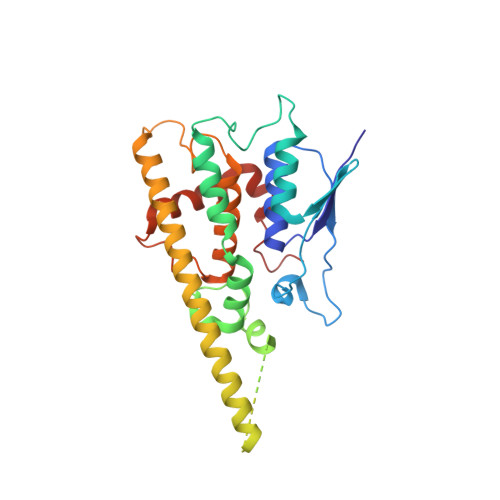
Crystal structure of the human GDAP1 CMT2 mutant-H123R


Experimental Data Snapshot

  • Method: X-RAY DIFFRACTION
  • Resolution: 2.20 Å
  • R-Value Free: 
    0.236 (Depositor), 0.237 (DCC) 
  • R-Value Work: 
    0.215 (Depositor), 0.215 (DCC) 
  • R-Value Observed: 
    0.216 (Depositor) 

Starting Model: experimental
View more details

wwPDB Validation 3D Report Full Report

Validation slider image for 7Q6J

Ligand Structure Quality Assessment 


This is version 1.4 of the entry. See complete history

Literature

Structural insights into Charcot-Marie-Tooth disease-linked mutations in human GDAP1.

Sutinen, A.Nguyen, G.T.T.Raasakka, A.Muruganandam, G.Loris, R.Ylikallio, E.Tyynismaa, H.Bartesaghi, L.Ruskamo, S.Kursula, P.

(2022) FEBS Open Bio 12: 1306-1324

  • DOI: https://doi.org/10.1002/2211-5463.13422
  • Primary Citation Related Structures: 
    7Q6J, 7Q6K, 7YWD

  • PubMed Abstract: 

    Charcot-Marie-Tooth disease (CMT) is the most common inherited peripheral polyneuropathy in humans, and its different subtypes are linked to mutations in dozens of different genes. Mutations in ganglioside-induced differentiation-associated protein 1 (GDAP1) cause two types of CMT, demyelinating CMT4A and axonal CMT2K. The GDAP1-linked CMT genotypes are mainly missense point mutations. Despite clinical profiling and in vivo studies on the mutations, the etiology of GDAP1-linked CMT is poorly understood. Here, we describe the biochemical and structural properties of the Finnish founding CMT2K mutation H123R and CMT2K-linked R120W, both of which are autosomal dominant mutations. The disease variant proteins retain close to normal structure and solution behavior, but both present a significant decrease in thermal stability. Using GDAP1 variant crystal structures, we identify a side-chain interaction network between helices ⍺3, ⍺6, and ⍺7, which is affected by CMT mutations, as well as a hinge in the long helix ⍺6, which is linked to structural flexibility. Structural analysis of GDAP1 indicates that CMT may arise from disruption of specific intra- and intermolecular interaction networks, leading to alterations in GDAP1 structure and stability, and, eventually, insufficient motor and sensory neuron function.


  • Organizational Affiliation
    • Faculty of Biochemistry and Molecular Medicine & Biocenter Oulu, University of Oulu, Finland.

Macromolecule Content 

  • Total Structure Weight: 65.8 kDa 
  • Atom Count: 4,339 
  • Modeled Residue Count: 505 
  • Deposited Residue Count: 560 
  • Unique protein chains: 1

Macromolecules

Find similar proteins by:|  3D Structure
Entity ID: 1
MoleculeChains  Sequence LengthOrganismDetailsImage
Ganglioside-induced differentiation-associated protein 1
A, B
280Homo sapiensMutation(s): 1 
Gene Names: GDAP1
UniProt & NIH Common Fund Data Resources
Find proteins for Q8TB36 (Homo sapiens)
Explore Q8TB36 
Go to UniProtKB:  Q8TB36
PHAROS:  Q8TB36
GTEx:  ENSG00000104381 
Entity Groups
Sequence Clusters30% Identity50% Identity70% Identity90% Identity95% Identity100% Identity
UniProt GroupQ8TB36
Sequence Annotations
Expand
Reference Sequence

Experimental Data & Validation

Experimental Data

  • Method: X-RAY DIFFRACTION
  • Resolution: 2.20 Å
  • R-Value Free:  0.236 (Depositor), 0.237 (DCC) 
  • R-Value Work:  0.215 (Depositor), 0.215 (DCC) 
  • R-Value Observed: 0.216 (Depositor) 
Space Group: P 21 21 21
Unit Cell:
Length ( Å )Angle ( ˚ )
a = 72.71α = 90
b = 115.88β = 90
c = 116.18γ = 90
Software Package:
Software NamePurpose
XDSdata reduction
XSCALEdata scaling
PHASERphasing
PHENIXrefinement
PDB_EXTRACTdata extraction

Structure Validation

View Full Validation Report


Ligand Structure Quality Assessment 


Entry History 

& Funding Information

Deposition Data


Funding OrganizationLocationGrant Number
Academy of FinlandFinland24302881

Revision History  (Full details and data files)

  • Version 1.0: 2022-06-08
    Type: Initial release
  • Version 1.1: 2022-06-15
    Changes: Database references
  • Version 1.2: 2022-07-13
    Changes: Database references
  • Version 1.3: 2024-01-31
    Changes: Data collection, Refinement description
  • Version 1.4: 2024-11-06
    Changes: Structure summary