7OH0 | pdb_00007oh0

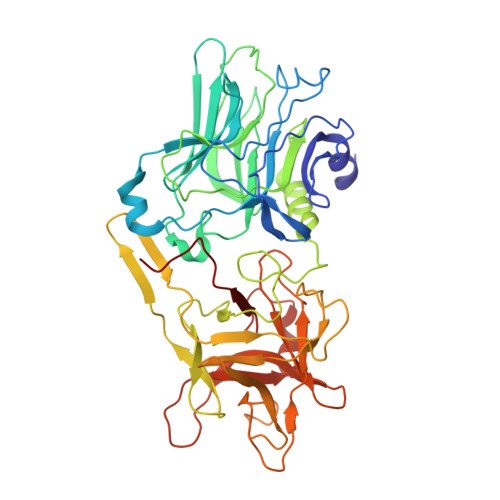
Tetanus neurotoxin HC domain in complex with TT104-Fab1


Experimental Data Snapshot

  • Method: ELECTRON MICROSCOPY
  • Resolution: 3.90 Å
  • Aggregation State: PARTICLE 
  • Reconstruction Method: SINGLE PARTICLE 

wwPDB Validation 3D Report Full Report

Validation slider image for 7OH0

This is version 1.4 of the entry. See complete history

Literature

Exceptionally potent human monoclonal antibodies are effective for prophylaxis and treatment of tetanus in mice.

Pirazzini, M.Grinzato, A.Corti, D.Barbieri, S.Leka, O.Vallese, F.Tonellato, M.Silacci-Fregni, C.Piccoli, L.Kandiah, E.Schiavo, G.Zanotti, G.Lanzavecchia, A.Montecucco, C.

(2021) J Clin Invest 131

  • DOI: https://doi.org/10.1172/JCI151676
  • Primary Citation Related Structures: 
    7OH0, 7OH1

  • PubMed Abstract: 

    We used human monoclonal antibodies (humAbs) to study the mechanism of neuron intoxication by tetanus neurotoxin and to evaluate these antibodies as a safe preventive and therapeutic substitute for hyperimmune sera to treat tetanus in mice. By screening memory B cells from immune donors, we selected 2 tetanus neurotoxin-specific mAbs with exceptionally high neutralizing activities and extensively characterized them both structurally and functionally. We found that these antibodies interfered with the binding and translocation of the neurotoxin into neurons by interacting with 2 epitopes, whose identification pinpoints crucial events in the cellular pathogenesis of tetanus. Our observations explain the neutralization ability of these antibodies, which we found to be exceptionally potent in preventing experimental tetanus when injected into mice long before the toxin. Moreover, their Fab derivatives neutralized tetanus neurotoxin in post-exposure experiments, suggesting their potential for therapeutic use via intrathecal injection. As such, we believe these humAbs, as well as their Fab derivatives, meet the requirements to be considered for prophylactic and therapeutic use in human tetanus and are ready for clinical trials.


  • Organizational Affiliation
    • Department of Biomedical Sciences, University of Padova, Padova, Italy.

Macromolecule Content 

  • Total Structure Weight: 97.59 kDa 
  • Atom Count: 6,830 
  • Modeled Residue Count: 870 
  • Deposited Residue Count: 876 
  • Unique protein chains: 3

Macromolecules

Find similar proteins by:|  3D Structure
Entity ID: 1
MoleculeChains  Sequence LengthOrganismDetailsImage
Tetanus toxin441Clostridium tetaniMutation(s): 0 
EC: 3.4.24.68
UniProt
Find proteins for P04958 (Clostridium tetani (strain Massachusetts / E88))
Explore P04958 
Go to UniProtKB:  P04958
Entity Groups
Sequence Clusters30% Identity50% Identity70% Identity90% Identity95% Identity100% Identity
UniProt GroupP04958
Sequence Annotations
Expand
Reference Sequence
Find similar proteins by:|  3D Structure
Entity ID: 2
MoleculeChains  Sequence LengthOrganismDetailsImage
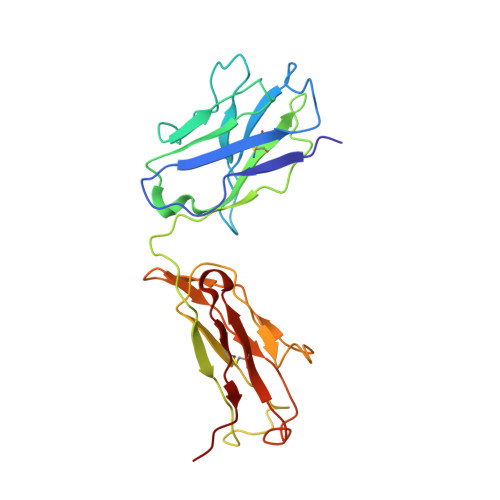
Fab TT104B [auth C]221Homo sapiensMutation(s): 0 
Find similar proteins by:|  3D Structure
Entity ID: 3
MoleculeChains  Sequence LengthOrganismDetailsImage
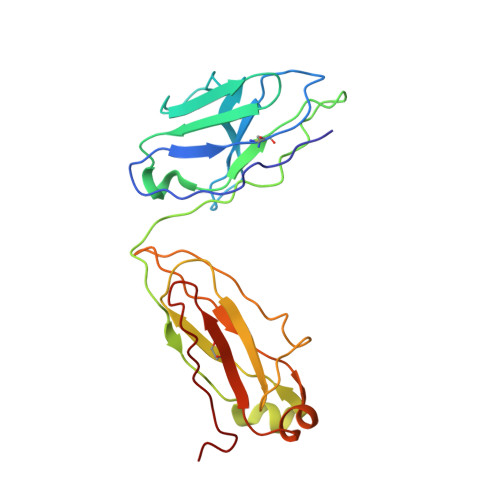
Fab TT104C [auth B]214Homo sapiensMutation(s): 0 

Experimental Data & Validation

Experimental Data

  • Method: ELECTRON MICROSCOPY
  • Resolution: 3.90 Å
  • Aggregation State: PARTICLE 
  • Reconstruction Method: SINGLE PARTICLE 
EM Software:
TaskSoftware PackageVersion
MODEL REFINEMENTPHENIX

Structure Validation

View Full Validation Report


Entry History 

Deposition Data

Revision History  (Full details and data files)

  • Version 1.0: 2021-10-27
    Type: Initial release
  • Version 1.1: 2021-11-03
    Changes: Data collection, Source and taxonomy
  • Version 1.2: 2021-11-24
    Changes: Database references
  • Version 1.3: 2024-11-06
    Changes: Data collection, Structure summary
  • Version 1.4: 2025-07-02
    Changes: Data collection