7OF8 | pdb_00007of8

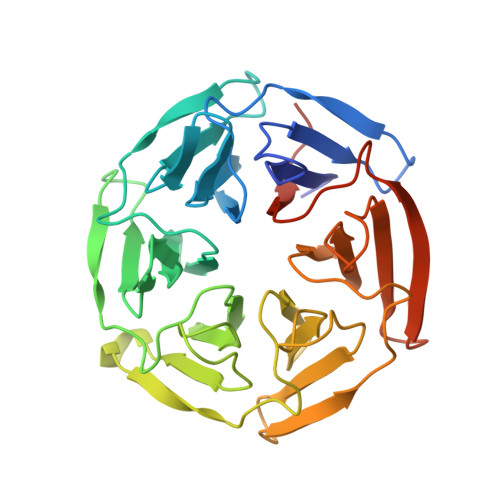
Keap1 kelch domain bound to a small molecule fragment


Experimental Data Snapshot

  • Method: X-RAY DIFFRACTION
  • Resolution: 1.78 Å
  • R-Value Free: 
    0.224 (Depositor), 0.224 (DCC) 
  • R-Value Work: 
    0.188 (Depositor), 0.188 (DCC) 
  • R-Value Observed: 
    0.190 (Depositor) 

Starting Model: experimental
View more details

wwPDB Validation 3D Report Full Report

Validation slider image for 7OF8

Ligand Structure Quality Assessment 


This is version 1.2 of the entry. See complete history

Literature

Development of Noncovalent Small-Molecule Keap1-Nrf2 Inhibitors by Fragment-Based Drug Discovery.

Narayanan, D.Tran, K.T.Pallesen, J.S.Solbak, S.M.O.Qin, Y.Mukminova, E.Luchini, M.Vasilyeva, K.O.Gonzalez Chichon, D.Goutsiou, G.Poulsen, C.Haapanen, N.Popowicz, G.M.Sattler, M.Olagnier, D.Gajhede, M.Bach, A.

(2022) J Med Chem 65: 14481-14526

  • DOI: https://doi.org/10.1021/acs.jmedchem.2c00830
  • Primary Citation Related Structures: 
    7OF8, 7OF9, 7OFA, 7OFB, 7OFC, 7OFD, 7OFE, 7OFF

  • PubMed Abstract: 

    Targeting the protein-protein interaction (PPI) between the transcription factor nuclear factor erythroid 2-related factor 2 (Nrf2) and its repressor, Kelch-like ECH-associated protein 1 (Keap1), constitutes a promising strategy for treating diseases involving oxidative stress and inflammation. Here, a fragment-based drug discovery (FBDD) campaign resulted in novel, high-affinity ( K i = 280 nM), and cell-active noncovalent small-molecule Keap1-Nrf2 PPI inhibitors. We screened 2500 fragments using orthogonal assays─fluorescence polarization (FP), thermal shift assay (TSA), and surface plasmon resonance (SPR)─and validated the hits by saturation transfer difference (STD) NMR, leading to 28 high-priority hits. Thirteen co-structures showed fragments binding mainly in the P4 and P5 subpockets of Keap1's Kelch domain, and three fluorenone-based fragments featuring a novel binding mode were optimized by structure-based drug discovery. We thereby disclose several fragment hits, including their binding modes, and show how FBDD can be performed to find new small-molecule Keap1-Nrf2 PPI inhibitors.


  • Organizational Affiliation
    • Department of Drug Design and Pharmacology, Faculty of Health and Medical Sciences, University of Copenhagen, Universitetsparken 2, 2100 Copenhagen, Denmark.

Macromolecule Content 

  • Total Structure Weight: 33.58 kDa 
  • Atom Count: 2,329 
  • Modeled Residue Count: 288 
  • Deposited Residue Count: 304 
  • Unique protein chains: 1

Macromolecules

Find similar proteins by:|  3D Structure
Entity ID: 1
MoleculeChains  Sequence LengthOrganismDetailsImage
Kelch-like ECH-associated protein 1304Mus musculusMutation(s): 0 
Gene Names: Keap1Inrf2Kiaa0132
UniProt
Find proteins for Q9Z2X8 (Mus musculus)
Explore Q9Z2X8 
Go to UniProtKB:  Q9Z2X8
Entity Groups
Sequence Clusters30% Identity50% Identity70% Identity90% Identity95% Identity100% Identity
UniProt GroupQ9Z2X8
Sequence Annotations
Expand
Reference Sequence

Small Molecules

Ligands 1 Unique
IDChains Name / Formula / InChI Key2D Diagram3D Interactions
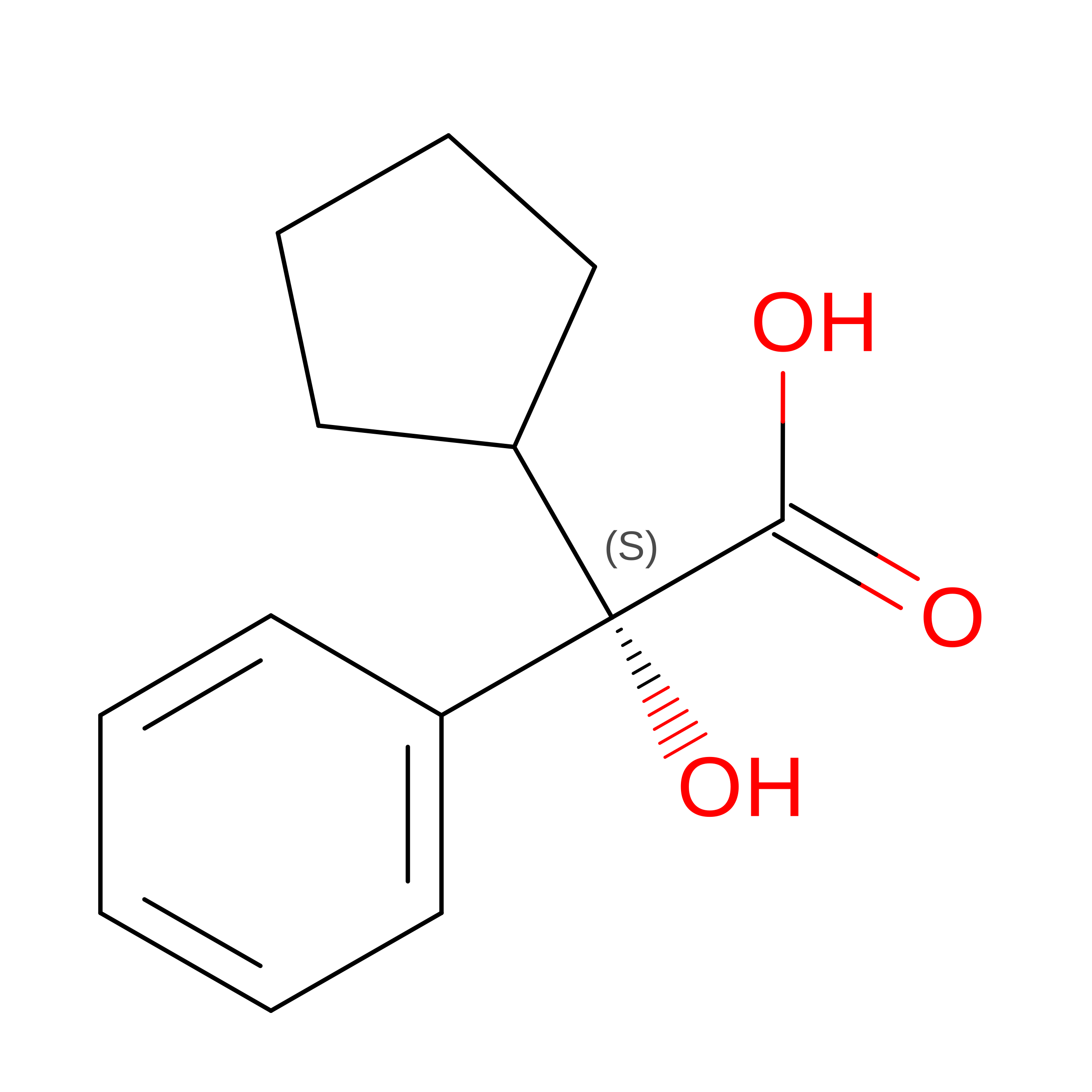
VCQ
(Subject of Investigation/LOI)

Query on VCQ


Download:Ideal Coordinates CCD File
B [auth A](2~{S})-2-cyclopentyl-2-oxidanyl-2-phenyl-ethanoic acid
C13 H16 O3
WFLUEQCOAQCQLP-CYBMUJFWSA-N

Experimental Data & Validation

Experimental Data

  • Method: X-RAY DIFFRACTION
  • Resolution: 1.78 Å
  • R-Value Free:  0.224 (Depositor), 0.224 (DCC) 
  • R-Value Work:  0.188 (Depositor), 0.188 (DCC) 
  • R-Value Observed: 0.190 (Depositor) 
Space Group: P 61
Unit Cell:
Length ( Å )Angle ( ˚ )
a = 104.32α = 90
b = 104.32β = 90
c = 55.986γ = 120
Software Package:
Software NamePurpose
DIALSdata reduction
Aimlessdata scaling
PHASERphasing
PHENIXrefinement

Structure Validation

View Full Validation Report


Ligand Structure Quality Assessment 


Entry History 

& Funding Information

Deposition Data


Funding OrganizationLocationGrant Number
LundbeckfondenDenmarkR190-2014-3710

Revision History  (Full details and data files)

  • Version 1.0: 2022-11-02
    Type: Initial release
  • Version 1.1: 2022-11-23
    Changes: Database references
  • Version 1.2: 2024-01-31
    Changes: Data collection, Refinement description