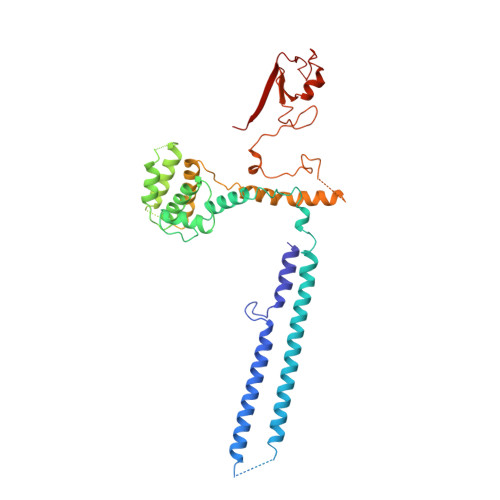
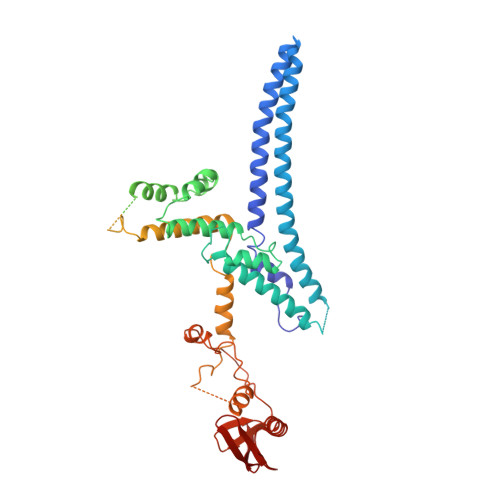
7NS4 | pdb_00007ns4

Catalytic module of yeast Chelator-GID SR4 E3 ubiquitin ligase


Experimental Data Snapshot

  • Method: ELECTRON MICROSCOPY
  • Resolution: 3.90 Å
  • Aggregation State: PARTICLE 
  • Reconstruction Method: SINGLE PARTICLE 

wwPDB Validation 3D Report Full Report

Validation slider image for 7NS4

This is version 1.5 of the entry. See complete history

Literature

GID E3 ligase supramolecular chelate assembly configures multipronged ubiquitin targeting of an oligomeric metabolic enzyme.

Sherpa, D.Chrustowicz, J.Qiao, S.Langlois, C.R.Hehl, L.A.Gottemukkala, K.V.Hansen, F.M.Karayel, O.von Gronau, S.Prabu, J.R.Mann, M.Alpi, A.F.Schulman, B.A.

(2021) Mol Cell 81: 2445

  • DOI: https://doi.org/10.1016/j.molcel.2021.03.025
  • Primary Citation Related Structures: 
    7NS3, 7NS4, 7NS5, 7NSB, 7NSC

  • PubMed Abstract: 

    How are E3 ubiquitin ligases configured to match substrate quaternary structures? Here, by studying the yeast GID complex (mutation of which causes deficiency in glucose-induced degradation of gluconeogenic enzymes), we discover supramolecular chelate assembly as an E3 ligase strategy for targeting an oligomeric substrate. Cryoelectron microscopy (cryo-EM) structures show that, to bind the tetrameric substrate fructose-1,6-bisphosphatase (Fbp1), two minimally functional GID E3s assemble into the 20-protein Chelator-GID SR4 , which resembles an organometallic supramolecular chelate. The Chelator-GID SR4 assembly avidly binds multiple Fbp1 degrons so that multiple Fbp1 protomers are simultaneously ubiquitylated at lysines near the allosteric and substrate binding sites. Importantly, key structural and biochemical features, including capacity for supramolecular assembly, are preserved in the human ortholog, the CTLH E3. Based on our integrative structural, biochemical, and cell biological data, we propose that higher-order E3 ligase assembly generally enables multipronged targeting, capable of simultaneously incapacitating multiple protomers and functionalities of oligomeric substrates.


  • Organizational Affiliation
    • Department of Molecular Machines and Signaling, Max Planck Institute of Biochemistry, Martinsried 82152, Germany.

Macromolecule Content 

  • Total Structure Weight: 109.35 kDa 
  • Atom Count: 5,465 
  • Modeled Residue Count: 698 
  • Deposited Residue Count: 937 
  • Unique protein chains: 2

Macromolecules

Find similar proteins by:|  3D Structure
Entity ID: 1
MoleculeChains  Sequence LengthOrganismDetailsImage
E3 ubiquitin-protein ligase RMD5A [auth b]421Saccharomyces cerevisiae S288CMutation(s): 0 
Gene Names: RMD5GID2YDR255CYD9320A.05c
EC: 2.3.2.27
UniProt
Find proteins for Q12508 (Saccharomyces cerevisiae (strain ATCC 204508 / S288c))
Explore Q12508 
Go to UniProtKB:  Q12508
Entity Groups
Sequence Clusters30% Identity50% Identity70% Identity90% Identity95% Identity100% Identity
UniProt GroupQ12508
Sequence Annotations
Expand
Reference Sequence
Find similar proteins by:|  3D Structure
Entity ID: 2
MoleculeChains  Sequence LengthOrganismDetailsImage
Protein FYV10B [auth i]516Saccharomyces cerevisiae S288CMutation(s): 0 
Gene Names: FYV10GID9YIL097W
EC: 2.3.2.27
UniProt
Find proteins for P40492 (Saccharomyces cerevisiae (strain ATCC 204508 / S288c))
Explore P40492 
Go to UniProtKB:  P40492
Entity Groups
Sequence Clusters30% Identity50% Identity70% Identity90% Identity95% Identity100% Identity
UniProt GroupP40492
Sequence Annotations
Expand
Reference Sequence

Experimental Data & Validation

Experimental Data

  • Method: ELECTRON MICROSCOPY
  • Resolution: 3.90 Å
  • Aggregation State: PARTICLE 
  • Reconstruction Method: SINGLE PARTICLE 
EM Software:
TaskSoftware PackageVersion
MODEL REFINEMENTPHENIX

Structure Validation

View Full Validation Report


Entry History 

& Funding Information

Deposition Data


Funding OrganizationLocationGrant Number
European Research Council (ERC)Germany789016-NEDD8Activate
German Research Foundation (DFG)GermanySCHU 3196/1-1

Revision History  (Full details and data files)

  • Version 1.0: 2021-05-05
    Type: Initial release
  • Version 1.1: 2021-05-12
    Changes: Database references, Derived calculations
  • Version 1.2: 2021-06-09
    Changes: Derived calculations
  • Version 1.3: 2021-06-16
    Changes: Database references
  • Version 1.4: 2024-07-10
    Changes: Data collection, Database references
  • Version 1.5: 2025-07-02
    Changes: Data collection, Structure summary