Download Mendeley
The periplasmic domains of Vibriocholerae ToxR and ToxS are forming a strong heterodimeric complex independent on the redox state of ToxR cysteines.
Gubensak, N., Wagner, G.E., Schrank, E., Falsone, F.S., Berger, T.M.I., Pavkov-Keller, T., Reidl, J., Zangger, K.(2021) Mol Microbiol 115: 1277-1291
- PubMed: 33368680 Search on PubMedSearch on PubMed Central
- DOI: https://doi.org/10.1111/mmi.14673
- Primary Citation Related Structures:
7NN6 - PubMed Abstract:
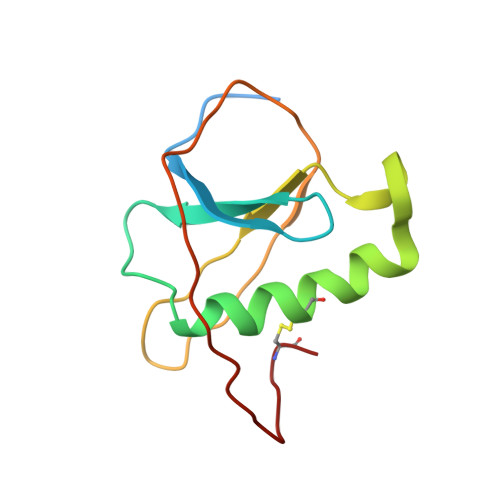
The transmembrane protein ToxR plays a key role in the virulence expression system of Vibrio cholerae. The activity of ToxR is dependent on its periplasmic sensor domain (ToxRp) and on the inner membrane protein ToxS. Herein, we present the Nuclear Magnetic Resonance NMR solution structure of the sensory ToxRp containing an intramolecular disulfide bond. The presented structural and dynamic experiments with reduced and oxidized ToxRp propose an explanation for the increased proteolytic sensitivity of reduced ToxR. Additionally, for the first time, we could identify the formation of a strong heterodimer complex between the periplasmic domains of ToxR and ToxS in solution. NMR interaction studies reveal that binding of ToxS is not dependent on the redox state of ToxR cysteines, and formed complexes are structurally similar. By monitoring the proteolytic cleavage of ToxRp with NMR, we additionally provide a direct evidence of ToxS protective function. Taken together our results suggest that ToxR activity is regulated by its stability which is, on the one hand, dependent on the redox states of its cysteines, influencing the stability of its fold, and on the other hand, on its interaction with ToxS, which binds independent on the cysteines and acts as a protection against proteases.
- Institute of Chemistry/Organic and Bioorganic Chemistry, University of Graz, Graz, Austria.
Organizational Affiliation: