7N8S | pdb_00007n8s

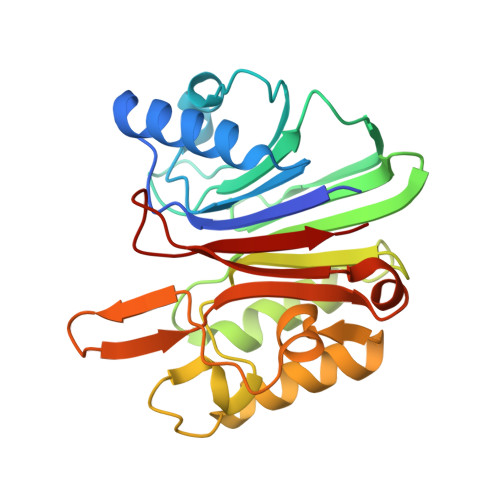
LINE-1 endonuclease domain complex with DNA


Experimental Data Snapshot

  • Method: X-RAY DIFFRACTION
  • Resolution: 2.79 Å
  • R-Value Free: 
    0.322 (Depositor), 0.321 (DCC) 
  • R-Value Work: 
    0.264 (Depositor), 0.263 (DCC) 
  • R-Value Observed: 
    0.269 (Depositor) 

Starting Model: experimental
View more details

wwPDB Validation 3D Report Full Report

Validation slider image for 7N8S

This is version 1.3 of the entry. See complete history

Literature

Structural dissection of sequence recognition and catalytic mechanism of human LINE-1 endonuclease.

Miller, I.Totrov, M.Korotchkina, L.Kazyulkin, D.N.Gudkov, A.V.Korolev, S.

(2021) Nucleic Acids Res 49: 11350-11366

  • DOI: https://doi.org/10.1093/nar/gkab826
  • Primary Citation Related Structures: 
    7N8K, 7N8S, 7N94

  • PubMed Abstract: 

    Long interspersed nuclear element-1 (L1) is an autonomous non-LTR retrotransposon comprising ∼20% of the human genome. L1 self-propagation causes genomic instability and is strongly associated with aging, cancer and other diseases. The endonuclease domain of L1's ORFp2 protein (L1-EN) initiates de novo L1 integration by nicking the consensus sequence 5'-TTTTT/AA-3'. In contrast, related nucleases including structurally conserved apurinic/apyrimidinic endonuclease 1 (APE1) are non-sequence specific. To investigate mechanisms underlying sequence recognition and catalysis by L1-EN, we solved crystal structures of L1-EN complexed with DNA substrates. This showed that conformational properties of the preferred sequence drive L1-EN's sequence-specificity and catalysis. Unlike APE1, L1-EN does not bend the DNA helix, but rather causes 'compression' near the cleavage site. This provides multiple advantages for L1-EN's role in retrotransposition including facilitating use of the nicked poly-T DNA strand as a primer for reverse transcription. We also observed two alternative conformations of the scissile bond phosphate, which allowed us to model distinct conformations for a nucleophilic attack and a transition state that are likely applicable to the entire family of nucleases. This work adds to our mechanistic understanding of L1-EN and related nucleases and should facilitate development of L1-EN inhibitors as potential anticancer and antiaging therapeutics.


  • Organizational Affiliation
    • Edward A. Doisy Department of Biochemistry and Molecular Biology, Saint Louis University School of Medicine, St. Louis, MO 63104, USA.

Macromolecule Content 

  • Total Structure Weight: 36.25 kDa 
  • Atom Count: 2,527 
  • Modeled Residue Count: 262 
  • Deposited Residue Count: 268 
  • Unique protein chains: 1
  • Unique nucleic acid chains: 2

Macromolecules


Find similar proteins by:|  3D Structure
Entity ID: 1
MoleculeChains  Sequence LengthOrganismDetailsImage
LINE-1 retrotransposable element ORF2 protein238Homo sapiensMutation(s): 2 
EC: 2.7.7.49 (PDB Primary Data), 3.1.21 (PDB Primary Data)
UniProt
Find proteins for O00370 (Homo sapiens)
Explore O00370 
Go to UniProtKB:  O00370
Entity Groups
Sequence Clusters30% Identity50% Identity70% Identity90% Identity95% Identity100% Identity
UniProt GroupO00370
Sequence Annotations
Expand
Reference Sequence
Find similar nucleic acids by:  Sequence
Entity ID: 2
MoleculeChains LengthOrganismImage
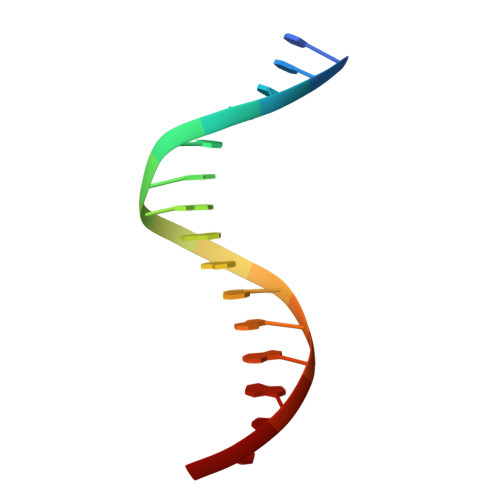
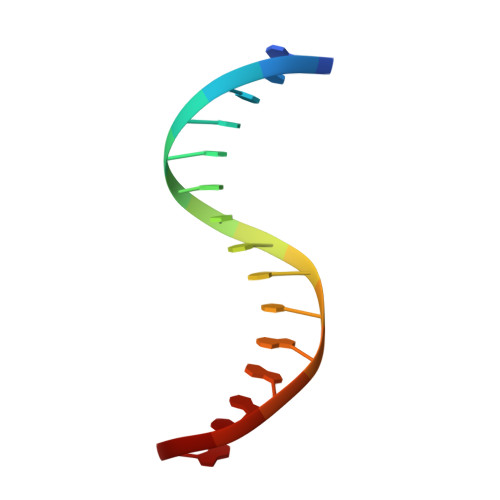
DNA (5'-D(*CP*CP*TP*TP*AP*AP*AP*AP*AP*GP*GP*AP*GP*CP*T)-3')B [auth D]15Homo sapiens
Sequence Annotations
Expand
Reference Sequence
Find similar nucleic acids by:  Sequence
Entity ID: 3
MoleculeChains LengthOrganismImage
DNA (5'-D(*GP*CP*TP*CP*CP*TP*TP*TP*TP*TP*AP*AP*GP*GP*A)-3')15Homo sapiens
Sequence Annotations
Expand
Reference Sequence

Experimental Data & Validation

Experimental Data

  • Method: X-RAY DIFFRACTION
  • Resolution: 2.79 Å
  • R-Value Free:  0.322 (Depositor), 0.321 (DCC) 
  • R-Value Work:  0.264 (Depositor), 0.263 (DCC) 
  • R-Value Observed: 0.269 (Depositor) 
Space Group: P 61 2 2
Unit Cell:
Length ( Å )Angle ( ˚ )
a = 91.613α = 90
b = 91.613β = 90
c = 229.822γ = 120
Software Package:
Software NamePurpose
PHENIXrefinement
PHENIXrefinement
HKL-2000data reduction
SCALEPACKdata scaling
PHENIXphasing

Structure Validation

View Full Validation Report


Entry History 

Deposition Data

Revision History  (Full details and data files)

  • Version 1.0: 2021-10-13
    Type: Initial release
  • Version 1.1: 2021-11-17
    Changes: Database references
  • Version 1.2: 2023-10-18
    Changes: Data collection, Refinement description
  • Version 1.3: 2024-10-16
    Changes: Structure summary