7N07 | pdb_00007n07

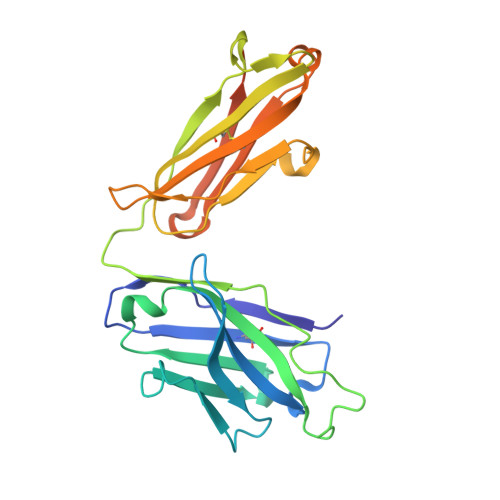
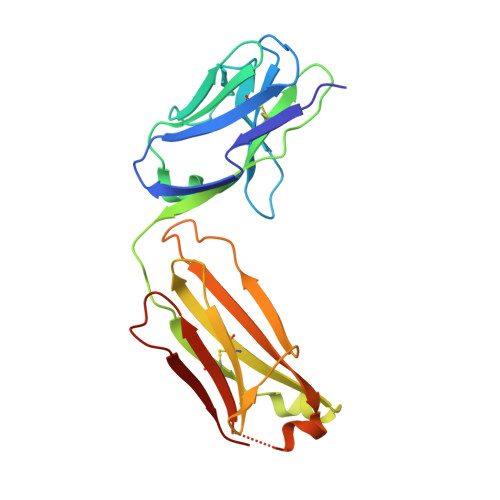
Crystal structure of the apo 3D6 antibody fragment

  • Classification: IMMUNE SYSTEM
  • Organism(s): Homo sapiens
  • Expression System: Homo sapiens
  • Mutation(s): No 

  • Deposited: 2021-05-25 Released: 2022-03-30 
  • Deposition Author(s): Cook, J.D., Lee, J.E.
  • Funding Organization(s): Canadian Institutes of Health Research (CIHR), Ontario Early Researcher Awards, Canada Research Chairs, Canada Foundation for Innovation

Experimental Data Snapshot

  • Method: X-RAY DIFFRACTION
  • Resolution: 2.40 Å
  • R-Value Free: 
    0.239 (Depositor), 0.248 (DCC) 
  • R-Value Work: 
    0.195 (Depositor), 0.204 (DCC) 
  • R-Value Observed: 
    0.199 (Depositor) 

Starting Model: experimental
View more details

wwPDB Validation 3D Report Full Report

Validation slider image for 7N07

This is version 1.3 of the entry. See complete history

Literature

Conformational plasticity of the HIV-1 gp41 immunodominant region is recognized by multiple non-neutralizing antibodies.

Cook, J.D.Khondker, A.Lee, J.E.

(2022) Commun Biol 5: 291-291

  • DOI: https://doi.org/10.1038/s42003-022-03235-w
  • Primary Citation Related Structures: 
    7N04, 7N05, 7N07, 7N08

  • PubMed Abstract: 

    The early humoral immune response to acute HIV-1 infection is largely non-neutralizing. The principal target of these antibodies is the primary immunodominant region (PID) on the gp41 fusion protein. The PID is a highly conserved 15-residue region displayed on the surface of HIV-1 virions. In this study, we analyzed the humoral determinants of HIV-1 gp41 PID binding using biophysical, structural, and computational methods. In complex with a patient-derived near-germline antibody fragment, the PID motif adopts an elongated random coil, whereas the PID bound to affinity-matured Fab adopts a strand-turn-helix conformation. Molecular dynamics simulations showed that the PID is structurally plastic suggesting that the PID can form an ensemble of structural states recognized by various non-neutralizing antibodies, facilitating HIV-1 immunodominance observed in acute and chronic HIV-1 infections. An improved understanding of how the HIV-1 gp41 PID misdirects the early humoral response should guide the development of an effective HIV-1 vaccine.


  • Organizational Affiliation
    • Department of Laboratory Medicine and Pathobiology, Temerty Faculty of Medicine, University of Toronto, Toronto, ON, M5S 1A8, Canada.

Macromolecule Content 

  • Total Structure Weight: 50.11 kDa 
  • Atom Count: 3,382 
  • Modeled Residue Count: 433 
  • Deposited Residue Count: 459 
  • Unique protein chains: 2

Macromolecules

Find similar proteins by:|  3D Structure
Entity ID: 1
MoleculeChains  Sequence LengthOrganismDetailsImage
Fab 3D6 heavy chainA [auth H]247Homo sapiensMutation(s): 0 
Find similar proteins by:|  3D Structure
Entity ID: 2
MoleculeChains  Sequence LengthOrganismDetailsImage
Fab 3D6 light chainB [auth L]212Homo sapiensMutation(s): 0 

Experimental Data & Validation

Experimental Data

  • Method: X-RAY DIFFRACTION
  • Resolution: 2.40 Å
  • R-Value Free:  0.239 (Depositor), 0.248 (DCC) 
  • R-Value Work:  0.195 (Depositor), 0.204 (DCC) 
  • R-Value Observed: 0.199 (Depositor) 
Space Group: P 43 21 2
Unit Cell:
Length ( Å )Angle ( ˚ )
a = 84.429α = 90
b = 84.429β = 90
c = 161.022γ = 90
Software Package:
Software NamePurpose
REFMACrefinement
Aimlessdata scaling
PDB_EXTRACTdata extraction
XDSdata reduction
PHASERphasing

Structure Validation

View Full Validation Report


Entry History 

& Funding Information

Deposition Data


Funding OrganizationLocationGrant Number
Canadian Institutes of Health Research (CIHR)CanadaMOP-115066
Canadian Institutes of Health Research (CIHR)CanadaPJT-173301
Ontario Early Researcher AwardsCanadaER-13-09-116
Canada Research ChairsCanada950-231672
Canada Foundation for InnovationCanada--

Revision History  (Full details and data files)

  • Version 1.0: 2022-03-30
    Type: Initial release
  • Version 1.1: 2022-04-13
    Changes: Database references
  • Version 1.2: 2023-10-18
    Changes: Data collection, Refinement description
  • Version 1.3: 2024-11-06
    Changes: Structure summary