7LY6 | pdb_00007ly6

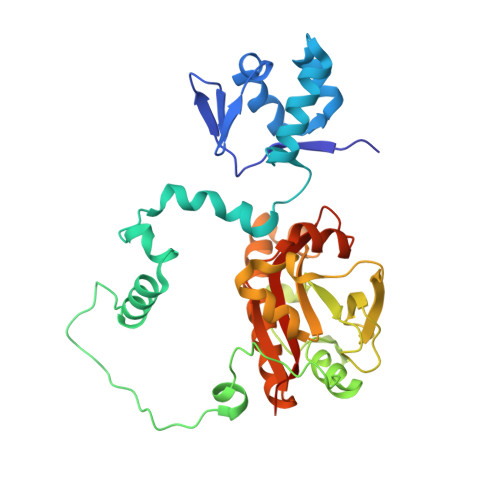
Structure of a trans-acting NRPS oxidase, BmdC, involved in bacillamide biosynthesis


Experimental Data Snapshot

  • Method: X-RAY DIFFRACTION
  • Resolution: 2.73 Å
  • R-Value Free: 
    0.194 (Depositor), 0.197 (DCC) 
  • R-Value Work: 
    0.172 (Depositor), 0.172 (DCC) 
  • R-Value Observed: 
    0.173 (Depositor) 

Starting Model: experimental
View more details

wwPDB Validation 3D Report Full Report

Validation slider image for 7LY6

Ligand Structure Quality Assessment 


This is version 1.2 of the entry. See complete history

Literature

Structures and function of a tailoring oxidase in complex with a nonribosomal peptide synthetase module.

Fortinez, C.M.Bloudoff, K.Harrigan, C.Sharon, I.Strauss, M.Schmeing, T.M.

(2022) Nat Commun 13: 548-548

  • DOI: https://doi.org/10.1038/s41467-022-28221-y
  • Primary Citation Related Structures: 
    7LY4, 7LY5, 7LY6, 7LY7

  • PubMed Abstract: 

    Nonribosomal peptide synthetases (NRPSs) are large modular enzymes that synthesize secondary metabolites and natural product therapeutics. Most NRPS biosynthetic pathways include an NRPS and additional proteins that introduce chemical modifications before, during or after assembly-line synthesis. The bacillamide biosynthetic pathway is a common, three-protein system, with a decarboxylase that prepares an NRPS substrate, an NRPS, and an oxidase. Here, the pathway is reconstituted in vitro. The oxidase is shown to perform dehydrogenation of the thiazoline in the peptide intermediate while it is covalently attached to the NRPS, as the penultimate step in bacillamide D synthesis. Structural analysis of the oxidase reveals a dimeric, two-lobed architecture with a remnant RiPP recognition element and a dramatic wrapping loop. The oxidase forms a stable complex with the NRPS and dimerizes it. We visualized co-complexes of the oxidase bound to the elongation module of the NRPS using X-ray crystallography and cryo-EM. The three active sites (for adenylation, condensation/cyclization, and oxidation) form an elegant arc to facilitate substrate delivery. The structures enabled a proof-of-principle bioengineering experiment in which the BmdC oxidase domain is embedded into the NRPS.


  • Organizational Affiliation
    • Department of Biochemistry, McGill University, Montréal, QC, H3G 0B1, Canada.

Macromolecule Content 

  • Total Structure Weight: 38.8 kDa 
  • Atom Count: 2,741 
  • Modeled Residue Count: 323 
  • Deposited Residue Count: 336 
  • Unique protein chains: 1

Macromolecules

Find similar proteins by:|  3D Structure
Entity ID: 1
MoleculeChains  Sequence LengthOrganismDetailsImage
BmdC, NRPS oxidase336Thermoactinomyces vulgarisMutation(s): 0 
UniProt
Find proteins for A0A8X6EGY6 (Thermoactinomyces vulgaris)
Explore A0A8X6EGY6 
Go to UniProtKB:  A0A8X6EGY6
Entity Groups
Sequence Clusters30% Identity50% Identity70% Identity90% Identity95% Identity100% Identity
UniProt GroupA0A8X6EGY6
Sequence Annotations
Expand
Reference Sequence

Experimental Data & Validation

Experimental Data

  • Method: X-RAY DIFFRACTION
  • Resolution: 2.73 Å
  • R-Value Free:  0.194 (Depositor), 0.197 (DCC) 
  • R-Value Work:  0.172 (Depositor), 0.172 (DCC) 
  • R-Value Observed: 0.173 (Depositor) 
Space Group: I 21 3
Unit Cell:
Length ( Å )Angle ( ˚ )
a = 188.15α = 90
b = 188.15β = 90
c = 188.15γ = 90
Software Package:
Software NamePurpose
PHENIXrefinement
iMOSFLMdata reduction
Aimlessdata scaling
MoRDaphasing

Structure Validation

View Full Validation Report


Ligand Structure Quality Assessment 


Entry History 

& Funding Information

Deposition Data


Funding OrganizationLocationGrant Number
Canadian Institutes of Health Research (CIHR)CanadaFDN-148472

Revision History  (Full details and data files)

  • Version 1.0: 2022-02-02
    Type: Initial release
  • Version 1.1: 2022-02-09
    Changes: Database references
  • Version 1.2: 2023-10-18
    Changes: Data collection, Refinement description