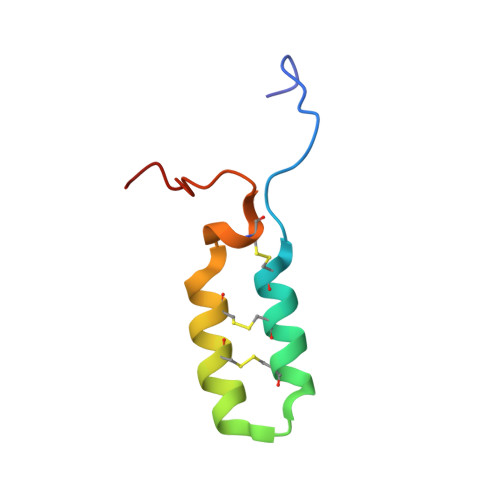
7LXK | pdb_00007lxk

Ara h 1 leader sequence, Ara h 1.0101 (25-83) A25G

  • Classification: ALLERGEN
  • Organism(s): Arachis hypogaea
  • Expression System: Escherichia coli
  • Mutation(s): Yes 

  • Deposited: 2021-03-03 Released: 2022-03-09 
  • Deposition Author(s): Mueller, G., London, R.
  • Funding Organization(s): National Institutes of Health/National Institute of Environmental Health Sciences (NIH/NIEHS)

Experimental Data Snapshot

  • Method: SOLUTION NMR
  • Conformers Calculated: 20 
  • Conformers Submitted: 20 
  • Selection Criteria: structures with the lowest energy 

wwPDB Validation 3D Report Full Report

Validation slider image for 7LXK

This is version 1.2 of the entry. See complete history

Literature

Structure, Immunogenicity, and IgE Cross-Reactivity among Walnut and Peanut Vicilin-Buried Peptides.

Foo, A.C.Y.Nesbit, J.B.Gipson, S.A.Y.Cheng, H.Bushel, P.DeRose, E.F.Schein, C.H.Teuber, S.S.Hurlburt, B.K.Maleki, S.J.Mueller, G.A.

(2022) J Agric Food Chem 70: 2389-2400

  • DOI: https://doi.org/10.1021/acs.jafc.1c07225
  • Primary Citation Related Structures: 
    7LVE, 7LVF, 7LVG, 7LXK

  • PubMed Abstract: 

    Vicilin-buried peptides (VBPs) from edible plants are derived from the N-terminal leader sequences (LSs) of seed storage proteins. VBPs are defined by a common α-hairpin fold mediated by conserved CxxxCx (10-14) CxxxC motifs. Here, peanut and walnut VBPs were characterized as potential mediators of both peanut/walnut allergenicity and cross-reactivity despite their low (∼17%) sequence identity. The structures of one peanut (AH1.1) and 3 walnut (JR2.1, JR2.2, JR2.3) VBPs were solved using solution NMR, revealing similar α-hairpin structures stabilized by disulfide bonds with high levels of surface similarity. Peptide microarrays identified several peptide sequences primarily on AH1.1 and JR2.1, which were recognized by peanut-, walnut-, and dual-allergic patient IgE, establishing these peanut and walnut VBPs as potential mediators of allergenicity and cross-reactivity. JR2.2 and JR2.3 displayed extreme resilience against endosomal digestion, potentially hindering epitope generation and likely contributing to their reduced allergic potential.


  • Organizational Affiliation
    • National Institute of Environmental Health Sciences, 111 T.W. Alexander Dr, MD-MR01, Research Triangle Park, North Carolina 27615, United States.

Macromolecule Content 

  • Total Structure Weight: 6.73 kDa 
  • Atom Count: 466 
  • Modeled Residue Count: 59 
  • Deposited Residue Count: 59 
  • Unique protein chains: 1

Macromolecules

Find similar proteins by:|  3D Structure
Entity ID: 1
MoleculeChains  Sequence LengthOrganismDetailsImage
Allergen Ara h 1, clone P41B59Arachis hypogaeaMutation(s): 1 
UniProt
Find proteins for P43238 (Arachis hypogaea)
Explore P43238 
Go to UniProtKB:  P43238
Entity Groups
Sequence Clusters30% Identity50% Identity70% Identity90% Identity95% Identity100% Identity
UniProt GroupP43238
Sequence Annotations
Expand
Reference Sequence

Experimental Data & Validation

Experimental Data

  • Method: SOLUTION NMR
  • Conformers Calculated: 20 
  • Conformers Submitted: 20 
  • Selection Criteria: structures with the lowest energy 

Structure Validation

View Full Validation Report


Entry History 

& Funding Information

Deposition Data


Funding OrganizationLocationGrant Number
National Institutes of Health/National Institute of Environmental Health Sciences (NIH/NIEHS)United StatesZ01-ES102885-01

Revision History  (Full details and data files)

  • Version 1.0: 2022-03-09
    Type: Initial release
  • Version 1.1: 2023-03-22
    Changes: Database references
  • Version 1.2: 2024-10-23
    Changes: Data collection, Database references, Structure summary