7LJN | pdb_00007ljn

Structure of the Bradyrhizobium diazoefficiens CD-NTase CdnG in complex with GTP


Experimental Data Snapshot

  • Method: X-RAY DIFFRACTION
  • Resolution: 1.60 Å
  • R-Value Free: 
    0.218 (Depositor), 0.177 (DCC) 
  • R-Value Work: 
    0.197 (Depositor) 
  • R-Value Observed: 
    0.197 (Depositor) 

Starting Model: experimental
View more details

wwPDB Validation 3D Report Full Report

Validation slider image for 7LJN

Ligand Structure Quality Assessment 


This is version 1.3 of the entry. See complete history

Literature

Molecular basis of CD-NTase nucleotide selection in CBASS anti-phage defense.

Govande, A.A.Duncan-Lowey, B.Eaglesham, J.B.Whiteley, A.T.Kranzusch, P.J.

(2021) Cell Rep 35: 109206-109206

  • DOI: https://doi.org/10.1016/j.celrep.2021.109206
  • Primary Citation Related Structures: 
    7LJL, 7LJM, 7LJN, 7LJO

  • PubMed Abstract: 

    cGAS/DncV-like nucleotidyltransferase (CD-NTase) enzymes are signaling proteins that initiate antiviral immunity in animal cells and cyclic-oligonucleotide-based anti-phage signaling system (CBASS) phage defense in bacteria. Upon phage recognition, bacterial CD-NTases catalyze synthesis of cyclic-oligonucleotide signals, which activate downstream effectors and execute cell death. How CD-NTases control nucleotide selection to specifically induce defense remains poorly defined. Here, we combine structural and nucleotide-analog interference-mapping approaches to identify molecular rules controlling CD-NTase specificity. Structures of the cyclic trinucleotide synthase Enterobacter cloacae CdnD reveal coordinating nucleotide interactions and a possible role for inverted nucleobase positioning during product synthesis. We demonstrate that correct nucleotide selection in the CD-NTase donor pocket results in the formation of a thermostable-protein-nucleotide complex, and we extend our analysis to establish specific patterns governing selectivity for each of the major bacterial CD-NTase clades A-H. Our results explain CD-NTase specificity and enable predictions of nucleotide second-messenger signals within diverse antiviral systems.


  • Organizational Affiliation
    • Department of Microbiology, Harvard Medical School, Boston, MA 02115, USA; Department of Cancer Immunology and Virology, Dana-Farber Cancer Institute, Boston, MA 02115, USA.

Macromolecule Content 

  • Total Structure Weight: 187.34 kDa 
  • Atom Count: 12,830 
  • Modeled Residue Count: 1,353 
  • Deposited Residue Count: 1,664 
  • Unique protein chains: 1

Macromolecules

Find similar proteins by:|  3D Structure
Entity ID: 1
MoleculeChains  Sequence LengthOrganismDetailsImage
CD-NTase
A, B, C, D
416Bradyrhizobium diazoefficiensMutation(s): 0 
Gene Names: blr0072
EC: 2.7.7.85
UniProt
Find proteins for Q89Y83 (Bradyrhizobium diazoefficiens (strain JCM 10833 / BCRC 13528 / IAM 13628 / NBRC 14792 / USDA 110))
Explore Q89Y83 
Go to UniProtKB:  Q89Y83
Entity Groups
Sequence Clusters30% Identity50% Identity70% Identity90% Identity95% Identity100% Identity
UniProt GroupQ89Y83
Sequence Annotations
Expand
Reference Sequence

Small Molecules

Ligands 2 Unique
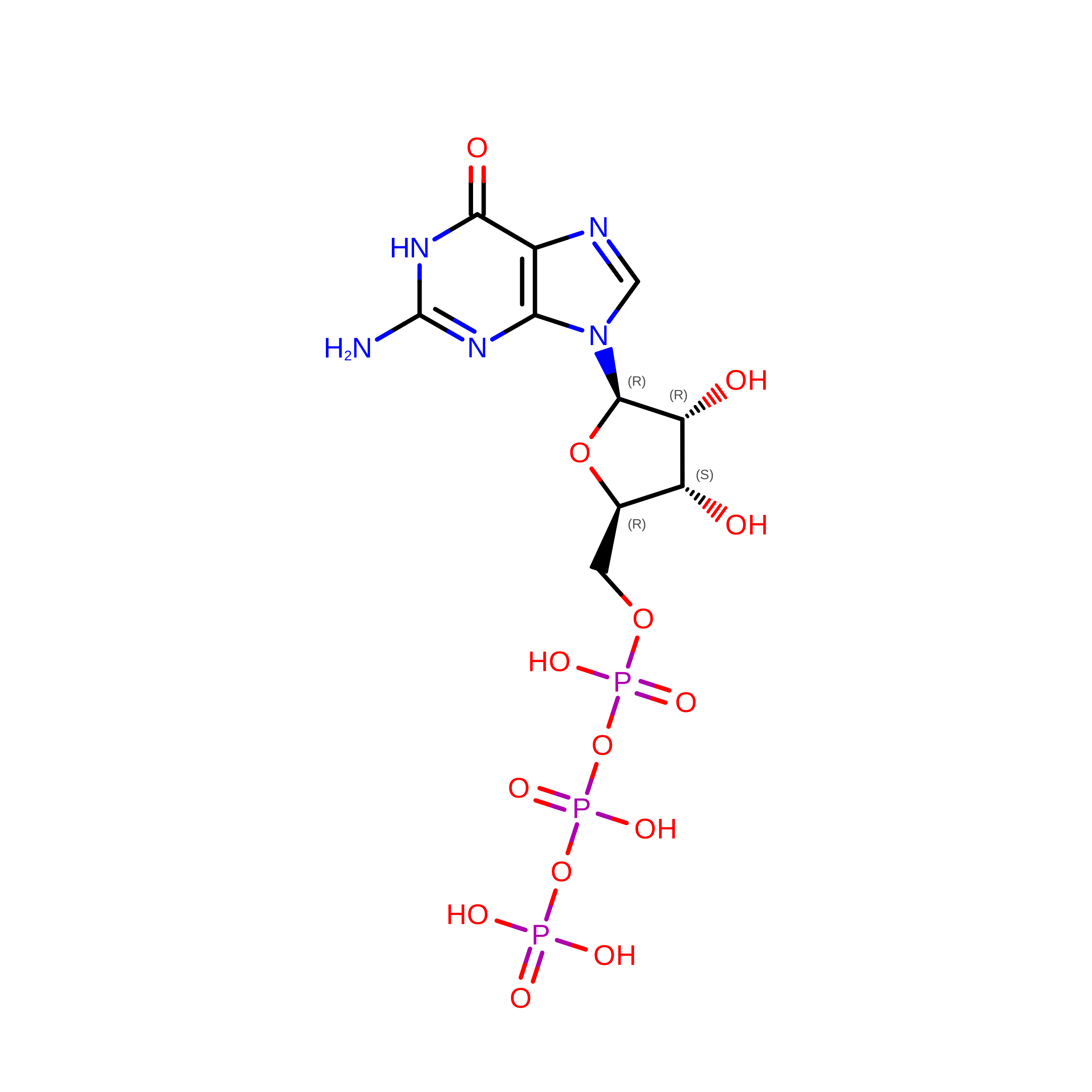
IDChains Name / Formula / InChI Key2D Diagram3D Interactions
GTP
(Subject of Investigation/LOI)

Query on GTP


Download:Ideal Coordinates CCD File
E [auth A],
G [auth B],
I [auth C],
K [auth D]
GUANOSINE-5'-TRIPHOSPHATE
C10 H16 N5 O14 P3
XKMLYUALXHKNFT-UUOKFMHZSA-N
MG

Query on MG


Download:Ideal Coordinates CCD File
F [auth A],
H [auth B],
J [auth C],
L [auth D]
MAGNESIUM ION
Mg
JLVVSXFLKOJNIY-UHFFFAOYSA-N

Experimental Data & Validation

Experimental Data

  • Method: X-RAY DIFFRACTION
  • Resolution: 1.60 Å
  • R-Value Free:  0.218 (Depositor), 0.177 (DCC) 
  • R-Value Work:  0.197 (Depositor) 
  • R-Value Observed: 0.197 (Depositor) 
Space Group: P 1 21 1
Unit Cell:
Length ( Å )Angle ( ˚ )
a = 111.996α = 90
b = 68.687β = 108.405
c = 112.432γ = 90
Software Package:
Software NamePurpose
PHENIXrefinement
XDSdata reduction
Aimlessdata scaling
AutoSolphasing

Structure Validation

View Full Validation Report


Ligand Structure Quality Assessment 


Entry History 

Deposition Data

Revision History  (Full details and data files)

  • Version 1.0: 2021-06-02
    Type: Initial release
  • Version 1.1: 2021-07-14
    Changes: Database references
  • Version 1.2: 2024-03-06
    Changes: Data collection, Database references
  • Version 1.3: 2024-04-03
    Changes: Refinement description