7L0L | pdb_00007l0l

Cryo-EM structure of the VRC316 clinical trial, vaccine-elicited, human antibody 316-310-1B11 in complex with an H2 CAN05 HA trimer


Experimental Data Snapshot

  • Method: ELECTRON MICROSCOPY
  • Resolution: 2.85 Å
  • Aggregation State: PARTICLE 
  • Reconstruction Method: SINGLE PARTICLE 

Starting Model: experimental
View more details

wwPDB Validation 3D Report Full Report

Validation slider image for 7L0L

This is version 1.3 of the entry. See complete history

Literature

A single residue in influenza virus H2 hemagglutinin enhances the breadth of the B cell response elicited by H2 vaccination.

Andrews, S.F.Raab, J.E.Gorman, J.Gillespie, R.A.Cheung, C.S.F.Rawi, R.Cominsky, L.Y.Boyington, J.C.Creanga, A.Shen, C.H.Harris, D.R.Olia, A.S.Nazzari, A.F.Zhou, T.Houser, K.V.Chen, G.L.Mascola, J.R.Graham, B.S.Kanekiyo, M.Ledgerwood, J.E.Kwong, P.D.McDermott, A.B.

(2022) Nat Med 28: 373-382

  • DOI: https://doi.org/10.1038/s41591-021-01636-8
  • Primary Citation Related Structures: 
    7L0L, 7MFG

  • PubMed Abstract: 

    Conserved epitopes on the influenza hemagglutinin (HA) stem are an attractive target for universal vaccine strategies as they elicit broadly neutralizing antibodies. Such antibody responses to stem-specific epitopes have been extensively characterized for HA subtypes H1 and H5 in humans. H2N2 influenza virus circulated 50 years ago and represents a pandemic threat due to the lack of widespread immunity, but, unlike H1 and H5, the H2 HA stem contains Phe45 HA2 predicted to sterically clash with HA stem-binding antibodies characterized to date. To understand the effect of Phe45 HA2 , we compared the HA stem-specific B cell response in post hoc analyses of two phase 1 clinical trials, one testing vaccination with an H2 ferritin nanoparticle immunogen ( NCT03186781 ) and one with an inactivated H5N1 vaccine ( NCT01086657 ). In H2-naive individuals, the magnitude of the B cell response was equivalent, but H2-elicited HA stem-binding B cells displayed greater cross-reactivity than those elicited by H5. However, in individuals with childhood H2 exposure, H5-elicited HA stem-binding B cells also displayed high cross-reactivity, suggesting recall of memory B cells formed 50 years ago. Overall, we propose that a one-residue difference on an HA immunogen can alter establishment and expansion of broadly neutralizing memory B cells. These data have implications for stem-based universal influenza vaccination strategies.


  • Organizational Affiliation
    • Vaccine Research Center, National Institute of Allergy and Infectious Diseases, National Institutes of Health, Bethesda, MD, USA. sarah.andrews2@nih.gov.

Macromolecule Content 

  • Total Structure Weight: 341.77 kDa 
  • Atom Count: 17,211 
  • Modeled Residue Count: 2,166 
  • Deposited Residue Count: 3,054 
  • Unique protein chains: 4

Macromolecules

Find similar proteins by:|  3D Structure
Entity ID: 1
MoleculeChains  Sequence LengthOrganismDetailsImage
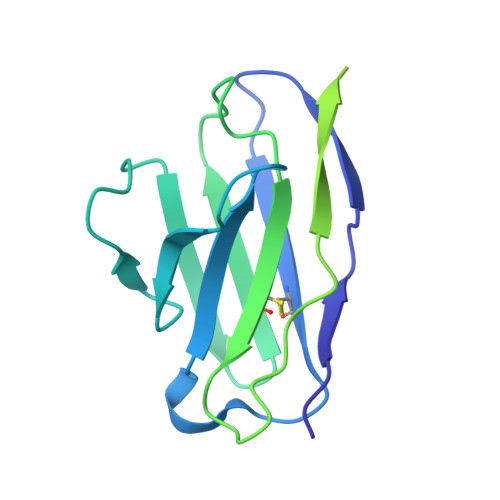
316-310-1B11 Light ChainA [auth L],
E [auth J],
I [auth K]
215Homo sapiensMutation(s): 0 
Find similar proteins by:|  3D Structure
Entity ID: 2
MoleculeChains  Sequence LengthOrganismDetailsImage
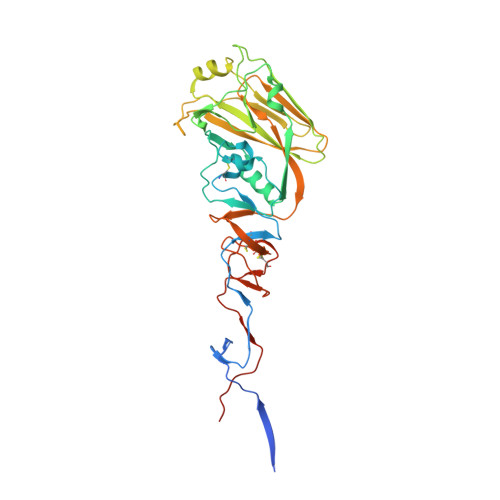
Hemagglutinin HA1 chainB [auth A],
F [auth C],
J [auth D]
345Influenza A virus (A/Canada/720/2005(H2N2))Mutation(s): 0 
Gene Names: HA
UniProt
Find proteins for Q4ZH98 (Influenza A virus)
Explore Q4ZH98 
Go to UniProtKB:  Q4ZH98
Entity Groups
Sequence Clusters30% Identity50% Identity70% Identity90% Identity95% Identity100% Identity
UniProt GroupQ4ZH98
Glycosylation
Glycosylation Sites: 4
Sequence Annotations
Expand
Reference Sequence
Find similar proteins by:|  3D Structure
Entity ID: 3
MoleculeChains  Sequence LengthOrganismDetailsImage
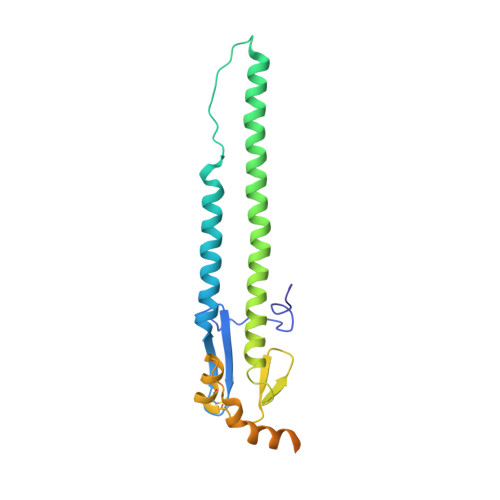
Hemagglutinin HA2 chainC [auth B],
G [auth E],
K [auth F]
222Influenza A virus (A/Canada/720/2005(H2N2))Mutation(s): 0 
Gene Names: HA
UniProt
Find proteins for Q4ZH98 (Influenza A virus)
Explore Q4ZH98 
Go to UniProtKB:  Q4ZH98
Entity Groups
Sequence Clusters30% Identity50% Identity70% Identity90% Identity95% Identity100% Identity
UniProt GroupQ4ZH98
Glycosylation
Glycosylation Sites: 1
Sequence Annotations
Expand
Reference Sequence
Find similar proteins by:|  3D Structure
Entity ID: 4
MoleculeChains  Sequence LengthOrganismDetailsImage
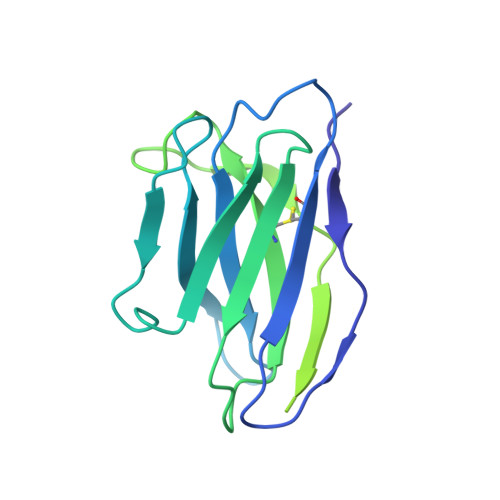
316-310-1B11 Heavy ChainD [auth H],
H [auth G],
L [auth I]
236Homo sapiensMutation(s): 0 

Small Molecules

Ligands 1 Unique
IDChains Name / Formula / InChI Key2D Diagram3D Interactions
NAG

Query on NAG


Download:Ideal Coordinates CCD File
AA [auth F]
M [auth A]
N [auth A]
O [auth A]
P [auth A]
AA [auth F],
M [auth A],
N [auth A],
O [auth A],
P [auth A],
Q [auth B],
R [auth C],
S [auth C],
T [auth C],
U [auth C],
V [auth E],
W [auth D],
X [auth D],
Y [auth D],
Z [auth D]
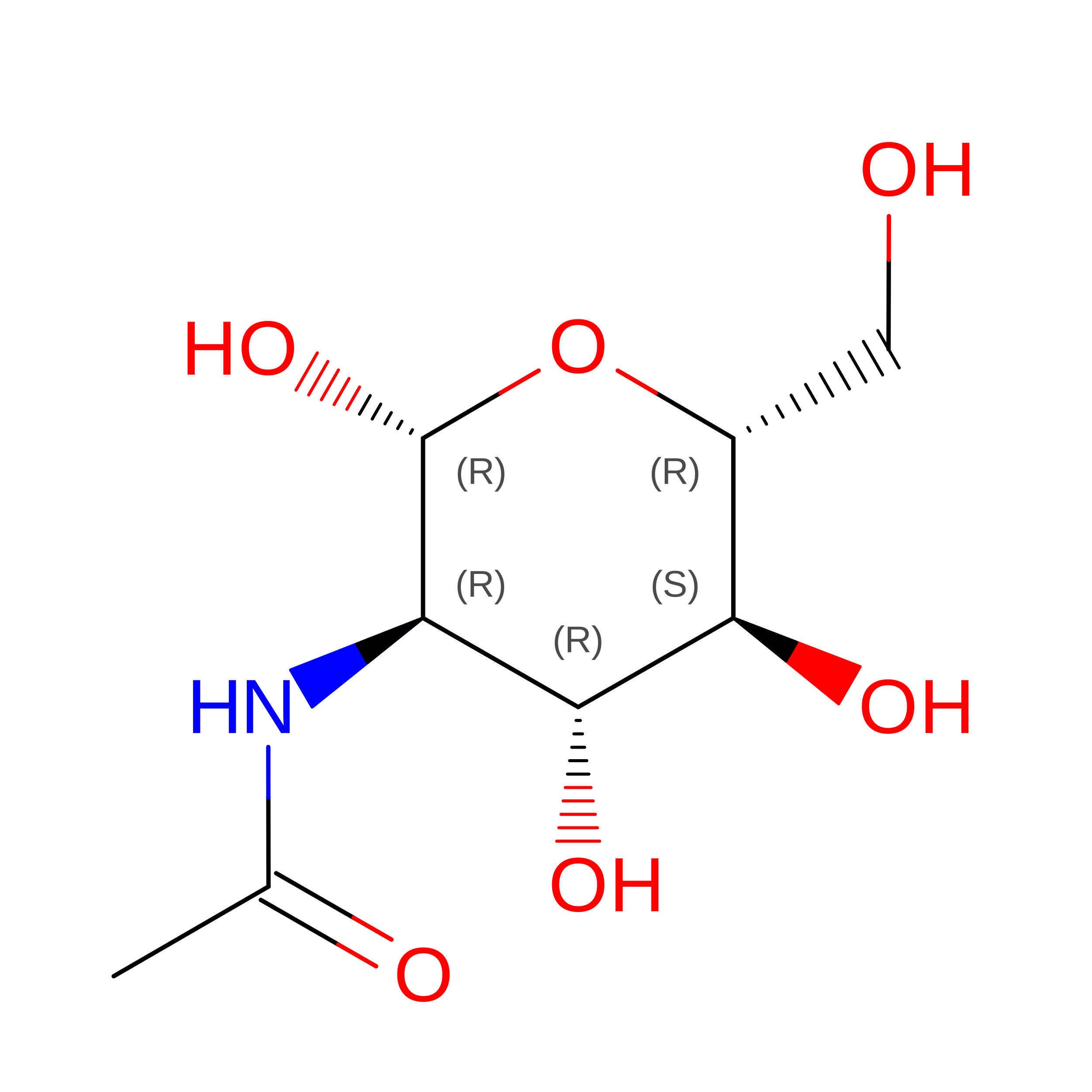
2-acetamido-2-deoxy-beta-D-glucopyranose
C8 H15 N O6
OVRNDRQMDRJTHS-FMDGEEDCSA-N

Experimental Data & Validation

Experimental Data

  • Method: ELECTRON MICROSCOPY
  • Resolution: 2.85 Å
  • Aggregation State: PARTICLE 
  • Reconstruction Method: SINGLE PARTICLE 
EM Software:
TaskSoftware PackageVersion
RECONSTRUCTIONcryoSPARC2.15
MODEL REFINEMENTPHENIX

Structure Validation

View Full Validation Report


Entry History 

& Funding Information

Deposition Data


Funding OrganizationLocationGrant Number
National Institutes of Health/National Institute of General Medical Sciences (NIH/NIGMS)United StatesGM103310
Other privateUnited StatesSimons Foundation (SF349247)

Revision History  (Full details and data files)

  • Version 1.0: 2021-11-03
    Type: Initial release
  • Version 1.1: 2022-02-23
    Changes: Database references
  • Version 1.2: 2022-03-09
    Changes: Database references
  • Version 1.3: 2024-11-13
    Changes: Data collection, Refinement description, Structure summary