7KRI | pdb_00007kri

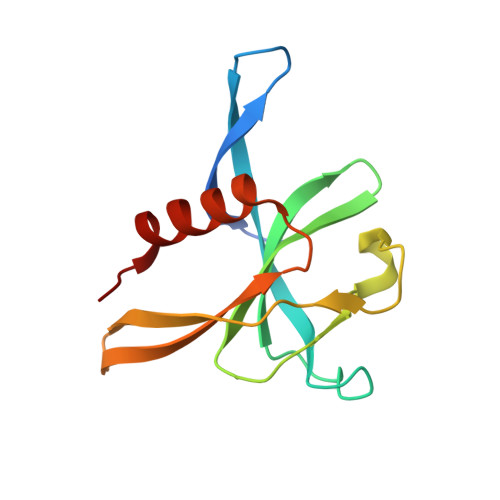
FR6-bound SARS-CoV-2 Nsp9 RNA-replicase


Experimental Data Snapshot

  • Method: X-RAY DIFFRACTION
  • Resolution: 1.58 Å
  • R-Value Free: 
    0.195 (Depositor), 0.196 (DCC) 
  • R-Value Work: 
    0.178 (Depositor), 0.180 (DCC) 
  • R-Value Observed: 
    0.179 (Depositor) 

Starting Model: experimental
View more details

wwPDB Validation 3D Report Full Report

Validation slider image for 7KRI

Ligand Structure Quality Assessment 


This is version 1.4 of the entry. See complete history

Literature

Binding of a pyrimidine RNA base-mimic to SARS-CoV-2 nonstructural protein 9.

Littler, D.R.Mohanty, B.Lowery, S.A.Colson, R.N.Gully, B.S.Perlman, S.Scanlon, M.J.Rossjohn, J.

(2021) J Biological Chem 297: 101018-101018

  • DOI: https://doi.org/10.1016/j.jbc.2021.101018
  • Primary Citation Related Structures: 
    7KRI

  • PubMed Abstract: 

    The coronaviral nonstructural protein 9 (Nsp9) is essential for viral replication; it is the primary substrate of Nsp12's pseudokinase domain within the viral replication transcription complex, an association that also recruits other components during different stages of RNA reproduction. In the unmodified state, Nsp9 forms an obligate homodimer via an essential GxxxG protein-interaction motif, but its ssRNA-binding mechanism remains unknown. Using structural biological techniques, here we show that a base-mimicking compound identified from a small molecule fragment screen engages Nsp9 via a tetrameric Pi-Pi stacking interaction that induces the formation of a parallel trimer-of-dimers. This oligomerization mechanism allows an interchange of "latching" N-termini, the charges of which contribute to a series of electropositive channels that suggests a potential interface for viral RNA. The identified pyrrolo-pyrimidine compound may also serve as a potential starting point for the development of compounds seeking to probe Nsp9's role within SARS-CoV-2 replication.


  • Organizational Affiliation
    • Infection and Immunity Program, Department of Biochemistry and Molecular Biology, Biomedicine Discovery Institute, Monash University, Clayton, Victoria, Australia. Electronic address: dene.littler@monash.edu.

Macromolecule Content 

  • Total Structure Weight: 45.24 kDa 
  • Atom Count: 3,307 
  • Modeled Residue Count: 377 
  • Deposited Residue Count: 399 
  • Unique protein chains: 1

Macromolecules

Find similar proteins by:|  3D Structure
Entity ID: 1
MoleculeChains  Sequence LengthOrganismDetailsImage
Non-structural protein 9
A, B, C
133Severe acute respiratory syndrome coronavirus 2Mutation(s): 0 
Gene Names: rep1a-1b
UniProt
Find proteins for P0DTD1 (Severe acute respiratory syndrome coronavirus 2)
Explore P0DTD1 
Go to UniProtKB:  P0DTD1
Entity Groups
Sequence Clusters30% Identity50% Identity70% Identity90% Identity95% Identity100% Identity
UniProt GroupP0DTD1
Sequence Annotations
Expand
Reference Sequence

Small Molecules

Ligands 3 Unique
IDChains Name / Formula / InChI Key2D Diagram3D Interactions
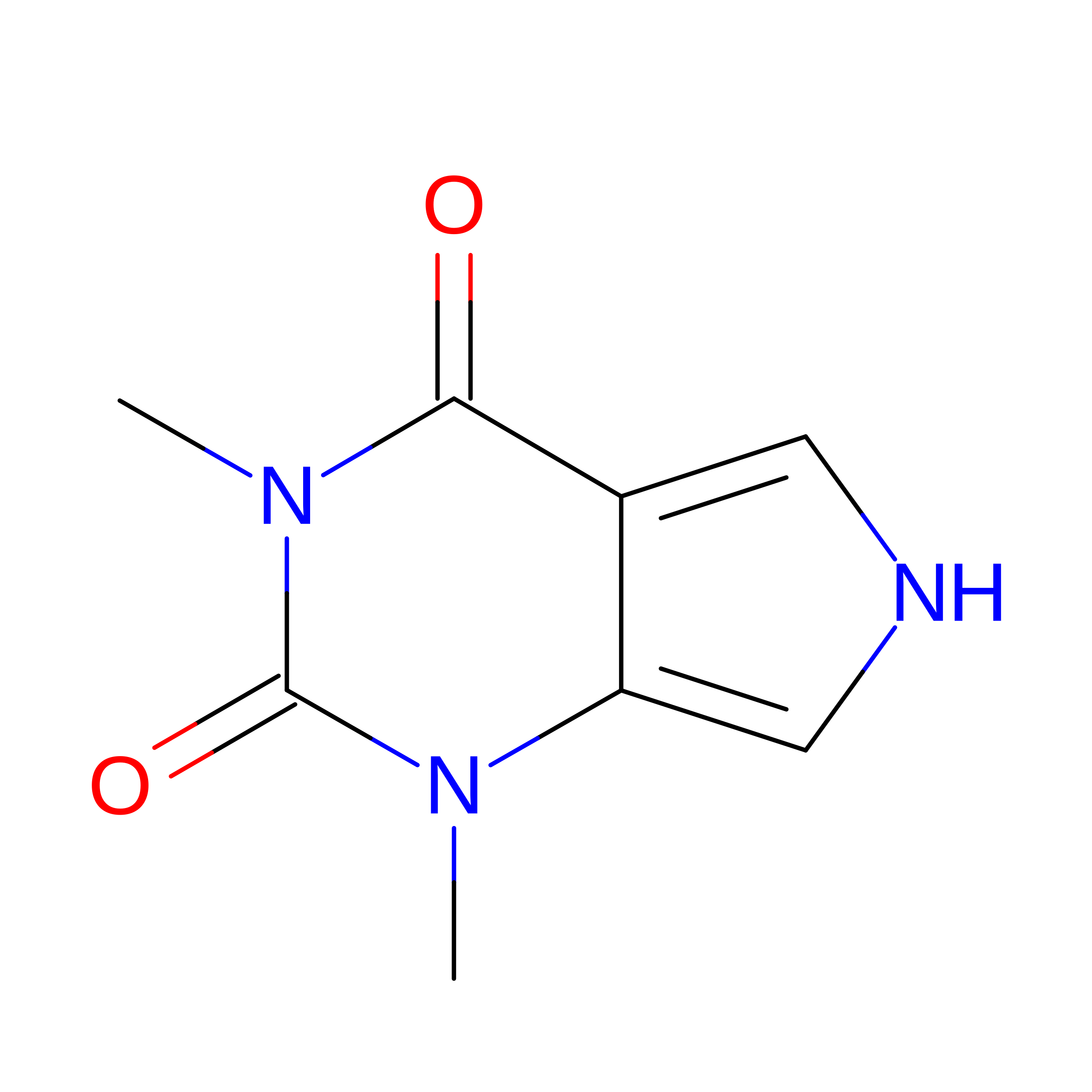
X0Y
(Subject of Investigation/LOI)

Query on X0Y


Download:Ideal Coordinates CCD File
E [auth A]
F [auth A]
H [auth B]
I [auth B]
L [auth C]
E [auth A],
F [auth A],
H [auth B],
I [auth B],
L [auth C],
M [auth C]
1,3-dimethyl-1H-pyrrolo[3,4-d]pyrimidine-2,4(3H,6H)-dione
C8 H9 N3 O2
MNPOFAXKBZPGNK-UHFFFAOYSA-N
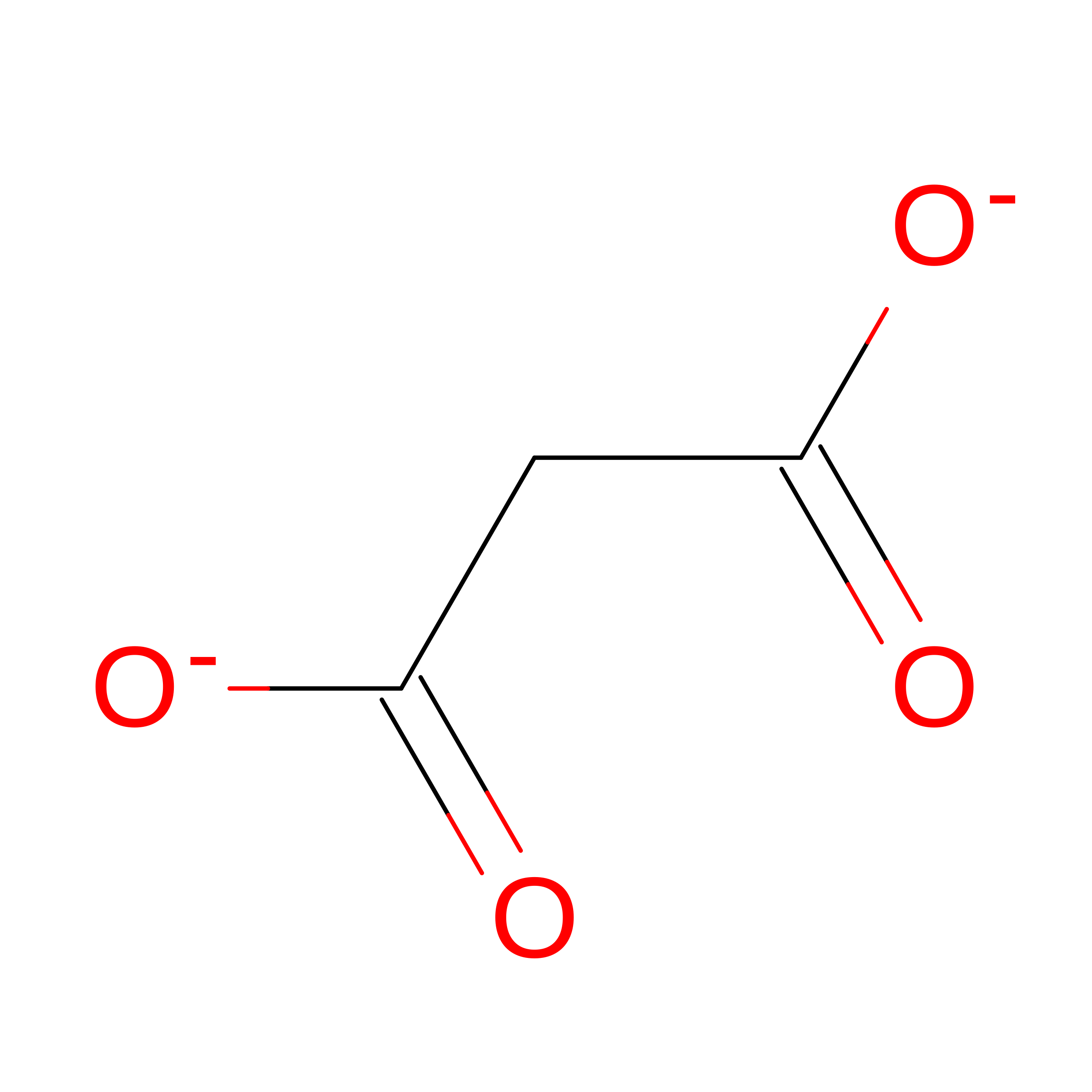
MLI

Query on MLI


Download:Ideal Coordinates CCD File
K [auth C]MALONATE ION
C3 H2 O4
OFOBLEOULBTSOW-UHFFFAOYSA-L
SO4

Query on SO4


Download:Ideal Coordinates CCD File
D [auth A],
G [auth B],
J [auth C]
SULFATE ION
O4 S
QAOWNCQODCNURD-UHFFFAOYSA-L

Experimental Data & Validation

Experimental Data

  • Method: X-RAY DIFFRACTION
  • Resolution: 1.58 Å
  • R-Value Free:  0.195 (Depositor), 0.196 (DCC) 
  • R-Value Work:  0.178 (Depositor), 0.180 (DCC) 
  • R-Value Observed: 0.179 (Depositor) 
Space Group: P 32 2 1
Unit Cell:
Length ( Å )Angle ( ˚ )
a = 109.459α = 90
b = 109.459β = 90
c = 77.046γ = 120
Software Package:
Software NamePurpose
PHENIXrefinement
HKL-2000data reduction
Aimlessdata scaling
PHASERphasing

Structure Validation

View Full Validation Report


Ligand Structure Quality Assessment 


Entry History 

Deposition Data

Revision History  (Full details and data files)

  • Version 1.0: 2021-07-21
    Type: Initial release
  • Version 1.1: 2021-08-04
    Changes: Database references
  • Version 1.2: 2021-08-25
    Changes: Database references
  • Version 1.3: 2021-09-01
    Changes: Database references
  • Version 1.4: 2023-10-18
    Changes: Data collection, Refinement description