7KP9 | pdb_00007kp9

asymmetric hTNF-alpha


Experimental Data Snapshot

  • Method: X-RAY DIFFRACTION
  • Resolution: 2.15 Å
  • R-Value Free: 
    0.241 (Depositor), 0.251 (DCC) 
  • R-Value Work: 
    0.188 (Depositor), 0.197 (DCC) 
  • R-Value Observed: 
    0.190 (Depositor) 

Starting Model: other
View more details

wwPDB Validation 3D Report Full Report

Validation slider image for 7KP9

Ligand Structure Quality Assessment 


This is version 1.3 of the entry. See complete history

Literature

Structural insights into the disruption of TNF-TNFR1 signalling by small molecules stabilising a distorted TNF.

McMillan, D.Martinez-Fleites, C.Porter, J.Fox 3rd, D.Davis, R.Mori, P.Ceska, T.Carrington, B.Lawson, A.Bourne, T.O'Connell, J.

(2021) Nat Commun 12: 582-582

  • DOI: https://doi.org/10.1038/s41467-020-20828-3
  • Primary Citation Related Structures: 
    7KP7, 7KP8, 7KP9

  • PubMed Abstract: 

    Tumour necrosis factor (TNF) is a trimeric protein which signals through two membrane receptors, TNFR1 and TNFR2. Previously, we identified small molecules that inhibit human TNF by stabilising a distorted trimer and reduce the number of receptors bound to TNF from three to two. Here we present a biochemical and structural characterisation of the small molecule-stabilised TNF-TNFR1 complex, providing insights into how a distorted TNF trimer can alter signalling function. We demonstrate that the inhibitors reduce the binding affinity of TNF to the third TNFR1 molecule. In support of this, we show by X-ray crystallography that the inhibitor-bound, distorted, TNF trimer forms a complex with a dimer of TNFR1 molecules. This observation, along with data from a solution-based network assembly assay, leads us to suggest a model for TNF signalling based on TNF-TNFR1 clusters, which are disrupted by small molecule inhibitors.


  • Organizational Affiliation
    • UCB Pharma, Slough, SL1 3WE, UK. david.mcmillan@ucb.com.

Macromolecule Content 

  • Total Structure Weight: 52.82 kDa 
  • Atom Count: 3,373 
  • Modeled Residue Count: 418 
  • Deposited Residue Count: 474 
  • Unique protein chains: 1

Macromolecules

Find similar proteins by:|  3D Structure
Entity ID: 1
MoleculeChains  Sequence LengthOrganismDetailsImage
Tumor necrosis factor
A, B, C
158Homo sapiensMutation(s): 0 
Gene Names: TNFTNFATNFSF2
UniProt & NIH Common Fund Data Resources
Find proteins for P01375 (Homo sapiens)
Explore P01375 
Go to UniProtKB:  P01375
PHAROS:  P01375
GTEx:  ENSG00000232810 
Entity Groups
Sequence Clusters30% Identity50% Identity70% Identity90% Identity95% Identity100% Identity
UniProt GroupP01375
Sequence Annotations
Expand
Reference Sequence

Small Molecules

Ligands 1 Unique
IDChains Name / Formula / InChI Key2D Diagram3D Interactions
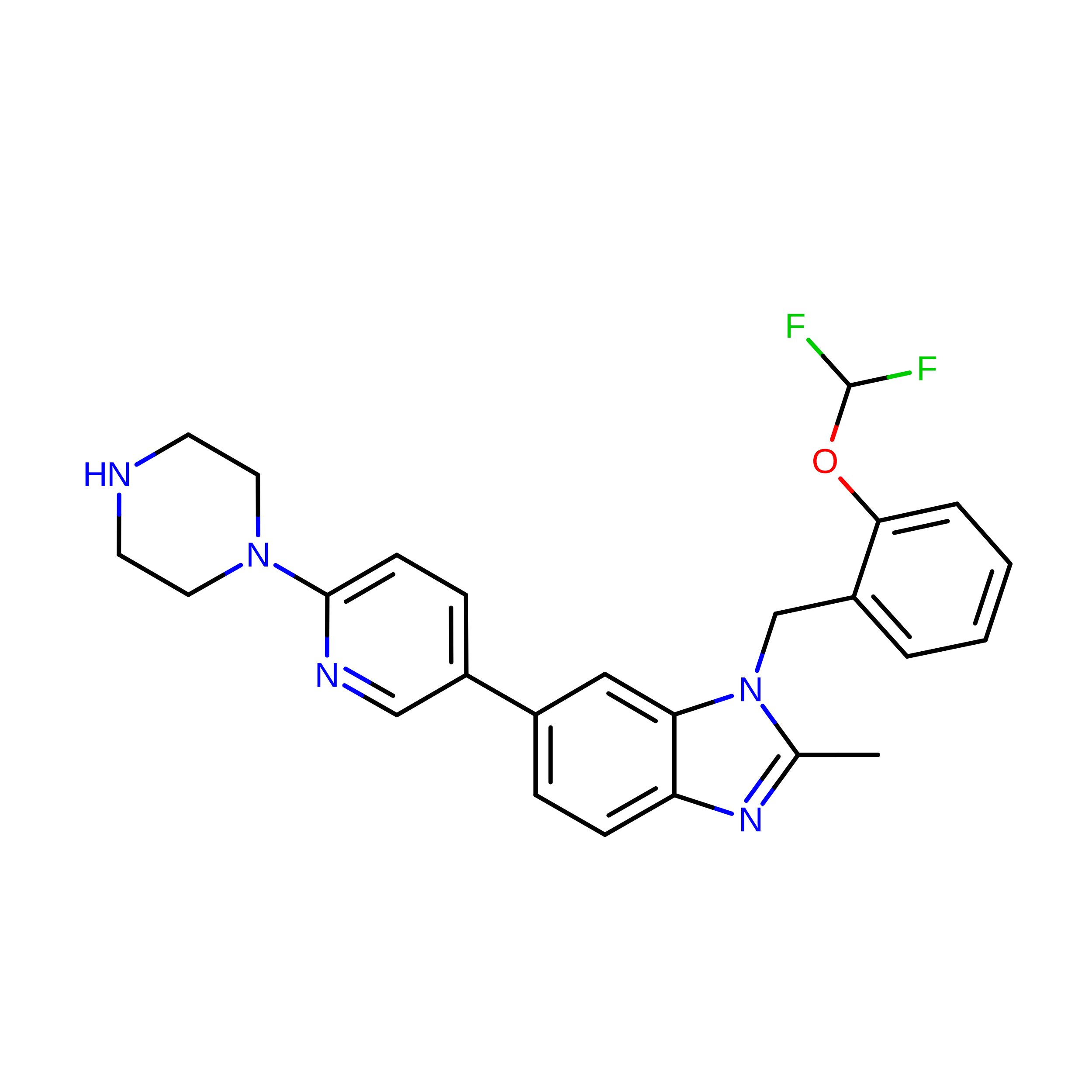
A7G
(Subject of Investigation/LOI)

Query on A7G


Download:Ideal Coordinates CCD File
D [auth C]1-{[2-(difluoromethoxy)phenyl]methyl}-2-methyl-6-[6-(piperazin-1-yl)pyridin-3-yl]-1H-benzimidazole
C25 H25 F2 N5 O
LRHACCJNWLLTDS-UHFFFAOYSA-N

Experimental Data & Validation

Experimental Data

  • Method: X-RAY DIFFRACTION
  • Resolution: 2.15 Å
  • R-Value Free:  0.241 (Depositor), 0.251 (DCC) 
  • R-Value Work:  0.188 (Depositor), 0.197 (DCC) 
  • R-Value Observed: 0.190 (Depositor) 
Space Group: P 21 21 21
Unit Cell:
Length ( Å )Angle ( ˚ )
a = 54.52α = 90
b = 81.96β = 90
c = 93.24γ = 90
Software Package:
Software NamePurpose
REFMACrefinement
XDSdata reduction
XSCALEdata scaling
REFMACphasing

Structure Validation

View Full Validation Report


Ligand Structure Quality Assessment 


Entry History 

Deposition Data

Revision History  (Full details and data files)

  • Version 1.0: 2021-01-13
    Type: Initial release
  • Version 1.1: 2021-02-03
    Changes: Database references
  • Version 1.2: 2024-04-03
    Changes: Data collection, Database references, Refinement description
  • Version 1.3: 2024-10-16
    Changes: Structure summary