7KDR | pdb_00007kdr

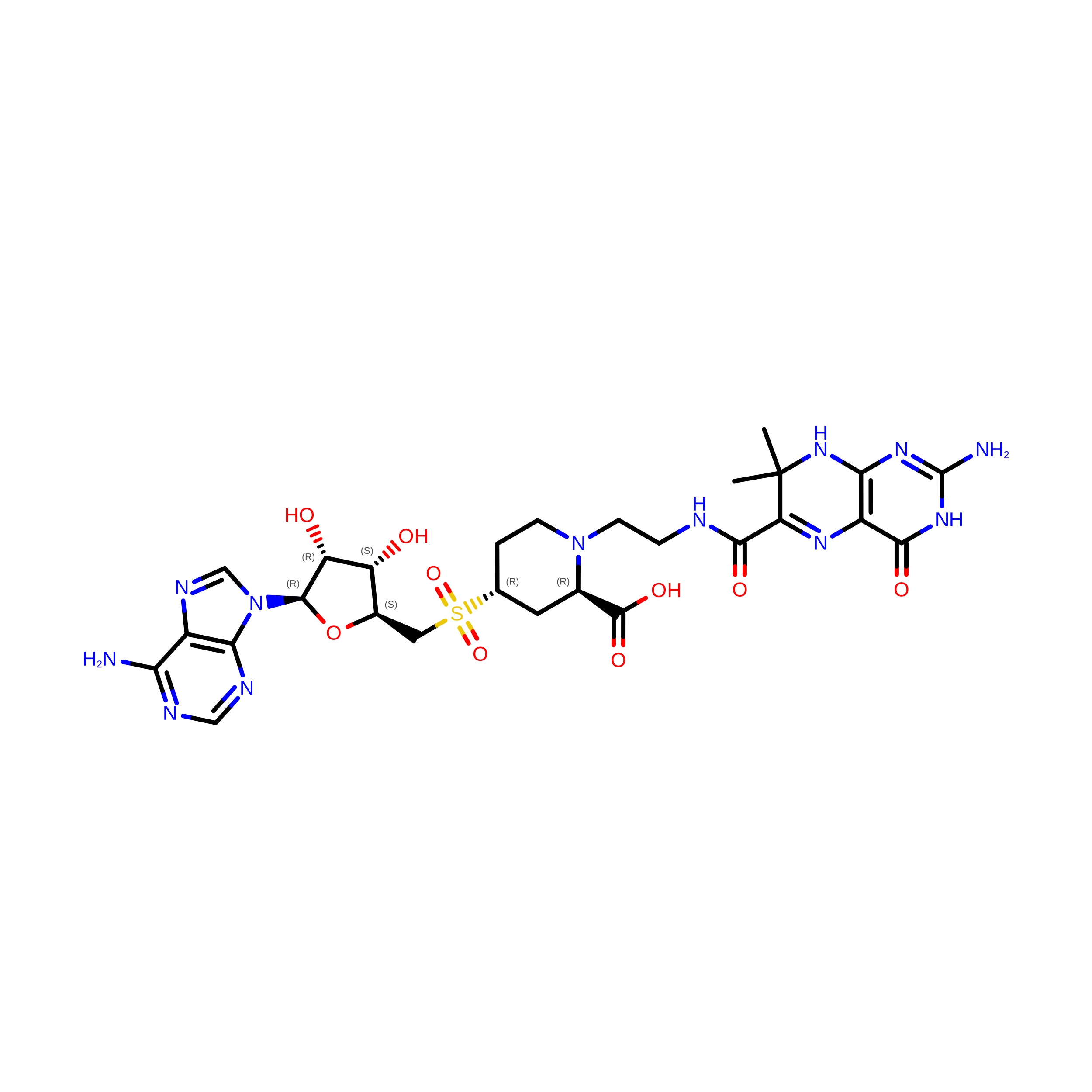
Crystal structure of Escherichia coli HPPK in complex with bisubstrate inhibitor HP-75


Experimental Data Snapshot

  • Method: X-RAY DIFFRACTION
  • Resolution: 1.49 Å
  • R-Value Free: 
    0.201 (Depositor), 0.202 (DCC) 
  • R-Value Work: 
    0.162 (Depositor), 0.163 (DCC) 
  • R-Value Observed: 
    0.164 (Depositor) 

Starting Model: experimental
View more details

wwPDB Validation 3D Report Full Report

Validation slider image for 7KDR

Ligand Structure Quality Assessment 


This is version 1.2 of the entry. See complete history

Literature

Bisubstrate inhibitors of 6-hydroxymethyl-7,8-dihydropterin pyrophosphokinase: Transition state analogs for high affinity binding.

Shi, G.Shaw, G.X.Zhu, F.Tarasov, S.G.Ji, X.

(2021) Bioorg Med Chem 29: 115847-115847

  • DOI: https://doi.org/10.1016/j.bmc.2020.115847
  • Primary Citation Related Structures: 
    7KDO, 7KDR

  • PubMed Abstract: 

    6-Hydroxymethyl-7,8-dihydropterin pyrophosphokinase (HPPK) is a key enzyme in the folate biosynthesis pathway. It catalyzes pyrophosphoryl transfer from ATP to 6-hydroxymethyl-7,8-dihydropterin (HP). HPPK is essential for microorganisms but absent in mammals; therefore, it is an attractive target for developing novel antimicrobial agents. Previously, based on our studies of the structure and mechanism of HPPK, we created first-generation bisubstrate inhibitors by linking 6-hydroxymethylpterin to adenosine through phosphate groups, and developed second-generation inhibitors by replacing the phosphate bridge with a linkage that contains a piperidine moiety. Here, we report third-generation inhibitors designed based on the piperidine-containing inhibitor, mimicking the transition state. We synthesized two such inhibitors, characterized their protein-binding and enzyme inhibition properties, and determined their crystal structures in complex with HPPK, advancing the development of such bisubstrate analog inhibitors.


  • Organizational Affiliation
    • Macromolecular Crystallography Laboratory, National Cancer Institute, Frederick, MD, USA.

Macromolecule Content 

  • Total Structure Weight: 18.83 kDa 
  • Atom Count: 1,656 
  • Modeled Residue Count: 158 
  • Deposited Residue Count: 158 
  • Unique protein chains: 1

Macromolecules

Find similar proteins by:|  3D Structure
Entity ID: 1
MoleculeChains  Sequence LengthOrganismDetailsImage
2-amino-4-hydroxy-6-hydroxymethyldihydropteridine pyrophosphokinase158Escherichia coli K-12Mutation(s): 0 
Gene Names: folKb0142JW0138
EC: 2.7.6.3
UniProt
Find proteins for P26281 (Escherichia coli (strain K12))
Explore P26281 
Go to UniProtKB:  P26281
Entity Groups
Sequence Clusters30% Identity50% Identity70% Identity90% Identity95% Identity100% Identity
UniProt GroupP26281
Sequence Annotations
Expand
Reference Sequence

Experimental Data & Validation

Experimental Data

  • Method: X-RAY DIFFRACTION
  • Resolution: 1.49 Å
  • R-Value Free:  0.201 (Depositor), 0.202 (DCC) 
  • R-Value Work:  0.162 (Depositor), 0.163 (DCC) 
  • R-Value Observed: 0.164 (Depositor) 
Space Group: C 1 2 1
Unit Cell:
Length ( Å )Angle ( ˚ )
a = 61.446α = 90
b = 42.797β = 101.54
c = 56.283γ = 90
Software Package:
Software NamePurpose
DENZOdata reduction
SCALEPACKdata scaling
PHENIXrefinement
PDB_EXTRACTdata extraction
PHENIXphasing

Structure Validation

View Full Validation Report


Ligand Structure Quality Assessment 


Entry History 

Deposition Data

Revision History  (Full details and data files)

  • Version 1.0: 2020-12-02
    Type: Initial release
  • Version 1.1: 2021-02-03
    Changes: Database references
  • Version 1.2: 2023-10-18
    Changes: Data collection, Database references, Refinement description