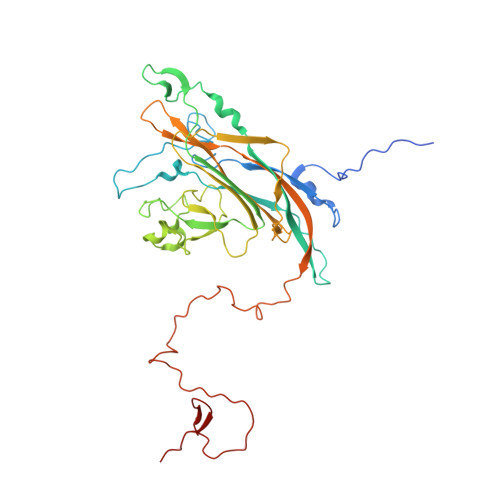
7K25 | pdb_00007k25

Murine polyomavirus hexavalent capsomer, subparticle reconstruction

  • Classification: VIRAL PROTEIN
  • Organism(s): Alphapolyomavirus muris
  • Expression System: Mus musculoides
  • Mutation(s): No 

  • Deposited: 2020-09-08 Released: 2020-10-07 
  • Deposition Author(s): Goetschius, D.J., Hafenstein, S.L.
  • Funding Organization(s): National Institutes of Health/National Institute of Neurological Disorders and Stroke (NIH/NINDS), National Institutes of Health/National Institute Of Allergy and Infectious Diseases (NIH/NIAID), National Institutes of Health/National Cancer Institute (NIH/NCI)

Experimental Data Snapshot

  • Method: ELECTRON MICROSCOPY
  • Resolution: 2.90 Å
  • Aggregation State: PARTICLE 
  • Reconstruction Method: SINGLE PARTICLE 

Starting Models: experimental
View more details

wwPDB Validation 3D Report Full Report

Validation slider image for 7K25

This is version 1.1 of the entry. See complete history

Literature

Antibody escape by polyomavirus capsid mutation facilitates neurovirulence.

Lauver, M.D.Goetschius, D.J.Netherby-Winslow, C.S.Ayers, K.N.Jin, G.Haas, D.G.Frost, E.L.Cho, S.H.Bator, C.Bywaters, S.M.Christensen, N.D.Hafenstein, S.L.Lukacher, A.E.

(2020) Elife 9

  • DOI: https://doi.org/10.7554/eLife.61056
  • Primary Citation Related Structures: 
    7K22, 7K23, 7K24, 7K25

  • PubMed Abstract: 

    JCPyV polyomavirus, a member of the human virome, causes progressive multifocal leukoencephalopathy (PML), an oft-fatal demyelinating brain disease in individuals receiving immunomodulatory therapies. Mutations in the major viral capsid protein, VP1, are common in JCPyV from PML patients (JCPyV-PML) but whether they confer neurovirulence or escape from virus-neutralizing antibody (nAb) in vivo is unknown. A mouse polyomavirus (MuPyV) with a sequence-equivalent JCPyV-PML VP1 mutation replicated poorly in the kidney, a major reservoir for JCPyV persistence, but retained the CNS infectivity, cell tropism, and neuropathology of the parental virus. This mutation rendered MuPyV resistant to a monoclonal Ab (mAb), whose specificity overlapped the endogenous anti-VP1 response. Using cryo-EM and a custom sub-particle refinement approach, we resolved an MuPyV:Fab complex map to 3.2 Å resolution. The structure revealed the mechanism of mAb evasion. Our findings demonstrate convergence between nAb evasion and CNS neurovirulence in vivo by a frequent JCPyV-PML VP1 mutation.


  • Organizational Affiliation
    • Department of Microbiology and Immunology, Penn State College of Medicine, Hershey, United States.

Macromolecule Content 

  • Total Structure Weight: 212.47 kDa 
  • Atom Count: 14,005 
  • Modeled Residue Count: 1,796 
  • Deposited Residue Count: 1,915 
  • Unique protein chains: 1

Macromolecules

Find similar proteins by:|  3D Structure
Entity ID: 1
MoleculeChains  Sequence LengthOrganismDetailsImage
Capsid protein VP1
A, B, C, D, E
383Alphapolyomavirus murisMutation(s): 0 
UniProt
Find proteins for P49302 (Murine polyomavirus (strain P16 small-plaque))
Explore P49302 
Go to UniProtKB:  P49302
Entity Groups
Sequence Clusters30% Identity50% Identity70% Identity90% Identity95% Identity100% Identity
UniProt GroupP49302
Sequence Annotations
Expand
Reference Sequence

Experimental Data & Validation

Experimental Data

  • Method: ELECTRON MICROSCOPY
  • Resolution: 2.90 Å
  • Aggregation State: PARTICLE 
  • Reconstruction Method: SINGLE PARTICLE 
EM Software:
TaskSoftware PackageVersion
MODEL REFINEMENTCoot
MODEL REFINEMENTPHENIX
RECONSTRUCTIONRELION3.1

Structure Validation

View Full Validation Report


Entry History 

& Funding Information

Deposition Data


Funding OrganizationLocationGrant Number
National Institutes of Health/National Institute of Neurological Disorders and Stroke (NIH/NINDS)United StatesR01NS088367
National Institutes of Health/National Institute of Neurological Disorders and Stroke (NIH/NINDS)United StatesR01NS092662
National Institutes of Health/National Institute Of Allergy and Infectious Diseases (NIH/NIAID)United StatesR01AI107121
National Institutes of Health/National Institute of Neurological Disorders and Stroke (NIH/NINDS)United StatesF32NS106730
National Institutes of Health/National Institute of Neurological Disorders and Stroke (NIH/NINDS)United StatesF31NS083336
National Institutes of Health/National Cancer Institute (NIH/NCI)United StatesT32CA060395

Revision History  (Full details and data files)

  • Version 1.0: 2020-10-07
    Type: Initial release
  • Version 1.1: 2024-10-30
    Changes: Data collection, Database references, Refinement description, Structure summary