7JZI | pdb_00007jzi

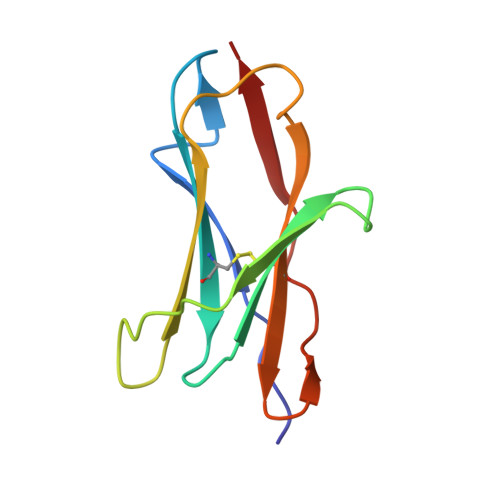
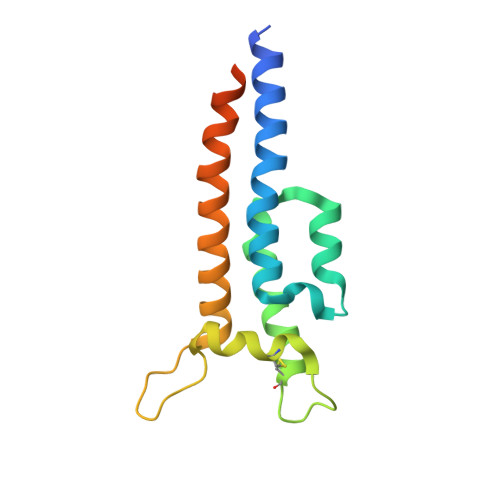
Crystal structure of LAIR1 ectodomain (from MGD21) in complex with Plasmodium RIFIN (PF3D7_1040300) V2 domain


Experimental Data Snapshot

  • Method: X-RAY DIFFRACTION
  • Resolution: 2.71 Å
  • R-Value Free: 
    0.281 (Depositor), 0.286 (DCC) 
  • R-Value Work: 
    0.240 (Depositor) 
  • R-Value Observed: 
    0.244 (Depositor) 

wwPDB Validation 3D Report Full Report

Validation slider image for 7JZI

This is version 1.2 of the entry. See complete history

Literature

Structural basis of LAIR1 targeting by polymorphic Plasmodium RIFINs.

Xu, K.Wang, Y.Shen, C.H.Chen, Y.Zhang, B.Liu, K.Tsybovsky, Y.Wang, S.Farney, S.K.Gorman, J.Stephens, T.Verardi, R.Yang, Y.Zhou, T.Chuang, G.Y.Lanzavecchia, A.Piccoli, L.Kwong, P.D.

(2021) Nat Commun 12: 4226-4226

  • DOI: https://doi.org/10.1038/s41467-021-24291-6
  • Primary Citation Related Structures: 
    7JZ1, 7JZ4, 7JZI, 7JZK

  • PubMed Abstract: 

    RIFIN, a large family of Plasmodium variant surface antigens, plays a crucial role in malaria pathogenesis by mediating immune suppression through activation of inhibitory receptors such as LAIR1, and antibodies with LAIR1 inserts have been identified that bind infected erythrocytes through RIFIN. However, details of RIFIN-mediated LAIR1 recognition and receptor activation have been unclear. Here, we use negative-stain EM to define the architecture of LAIR1-inserted antibodies and determine crystal structures of RIFIN-variable 2 (V2) domain in complex with a LAIR1 domain. These structures reveal the LAIR1-binding region of RIFIN to be hydrophobic and membrane-distal, to exhibit extensive structural diversity, and to interact with RIFIN-V2 in a one-to-one fashion. Through structural and sequence analysis of various LAIR1 constructs, we identify essential elements of RIFIN-binding on LAIR1. Furthermore, a structure-derived LAIR1-binding sequence signature ascertained >20 LAIR1-binding RIFINs, including some from P. falciparum field strains and Plasmodium species infecting gorillas and chimpanzees.


  • Organizational Affiliation
    • Vaccine Research Center, National Institute of Allergy and Infectious Diseases, National Institutes of Health, Bethesda, MD, USA. xu.4692@osu.edu.

Macromolecule Content 

  • Total Structure Weight: 52.82 kDa 
  • Atom Count: 3,430 
  • Modeled Residue Count: 450 
  • Deposited Residue Count: 486 
  • Unique protein chains: 2

Macromolecules

Find similar proteins by:|  3D Structure
Entity ID: 1
MoleculeChains  Sequence LengthOrganismDetailsImage
LAIR1 ectodomain from antibody MGD21
A, C
98Homo sapiensMutation(s): 0 
UniProt
Find proteins for A0A6B9UEV8 (Homo sapiens)
Explore A0A6B9UEV8 
Go to UniProtKB:  A0A6B9UEV8
Entity Groups
Sequence Clusters30% Identity50% Identity70% Identity90% Identity95% Identity100% Identity
UniProt GroupA0A6B9UEV8
Sequence Annotations
Expand
Reference Sequence
Find similar proteins by:|  3D Structure
Entity ID: 2
MoleculeChains  Sequence LengthOrganismDetailsImage
Rifin
B, D
145Plasmodium falciparum NF54Mutation(s): 0 
Gene Names: CK202_4895
UniProt
Find proteins for Q8IJ06 (Plasmodium falciparum (isolate 3D7))
Explore Q8IJ06 
Go to UniProtKB:  Q8IJ06
Entity Groups
Sequence Clusters30% Identity50% Identity70% Identity90% Identity95% Identity100% Identity
UniProt GroupQ8IJ06
Sequence Annotations
Expand
Reference Sequence

Experimental Data & Validation

Experimental Data

  • Method: X-RAY DIFFRACTION
  • Resolution: 2.71 Å
  • R-Value Free:  0.281 (Depositor), 0.286 (DCC) 
  • R-Value Work:  0.240 (Depositor) 
  • R-Value Observed: 0.244 (Depositor) 
Space Group: C 1 2 1
Unit Cell:
Length ( Å )Angle ( ˚ )
a = 144.409α = 90
b = 72.178β = 91.08
c = 57.917γ = 90
Software Package:
Software NamePurpose
PHENIXrefinement
SCALEPACKdata scaling
SOLVEphasing
PDB_EXTRACTdata extraction
HKL-2000data reduction

Structure Validation

View Full Validation Report


Entry History 

Deposition Data

Revision History  (Full details and data files)

  • Version 1.0: 2021-05-26
    Type: Initial release
  • Version 1.1: 2021-09-22
    Changes: Database references
  • Version 1.2: 2024-10-23
    Changes: Data collection, Refinement description, Structure summary