7FIC | pdb_00007fic

Reversible lysine-targeted probes reveal residence time-based kinase selectivity in vivo


Experimental Data Snapshot

  • Method: X-RAY DIFFRACTION
  • Resolution: 2.32 Å
  • R-Value Free: 
    0.274 (Depositor), 0.285 (DCC) 
  • R-Value Work: 
    0.236 (Depositor), 0.256 (DCC) 
  • R-Value Observed: 
    0.237 (Depositor) 

Starting Model: experimental
View more details

wwPDB Validation 3D Report Full Report

Validation slider image for 7FIC

Ligand Structure Quality Assessment 


This is version 1.3 of the entry. See complete history

Literature

Reversible lysine-targeted probes reveal residence time-based kinase selectivity.

Yang, T.Cuesta, A.Wan, X.Craven, G.B.Hirakawa, B.Khamphavong, P.May, J.R.Kath, J.C.Lapek Jr., J.D.Niessen, S.Burlingame, A.L.Carelli, J.D.Taunton, J.

(2022) Nat Chem Biol 18: 934-941

  • DOI: https://doi.org/10.1038/s41589-022-01019-1
  • Primary Citation Related Structures: 
    7FIC

  • PubMed Abstract: 

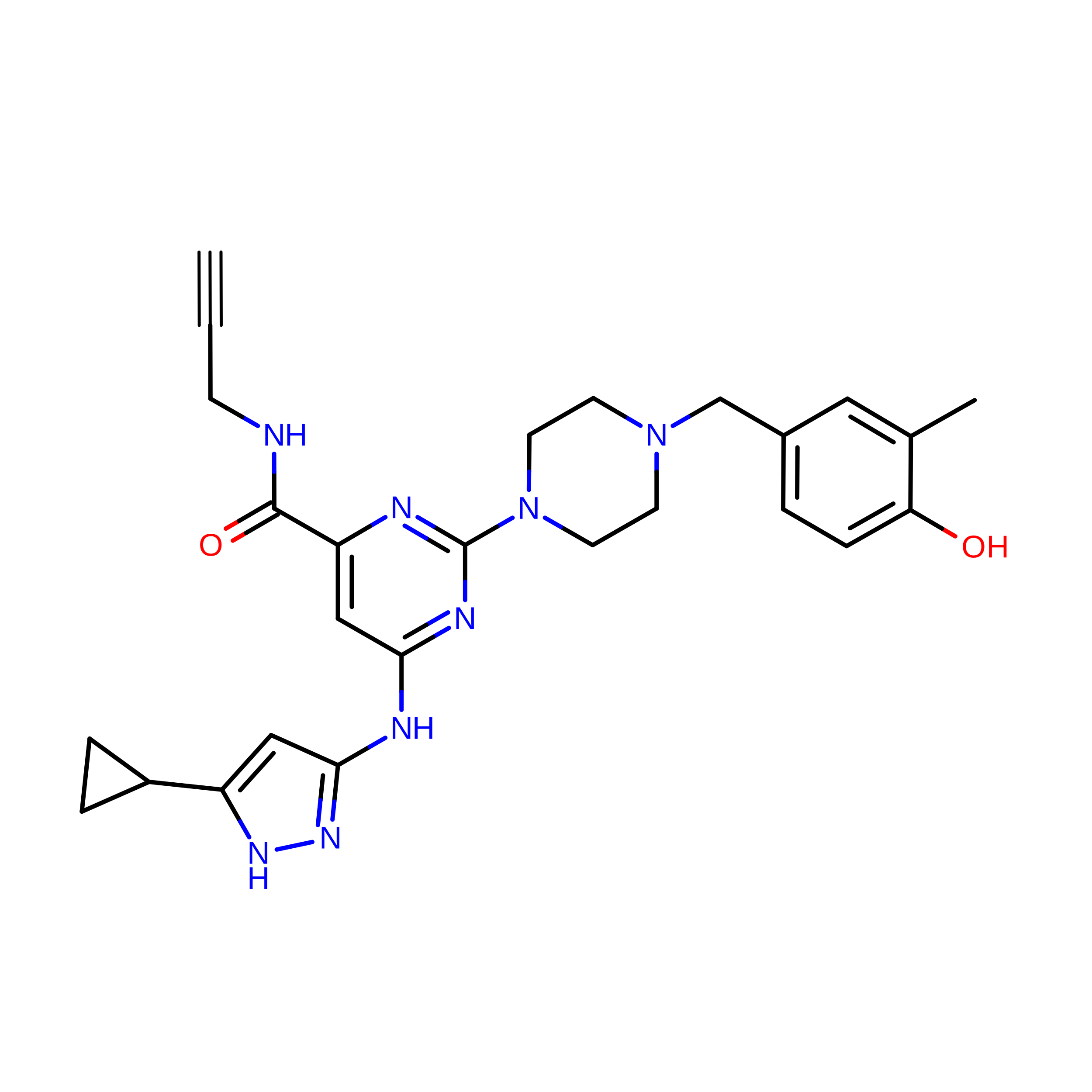
    The expansion of the target landscape of covalent inhibitors requires the engagement of nucleophiles beyond cysteine. Although the conserved catalytic lysine in protein kinases is an attractive candidate for a covalent approach, selectivity remains an obvious challenge. Moreover, few covalent inhibitors have been shown to engage the kinase catalytic lysine in animals. We hypothesized that reversible, lysine-targeted inhibitors could provide sustained kinase engagement in vivo, with selectivity driven in part by differences in residence time. By strategically linking benzaldehydes to a promiscuous kinase binding scaffold, we developed chemoproteomic probes that reversibly and covalently engage >200 protein kinases in cells and mice. Probe-kinase residence time was dramatically enhanced by a hydroxyl group ortho to the aldehyde. Remarkably, only a few kinases, including Aurora A, showed sustained, quasi-irreversible occupancy in vivo, the structural basis for which was revealed by X-ray crystallography. We anticipate broad application of salicylaldehyde-based probes to proteins that lack a druggable cysteine.


  • Organizational Affiliation
    • Department of Cellular and Molecular Pharmacology, University of California, San Francisco, CA, USA.

Macromolecule Content 

  • Total Structure Weight: 31.31 kDa 
  • Atom Count: 2,035 
  • Modeled Residue Count: 254 
  • Deposited Residue Count: 265 
  • Unique protein chains: 1

Macromolecules

Find similar proteins by:|  3D Structure
Entity ID: 1
MoleculeChains  Sequence LengthOrganismDetailsImage
Aurora kinase A265Homo sapiensMutation(s): 1 
Gene Names: AURKAAIKAIRK1ARK1AURAAYK1BTAKIAK1STK15STK6
EC: 2.7.11.1
UniProt & NIH Common Fund Data Resources
Find proteins for O14965 (Homo sapiens)
Explore O14965 
Go to UniProtKB:  O14965
PHAROS:  O14965
GTEx:  ENSG00000087586 
Entity Groups
Sequence Clusters30% Identity50% Identity70% Identity90% Identity95% Identity100% Identity
UniProt GroupO14965
Sequence Annotations
Expand
Reference Sequence

Experimental Data & Validation

Experimental Data

  • Method: X-RAY DIFFRACTION
  • Resolution: 2.32 Å
  • R-Value Free:  0.274 (Depositor), 0.285 (DCC) 
  • R-Value Work:  0.236 (Depositor), 0.256 (DCC) 
  • R-Value Observed: 0.237 (Depositor) 
Space Group: P 32 2 1
Unit Cell:
Length ( Å )Angle ( ˚ )
a = 87.95α = 90
b = 87.95β = 90
c = 76.824γ = 120
Software Package:
Software NamePurpose
REFMACrefinement
PHENIXrefinement
XDSdata reduction
Aimlessdata scaling
PHASERphasing

Structure Validation

View Full Validation Report


Ligand Structure Quality Assessment 


Entry History 

& Funding Information

Deposition Data


Funding OrganizationLocationGrant Number
Other privateUnited StatesPfizer

Revision History  (Full details and data files)

  • Version 1.0: 2022-06-08
    Type: Initial release
  • Version 1.1: 2022-09-07
    Changes: Database references
  • Version 1.2: 2023-11-29
    Changes: Data collection, Refinement description
  • Version 1.3: 2024-10-09
    Changes: Structure summary