Download Mendeley
Identification of a diarylpentanoid-producing polyketide synthase revealing an unusual biosynthetic pathway of 2-(2-phenylethyl)chromones in agarwood.
Wang, X.H., Gao, B.W., Nakashima, Y., Mori, T., Zhang, Z.X., Kodama, T., Lee, Y.E., Zhang, Z.K., Wong, C.P., Liu, Q.Q., Qi, B.W., Wang, J., Li, J., Liu, X., Abe, I., Morita, H., Tu, P.F., Shi, S.P.(2022) Nat Commun 13: 348-348
- PubMed: 35039506 Search on PubMedSearch on PubMed Central
- DOI: https://doi.org/10.1038/s41467-022-27971-z
- Primary Citation Related Structures:
7FFA, 7FFC, 7FFG, 7FFH, 7FFI - PubMed Abstract:
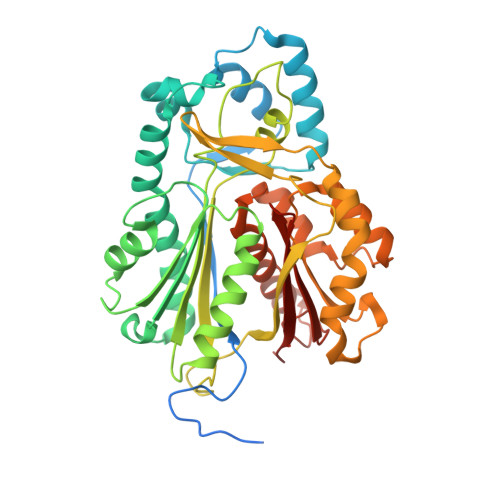
2-(2-Phenylethyl)chromones (PECs) are the principal constituents contributing to the distinctive fragrance of agarwood. How PECs are biosynthesized is currently unknown. In this work, we describe a diarylpentanoid-producing polyketide synthase (PECPS) identified from Aquilaria sinensis. Through biotransformation experiments using fluorine-labeled substrate, transient expression of PECPS in Nicotiana benthamiana, and knockdown of PECPS expression in A. sinensis calli, we demonstrate that the C 6 -C 5 -C 6 scaffold of diarylpentanoid is the common precursor of PECs, and PECPS plays a crucial role in PECs biosynthesis. Crystal structure (1.98 Å) analyses and site-directed mutagenesis reveal that, due to its small active site cavity (247 Å 3 ), PECPS employs a one-pot formation mechanism including a "diketide-CoA intermediate-released" step for the formation of the C 6 -C 5 -C 6 scaffold. The identification of PECPS, the pivotal enzyme of PECs biosynthesis, provides insight into not only the feasibility of overproduction of pharmaceutically important PECs using metabolic engineering approaches, but also further exploration of how agarwood is formed.
- Modern Research Center for Traditional Chinese Medicine, Beijing University of Chinese Medicine, Beijing, 100029, People's Republic of China.
Organizational Affiliation: