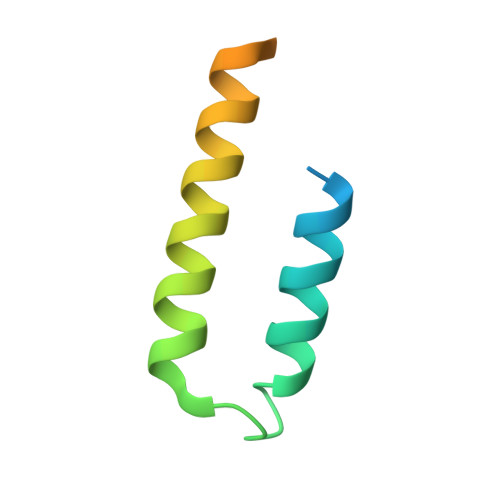
7EVP | pdb_00007evp

Cryo-EM structure of the Gp168-beta-clamp complex


Experimental Data Snapshot

  • Method: ELECTRON MICROSCOPY
  • Resolution: 3.20 Å
  • Aggregation State: PARTICLE 
  • Reconstruction Method: SINGLE PARTICLE 

wwPDB Validation 3D Report Full Report

Validation slider image for 7EVP

This is version 1.2 of the entry. See complete history. 

Literature

Bacteriophage Twort protein Gp168 is a beta-clamp inhibitor by occupying the DNA sliding channel.

Liu, B., Li, S., Liu, Y., Chen, H., Hu, Z., Wang, Z., Zhao, Y., Zhang, L., Ma, B., Wang, H., Matthews, S., Wang, Y., Zhang, K.

(2021) Nucleic Acids Res 49: 11367-11378

  • DOI: https://doi.org/10.1093/nar/gkab875
  • Primary Citation Related Structures: 
    7EVP

  • PubMed Abstract: 

    Bacterial chromosome replication is mainly catalyzed by DNA polymerase III, whose beta subunits enable rapid processive DNA replication. Enabled by the clamp-loading complex, the two beta subunits form a ring-like clamp around DNA and keep the polymerase sliding along. Given the essential role of β-clamp, its inhibitors have been explored for antibacterial purposes. Similarly, β-clamp is an ideal target for bacteriophages to shut off host DNA synthesis during host takeover. The Gp168 protein of phage Twort is such an example, which binds to the β-clamp of Staphylococcus aureus and prevents it from loading onto DNA causing replication arrest. Here, we report a cryo-EM structure of the clamp-Gp168 complex at 3.2-Å resolution. In the structure of the complex, the Gp168 dimer occupies the DNA sliding channel of β-clamp and blocks its loading onto DNA, which represents a new inhibitory mechanism against β-clamp function. Interestingly, the key residues responsible for this interaction on the β-clamp are well conserved among bacteria. We therefore demonstrate that Gp168 is potentially a cross-species β-clamp inhibitor, as it forms complex with the Bacillus subtilis β-clamp. Our findings reveal an alternative mechanism for bacteriophages to inhibit β-clamp and provide a new strategy to combat bacterial drug resistance.


  • Organizational Affiliation: 
    • BioBank, The First Affiliated Hospital of Xi'an Jiaotong University, Shaanxi 710061, China.

Macromolecule Content 

  • Total Structure Weight: 101.91 kDa 
  • Atom Count: 6,616 
  • Modeled Residue Count: 840 
  • Deposited Residue Count: 902 
  • Unique protein chains: 2

Macromolecules

Find similar proteins by:|  3D Structure
Entity ID: 1
MoleculeChains  Sequence LengthOrganismDetailsImage
Beta sliding clampA,
C [auth B]
377Staphylococcus aureusMutation(s): 0 
Gene Names: dnaN
UniProt
Find proteins for P0A024 (Staphylococcus aureus)
Explore P0A024 
Go to UniProtKB:  P0A024
Entity Groups
Sequence Clusters30% Identity50% Identity70% Identity90% Identity95% Identity100% Identity
UniProt GroupP0A024
Sequence Annotations
Expand
Reference Sequence
Find similar proteins by:|  3D Structure
Entity ID: 2
MoleculeChains  Sequence LengthOrganismDetailsImage
Sliding clamp inhibitorB [auth C],
D
74Twortvirus twortMutation(s): 0 
Gene Names: TwortDSMZ_173
UniProt
Find proteins for Q4Z971 (Staphylococcus phage Twort (strain DSM 17442 / HER 48))
Explore Q4Z971 
Go to UniProtKB:  Q4Z971
Entity Groups
Sequence Clusters30% Identity50% Identity70% Identity90% Identity95% Identity100% Identity
UniProt GroupQ4Z971
Sequence Annotations
Expand
Reference Sequence

Experimental Data & Validation

Experimental Data

  • Method: ELECTRON MICROSCOPY
  • Resolution: 3.20 Å
  • Aggregation State: PARTICLE 
  • Reconstruction Method: SINGLE PARTICLE 
EM Software:
TaskSoftware PackageVersion
MODEL REFINEMENTPHENIX
RECONSTRUCTIONcryoSPARC3.0

Structure Validation

View Full Validation Report


Entry History 

& Funding Information

Deposition Data


Funding OrganizationLocationGrant Number
National Natural Science Foundation of China (NSFC)China81871662

Revision History  (Full details and data files)

  • Version 1.0: 2022-02-16
    Type: Initial release
  • Version 1.1: 2024-06-05
    Changes: Data collection
  • Version 1.2: 2025-07-02
    Changes: Data collection, Structure summary