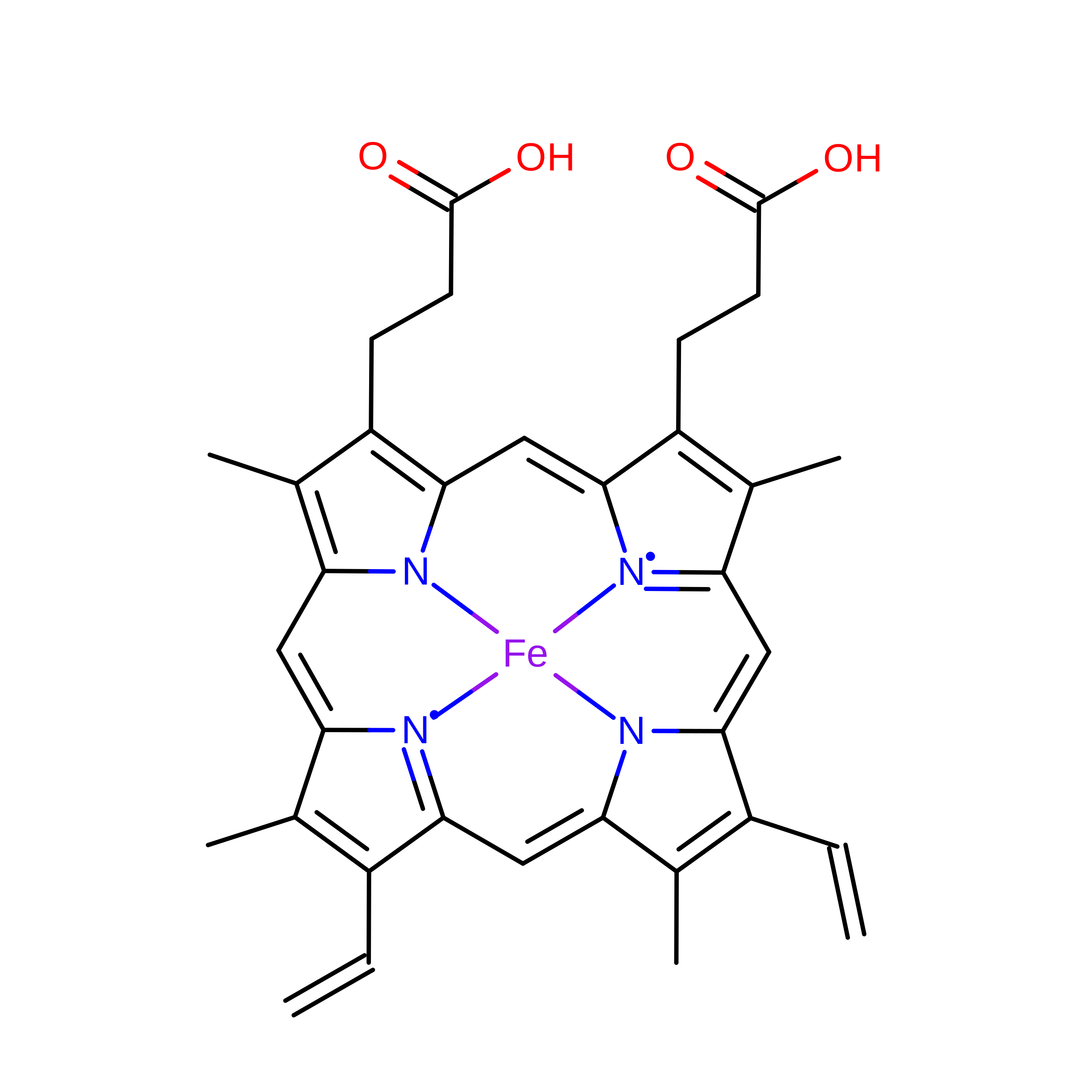
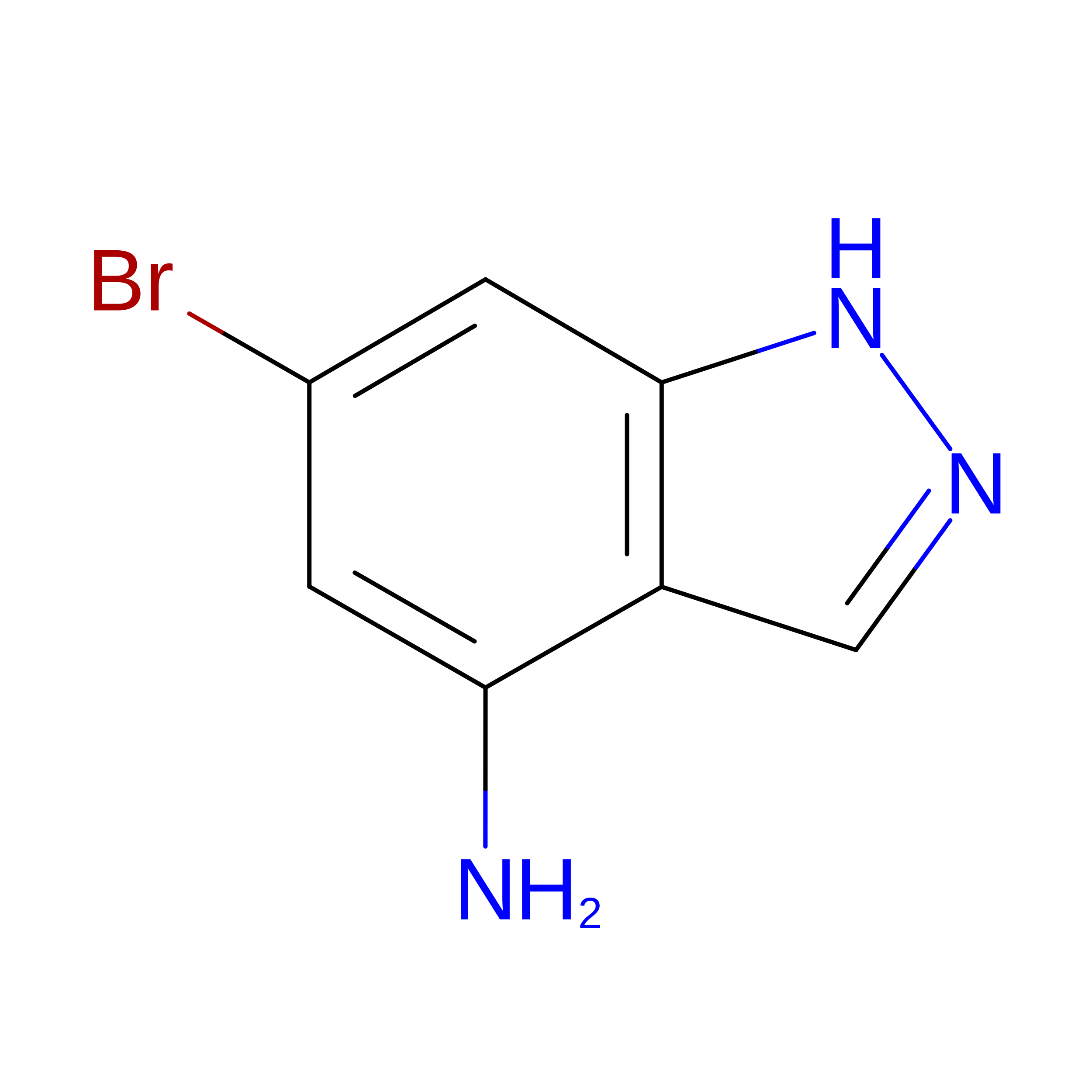
7E0O | pdb_00007e0o

Crystal Structure of Human Indoleamine 2,3-dioxygenagse 1 (hIDO1) Complexed with 6-Bromo-1H-indazol-4-amine (1)


Experimental Data Snapshot

  • Method: X-RAY DIFFRACTION
  • Resolution: 3.34 Å
  • R-Value Free: 
    0.302 (Depositor), 0.289 (DCC) 
  • R-Value Work: 
    0.211 (Depositor) 
  • R-Value Observed: 
    0.221 (Depositor) 

Starting Model: experimental
View more details

wwPDB Validation 3D Report Full Report

Validation slider image for 7E0O

Ligand Structure Quality Assessment 


This is version 1.2 of the entry. See complete history

Literature

X-ray Structure-Guided Discovery of a Potent, Orally Bioavailable, Dual Human Indoleamine/Tryptophan 2,3-Dioxygenase (hIDO/hTDO) Inhibitor That Shows Activity in a Mouse Model of Parkinson's Disease.

Ning, X.L.Li, Y.Z.Huo, C.Deng, J.Gao, C.Zhu, K.R.Wang, M.Wu, Y.X.Yu, J.L.Ren, Y.L.Luo, Z.Y.Li, G.Chen, Y.Wang, S.Y.Peng, C.Yang, L.L.Wang, Z.Y.Wu, Y.Qian, S.Li, G.B.

(2021) J Med Chem 64: 8303-8332

  • DOI: https://doi.org/10.1021/acs.jmedchem.1c00303
  • Primary Citation Related Structures: 
    7E0O, 7E0P, 7E0Q, 7E0S, 7E0T, 7E0U

  • PubMed Abstract: 

    Human indoleamine 2,3-dioxygenase 1 (hIDO1) and tryptophan 2,3-dioxygenase (hTDO) have been closely linked to the pathogenesis of Parkinson's disease (PD); nevertheless, development of dual hIDO1 and hTDO inhibitors to evaluate their potential efficacy against PD is still lacking. Here, we report biochemical, biophysical, and computational analyses revealing that 1 H -indazole-4-amines inhibit both hIDO1 and hTDO by a mechanism involving direct coordination with the heme ferrous and ferric states. Crystal structure-guided optimization led to 23 , which manifested IC 50 values of 0.64 and 0.04 μM to hIDO1 and hTDO, respectively, and had good pharmacokinetic properties and brain penetration in mice. 23 showed efficacy against the 1-methyl-4-phenyl-1,2,3,6-tetrahydropyridine-induced mouse motor coordination deficits, comparable to Madopar, an anti-PD medicine. Further studies revealed that different from Madopar, 23 likely has specific anti-PD mechanisms involving lowering IDO1 expression, alleviating dopaminergic neurodegeneration, reducing inflammatory cytokines and quinolinic acid in mouse brain, and increasing kynurenic acid in mouse blood.


  • Organizational Affiliation
    • Key Laboratory of Drug-Targeting and Drug Delivery System of the Education Ministry and Sichuan Province, Department of Medicinal Chemistry, West China School of Pharmacy, Sichuan University, Chengdu 610041, China.

Macromolecule Content 

  • Total Structure Weight: 89.88 kDa 
  • Atom Count: 5,966 
  • Modeled Residue Count: 740 
  • Deposited Residue Count: 784 
  • Unique protein chains: 1

Macromolecules

Find similar proteins by:|  3D Structure
Entity ID: 1
MoleculeChains  Sequence LengthOrganismDetailsImage
Indoleamine 2,3-dioxygenase 1
A, B
392Homo sapiensMutation(s): 0 
Gene Names: IDO1IDOINDO
EC: 1.13.11.52
UniProt & NIH Common Fund Data Resources
Find proteins for P14902 (Homo sapiens)
Explore P14902 
Go to UniProtKB:  P14902
PHAROS:  P14902
GTEx:  ENSG00000131203 
Entity Groups
Sequence Clusters30% Identity50% Identity70% Identity90% Identity95% Identity100% Identity
UniProt GroupP14902
Sequence Annotations
Expand
Reference Sequence

Experimental Data & Validation

Experimental Data

  • Method: X-RAY DIFFRACTION
  • Resolution: 3.34 Å
  • R-Value Free:  0.302 (Depositor), 0.289 (DCC) 
  • R-Value Work:  0.211 (Depositor) 
  • R-Value Observed: 0.221 (Depositor) 
Space Group: P 21 21 21
Unit Cell:
Length ( Å )Angle ( ˚ )
a = 85.594α = 90
b = 96.793β = 90
c = 130.983γ = 90
Software Package:
Software NamePurpose
PHENIXrefinement
PDB_EXTRACTdata extraction
AutoProcessdata reduction
Web-Icedata scaling
PHASERphasing

Structure Validation

View Full Validation Report


Ligand Structure Quality Assessment 


Entry History 

& Funding Information

Deposition Data


Funding OrganizationLocationGrant Number
National Natural Science Foundation of China (NSFC)China81874291; 81502989; 82073698

Revision History  (Full details and data files)

  • Version 1.0: 2021-07-21
    Type: Initial release
  • Version 1.1: 2023-11-29
    Changes: Data collection, Database references, Refinement description
  • Version 1.2: 2024-10-23
    Changes: Structure summary