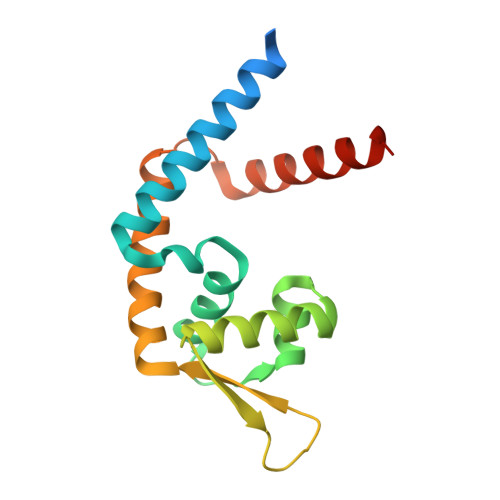
7DVS | pdb_00007dvs

Crystal structure of Apo (heme-free) PefR


Experimental Data Snapshot

  • Method: X-RAY DIFFRACTION
  • Resolution: 2.60 Å
  • R-Value Free: 
    0.288 (Depositor), 0.287 (DCC) 
  • R-Value Work: 
    0.236 (Depositor), 0.240 (DCC) 
  • R-Value Observed: 
    0.239 (Depositor) 

Starting Model: experimental
View more details

wwPDB Validation 3D Report Full Report

Validation slider image for 7DVS

This is version 1.1 of the entry. See complete history

Literature

Heme controls the structural rearrangement of its sensor protein mediating the hemolytic bacterial survival.

Nishinaga, M.Sugimoto, H.Nishitani, Y.Nagai, S.Nagatoishi, S.Muraki, N.Tosha, T.Tsumoto, K.Aono, S.Shiro, Y.Sawai, H.

(2021) Commun Biol 4: 467-467

  • DOI: https://doi.org/10.1038/s42003-021-01987-5
  • Primary Citation Related Structures: 
    7DVR, 7DVS, 7DVT, 7DVU, 7DVV

  • PubMed Abstract: 

    Hemes (iron-porphyrins) are critical for biological processes in all organisms. Hemolytic bacteria survive by acquiring b-type heme from hemoglobin in red blood cells from their animal hosts. These bacteria avoid the cytotoxicity of excess heme during hemolysis by expressing heme-responsive sensor proteins that act as transcriptional factors to regulate the heme efflux system in response to the cellular heme concentration. Here, the underlying regulatory mechanisms were investigated using crystallographic, spectroscopic, and biochemical studies to understand the structural basis of the heme-responsive sensor protein PefR from Streptococcus agalactiae, a causative agent of neonatal life-threatening infections. Structural comparison of heme-free PefR, its complex with a target DNA, and heme-bound PefR revealed that unique heme coordination controls a >20 Å structural rearrangement of the DNA binding domains to dissociate PefR from the target DNA. We also found heme-bound PefR stably binds exogenous ligands, including carbon monoxide, a by-product of the heme degradation reaction.


  • Organizational Affiliation
    • Graduate School of Life Science, University of Hyogo, Ako, Hyogo, Japan.

Macromolecule Content 

  • Total Structure Weight: 75.24 kDa 
  • Atom Count: 3,704 
  • Modeled Residue Count: 502 
  • Deposited Residue Count: 648 
  • Unique protein chains: 1

Macromolecules

Find similar proteins by:|  3D Structure
Entity ID: 1
MoleculeChains  Sequence LengthOrganismDetailsImage
MarR family transcriptional regulator
A, B, C, D
162Streptococcus agalactiaeMutation(s): 0 
Gene Names: AX245_08385C6N10_09725DX05_07110E8E04_04745F5043_04730GD434_04460NCTC6175_00806RDF_1281
UniProt
Find proteins for R4Z9I5 (Streptococcus agalactiae)
Explore R4Z9I5 
Go to UniProtKB:  R4Z9I5
Entity Groups
Sequence Clusters30% Identity50% Identity70% Identity90% Identity95% Identity100% Identity
UniProt GroupR4Z9I5
Sequence Annotations
Expand
Reference Sequence

Experimental Data & Validation

Experimental Data

  • Method: X-RAY DIFFRACTION
  • Resolution: 2.60 Å
  • R-Value Free:  0.288 (Depositor), 0.287 (DCC) 
  • R-Value Work:  0.236 (Depositor), 0.240 (DCC) 
  • R-Value Observed: 0.239 (Depositor) 
Space Group: C 1 2 1
Unit Cell:
Length ( Å )Angle ( ˚ )
a = 122.98α = 90
b = 46.02β = 92.81
c = 135.22γ = 90
Software Package:
Software NamePurpose
PHENIXrefinement
XDSdata reduction
XSCALEdata scaling
PHASERphasing

Structure Validation

View Full Validation Report


Entry History 

Deposition Data

Revision History  (Full details and data files)

  • Version 1.0: 2021-09-29
    Type: Initial release
  • Version 1.1: 2023-11-29
    Changes: Data collection, Refinement description