7D9Z | pdb_00007d9z

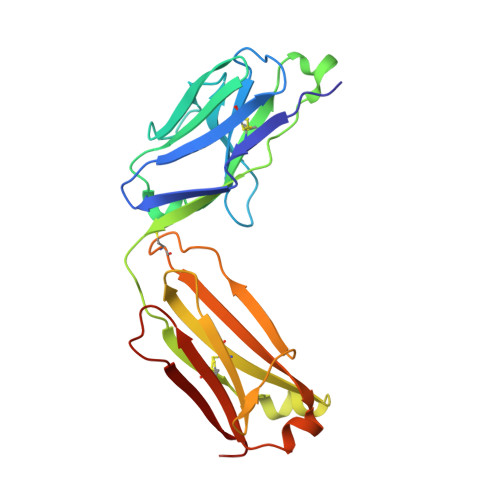
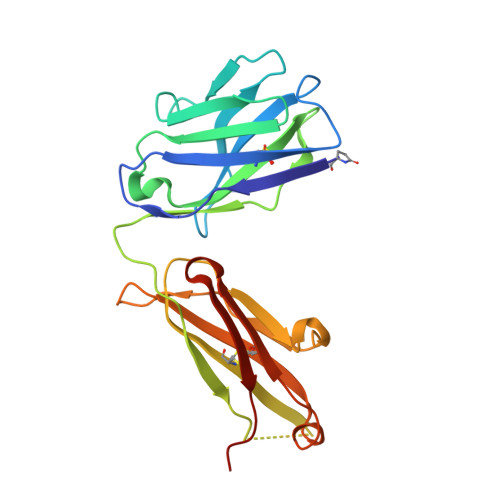
Crystal structure of anti-basigin Fab fragment


Experimental Data Snapshot

  • Method: X-RAY DIFFRACTION
  • Resolution: 1.12 Å
  • R-Value Free: 
    0.150 (Depositor), 0.151 (DCC) 
  • R-Value Work: 
    0.121 (Depositor), 0.122 (DCC) 
  • R-Value Observed: 
    0.122 (Depositor) 

Starting Model: experimental
View more details

wwPDB Validation 3D Report Full Report

Validation slider image for 7D9Z

This is version 1.2 of the entry. See complete history

Literature

The tertiary structure of the human Xkr8-Basigin complex that scrambles phospholipids at plasma membranes.

Sakuragi, T.Kanai, R.Tsutsumi, A.Narita, H.Onishi, E.Nishino, K.Miyazaki, T.Baba, T.Kosako, H.Nakagawa, A.Kikkawa, M.Toyoshima, C.Nagata, S.

(2021) Nat Struct Mol Biol 28: 825-834

  • DOI: https://doi.org/10.1038/s41594-021-00665-8
  • Primary Citation Related Structures: 
    7D9Z, 7DAA, 7DCE

  • PubMed Abstract: 

    Xkr8-Basigin is a plasma membrane phospholipid scramblase activated by kinases or caspases. We combined cryo-EM and X-ray crystallography to investigate its structure at an overall resolution of 3.8 Å. Its membrane-spanning region carrying 22 charged amino acids adopts a cuboid-like structure stabilized by salt bridges between hydrophilic residues in transmembrane helices. Phosphatidylcholine binding was observed in a hydrophobic cleft on the surface exposed to the outer leaflet of the plasma membrane. Six charged residues placed from top to bottom inside the molecule were essential for scrambling phospholipids in inward and outward directions, apparently providing a pathway for their translocation. A tryptophan residue was present between the head group of phosphatidylcholine and the extracellular end of the path. Its mutation to alanine made the Xkr8-Basigin complex constitutively active, indicating that it plays a vital role in regulating its scramblase activity. The structure of Xkr8-Basigin provides insights into the molecular mechanisms underlying phospholipid scrambling.


  • Organizational Affiliation
    • Laboratory of Biochemistry and Immunology, World Premier International Immunology Frontier Research Center, Osaka University, Suita, Japan.

Macromolecule Content 

  • Total Structure Weight: 46.67 kDa 
  • Atom Count: 4,153 
  • Modeled Residue Count: 425 
  • Deposited Residue Count: 435 
  • Unique protein chains: 2

Macromolecules

Find similar proteins by:|  3D Structure
Entity ID: 1
MoleculeChains  Sequence LengthOrganismDetailsImage
Light chain of antibody Fab fragmentA [auth L]218Oryctolagus cuniculusMutation(s): 0 
Find similar proteins by:|  3D Structure
Entity ID: 2
MoleculeChains  Sequence LengthOrganismDetailsImage
Heavy chain of antibody Fab fragmentB [auth H]217Oryctolagus cuniculusMutation(s): 0 

Small Molecules

Modified Residues  1 Unique
IDChains TypeFormula2D DiagramParent
PCA
Query on PCA
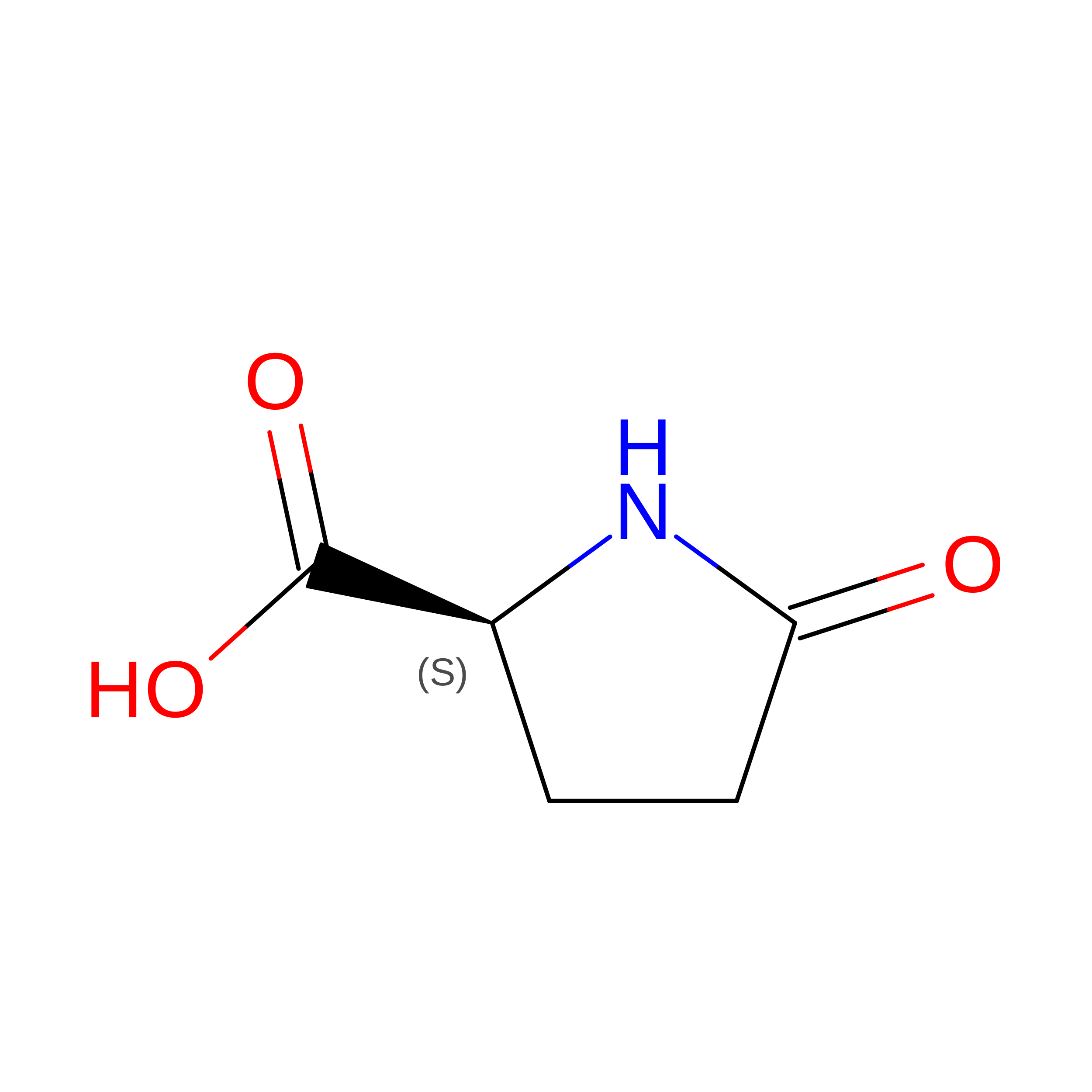
B [auth H]L-PEPTIDE LINKINGC5 H7 N O3GLN

Experimental Data & Validation

Experimental Data

  • Method: X-RAY DIFFRACTION
  • Resolution: 1.12 Å
  • R-Value Free:  0.150 (Depositor), 0.151 (DCC) 
  • R-Value Work:  0.121 (Depositor), 0.122 (DCC) 
  • R-Value Observed: 0.122 (Depositor) 
Space Group: C 1 2 1
Unit Cell:
Length ( Å )Angle ( ˚ )
a = 163.452α = 90
b = 53.048β = 105.047
c = 54.313γ = 90
Software Package:
Software NamePurpose
PHENIXrefinement
autoPROCdata processing
STARANISOdata processing
MOLREPphasing
Cootmodel building
XDSdata processing
pointlessdata reduction
Aimlessdata reduction

Structure Validation

View Full Validation Report


Entry History 

& Funding Information

Deposition Data


Funding OrganizationLocationGrant Number
Japan Society for the Promotion of Science (JSPS)Japan15H05785
Japan Society for the Promotion of Science (JSPS)Japan20K15731
Japan Science and TechnologyJapanJPMJCR14M4
Japan Agency for Medical Research and Development (AMED)JapanJP17am010172
Japan Agency for Medical Research and Development (AMED)JapanJP18am0101072
Japan Agency for Medical Research and Development (AMED)JapanJP19am0101072

Revision History  (Full details and data files)

  • Version 1.0: 2021-10-20
    Type: Initial release
  • Version 1.1: 2023-11-29
    Changes: Data collection, Refinement description
  • Version 1.2: 2024-11-13
    Changes: Structure summary