7CNS | pdb_00007cns

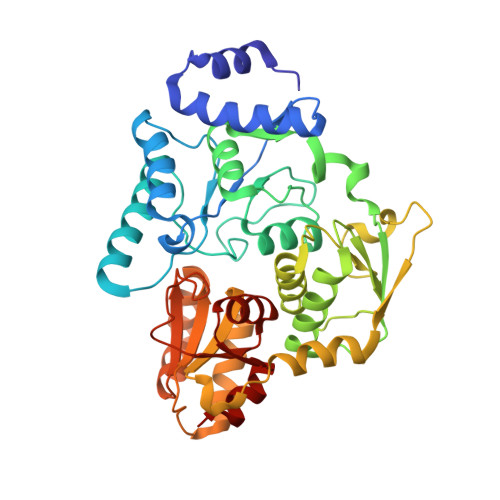
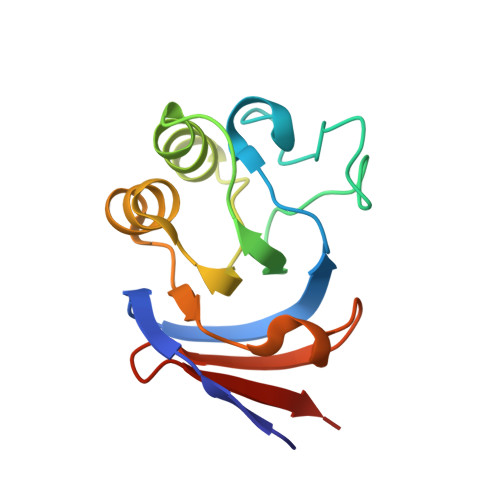
Crystal structure of Thermococcus kodakaraensis aconitase X (holo-form)


Experimental Data Snapshot

  • Method: X-RAY DIFFRACTION
  • Resolution: 1.90 Å
  • R-Value Free: 
    0.201 (Depositor), 0.203 (DCC) 
  • R-Value Work: 
    0.169 (Depositor), 0.170 (DCC) 
  • R-Value Observed: 
    0.171 (Depositor) 

wwPDB Validation 3D Report Full Report

Validation slider image for 7CNS

Ligand Structure Quality Assessment 


This is version 1.2 of the entry. See complete history

Literature

Crystal structures of aconitase X enzymes from bacteria and archaea provide insights into the molecular evolution of the aconitase superfamily.

Watanabe, S.Murase, Y.Watanabe, Y.Sakurai, Y.Tajima, K.

(2021) Commun Biol 4: 687-687

  • DOI: https://doi.org/10.1038/s42003-021-02147-5
  • Primary Citation Related Structures: 
    7CNP, 7CNQ, 7CNR, 7CNS, 7D2R

  • PubMed Abstract: 

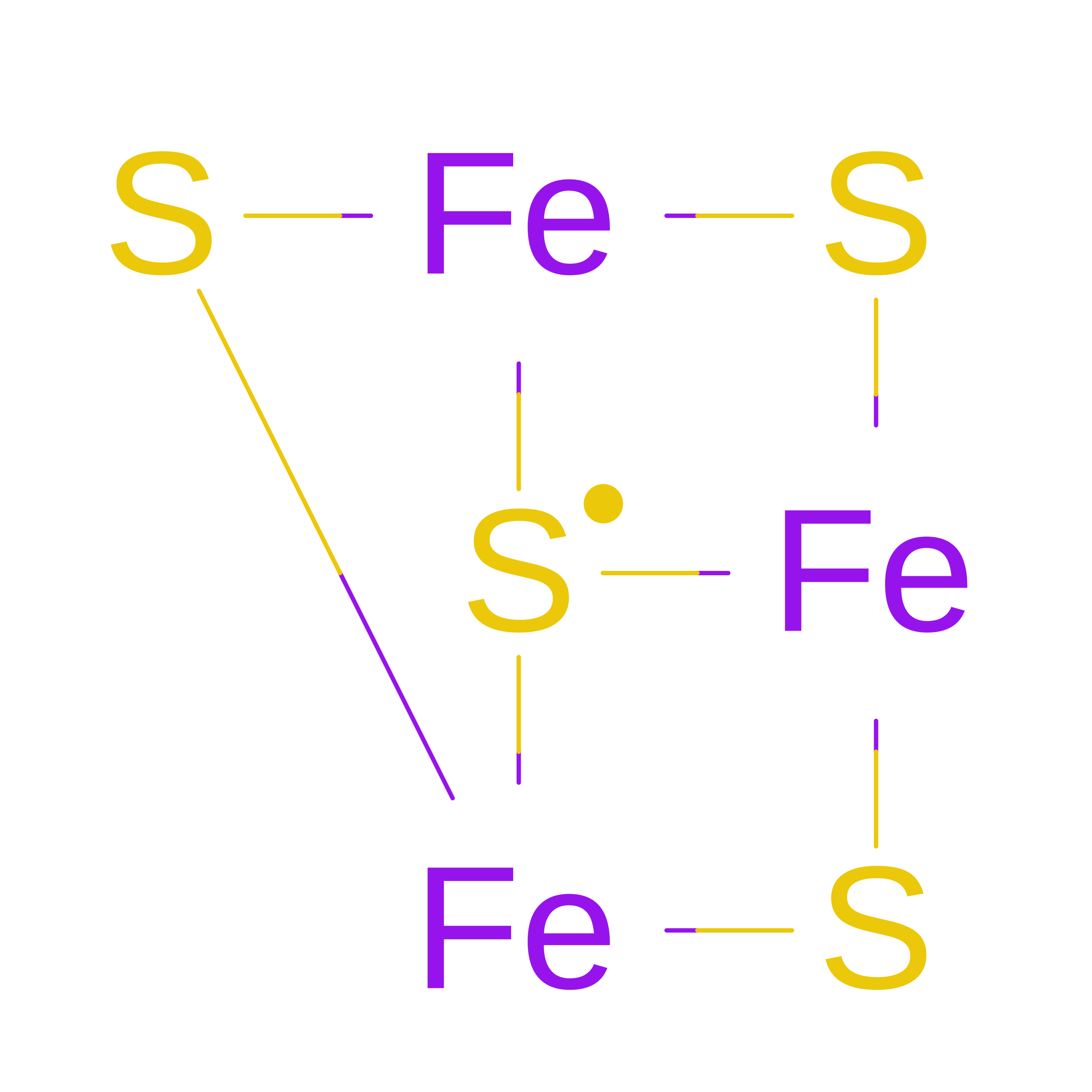
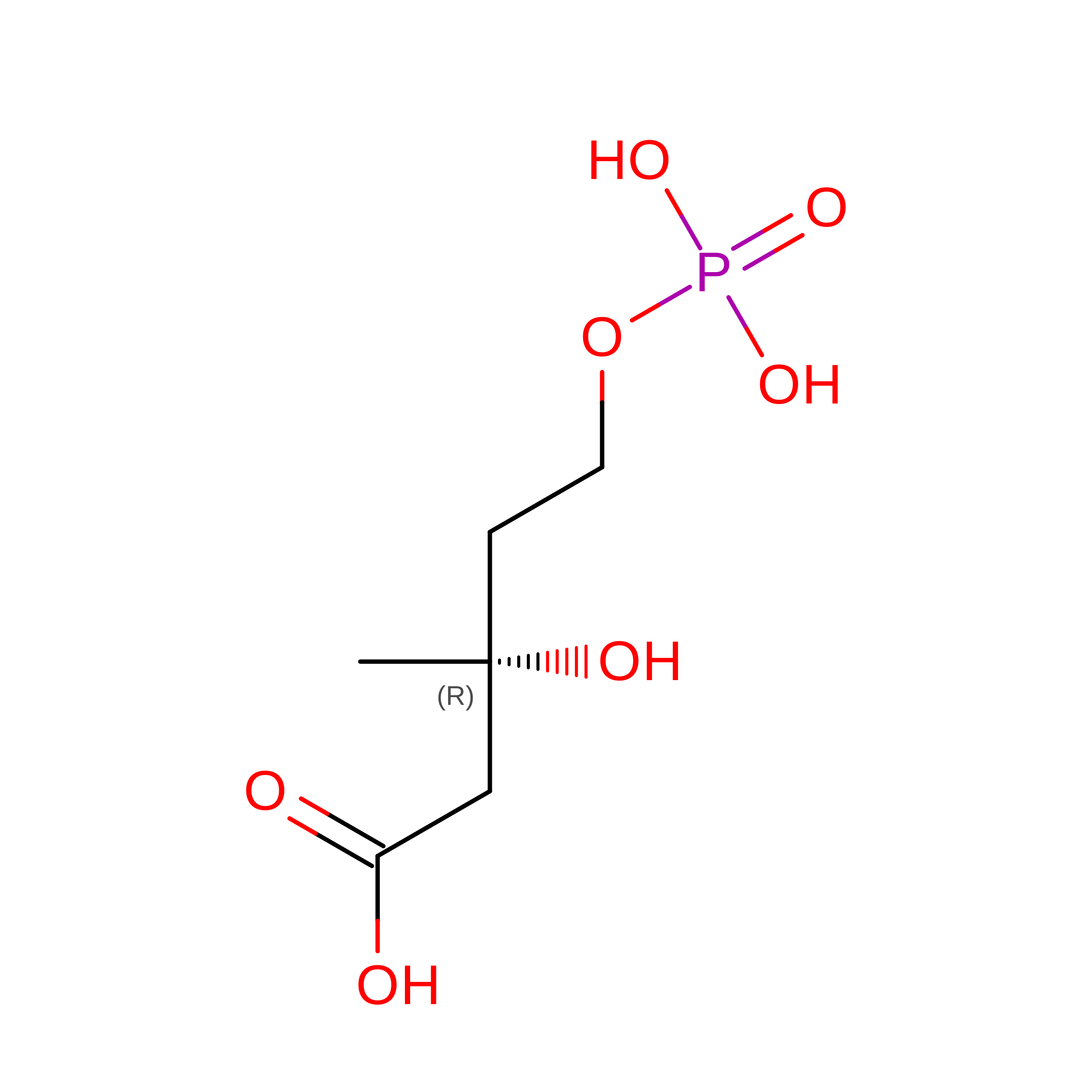
    Aconitase superfamily members catalyze the homologous isomerization of specific substrates by sequential dehydration and hydration and contain a [4Fe-4S] cluster. However, monomeric and heterodimeric types of function unknown aconitase X (AcnX) have recently been characterized as a cis-3-hydroxy-L-proline dehydratase (AcnX Type-I ) and mevalonate 5-phosphate dehydratase (AcnX Type-II ), respectively. We herein elucidated the crystal structures of AcnX Type-I from Agrobacterium tumefaciens (AtAcnX) and AcnX Type-II from Thermococcus kodakarensis (TkAcnX) without a ligand and in complex with substrates. AtAcnX and TkAcnX contained the [2Fe-2S] and [3Fe-4S] clusters, respectively, conforming to UV and EPR spectroscopy analyses. The binding sites of the [Fe-S] cluster and substrate were clearlydifferent from those that were completely conserved in other aconitase enzymes; however, theoverall structural frameworks and locations of active sites were partially similar to each other.These results provide novel insights into the evolutionary scenario of the aconitase superfamilybased on the recruitment hypothesis.


  • Organizational Affiliation
    • Department of Bioscience, Graduate School of Agriculture, Ehime University, Matsuyama, Ehime, Japan. irab@agr.ehime-u.ac.jp.

Macromolecule Content 

  • Total Structure Weight: 56.84 kDa 
  • Atom Count: 4,219 
  • Modeled Residue Count: 517 
  • Deposited Residue Count: 520 
  • Unique protein chains: 2

Macromolecules

Find similar proteins by:|  3D Structure
Entity ID: 1
MoleculeChains  Sequence LengthOrganismDetailsImage
DUF521 domain-containing protein386Thermococcus kodakarensis KOD1Mutation(s): 0 
Gene Names: TK1249
EC: 4.2.1.182
UniProt
Find proteins for Q5JGJ6 (Thermococcus kodakarensis (strain ATCC BAA-918 / JCM 12380 / KOD1))
Explore Q5JGJ6 
Go to UniProtKB:  Q5JGJ6
Entity Groups
Sequence Clusters30% Identity50% Identity70% Identity90% Identity95% Identity100% Identity
UniProt GroupQ5JGJ6
Sequence Annotations
Expand
Reference Sequence
Find similar proteins by:|  3D Structure
Entity ID: 2
MoleculeChains  Sequence LengthOrganismDetailsImage
UPF0107 protein TK1248134Thermococcus kodakarensis KOD1Mutation(s): 0 
Gene Names: TK1248
EC: 4.2.1.182
UniProt
Find proteins for Q5JGJ7 (Thermococcus kodakarensis (strain ATCC BAA-918 / JCM 12380 / KOD1))
Explore Q5JGJ7 
Go to UniProtKB:  Q5JGJ7
Entity Groups
Sequence Clusters30% Identity50% Identity70% Identity90% Identity95% Identity100% Identity
UniProt GroupQ5JGJ7
Sequence Annotations
Expand
Reference Sequence

Experimental Data & Validation

Experimental Data

  • Method: X-RAY DIFFRACTION
  • Resolution: 1.90 Å
  • R-Value Free:  0.201 (Depositor), 0.203 (DCC) 
  • R-Value Work:  0.169 (Depositor), 0.170 (DCC) 
  • R-Value Observed: 0.171 (Depositor) 
Space Group: P 42 21 2
Unit Cell:
Length ( Å )Angle ( ˚ )
a = 102.444α = 90
b = 102.444β = 90
c = 115.849γ = 90
Software Package:
Software NamePurpose
XDSdata scaling
PHENIXrefinement
PDB_EXTRACTdata extraction
PHASERphasing

Structure Validation

View Full Validation Report


Ligand Structure Quality Assessment 


Entry History 

Deposition Data

Revision History  (Full details and data files)

  • Version 1.0: 2021-06-16
    Type: Initial release
  • Version 1.1: 2022-12-28
    Changes: Database references
  • Version 1.2: 2024-05-29
    Changes: Data collection